


1. Which of the following statements is/are correct regarding the Budget Session of Parliament?
1. As per the constitution of India, the Union Finance minister causes to be laid before Parliament an annual statement of estimated receipts and expenditure of the government
2. The President’s recommendation is required before a money bill is introduced in Parliament.
3. Rajya Sabha can discuss and vote on the Demands for Grants
4. Rajya Sabha can suggest amendments to money bills within 14 days of receipt.
Select the correct answer using the code given below:
(a) 1, 2 and 3 only
(b) 1, 3 and 4 only
(c) 2 and 4 only
(d) 1, 2, 3 and 4
Answer: (c) 2 and 4 only
Explanation:
In NEWS: Budget Session of Parliament to begin today
Article 112 – Annual Financial Statement (Union Budget)
- The President causes to be laid before Parliament an annual statement of estimated receipts and expenditure of the government (Union Budget). Hence statement 1 is incorrect.
Article 113 – Supplementary, Additional and Excess Grants
- Empowers Parliament to authorize supplementary expenditure over the original Budget.
Article 114 – Appropriation from Consolidated Fund of India
- No money can be withdrawn from the Consolidated Fund of India without Parliament’s approval through the Appropriation Bill.
Budget Session of Parliament:
- The Budget Session is one of the three annual sessions of the Indian Parliament, along with the Monsoon and Winter sessions.
- Its primary purpose is the presentation, discussion, and approval of the Union Budget.
- The Budget Session usually occurs between February and May.
- The session typically lasts for about three months.
Key Components
- The Union Budget is presented by the Finance Minister in the Lok Sabha.
- The Finance Bill gives effect to the government’s financial proposals, including taxation and revenue measures.
- The Appropriation Bill authorizes withdrawal of funds from the Consolidated Fund of India.
- Demands for Grants are presented by individual ministries and voted upon in the Lok Sabha.
Procedure
- The Budget is first presented in the Lok Sabha, usually on the last day of February.
- General discussion on the Budget is held in both Houses of Parliament.
- Demands for Grants are debated and voted only in Lok Sabha, not in Rajya Sabha. Hence statement 3 is incorrect.
- The Finance Bill and Appropriation Bill are introduced after the presentation of the Budget.
- The President’s recommendation is required before a money bill can be introduced in Parliament. Hence statement 2 is correct.
- Rajya Sabha can suggest amendments to money bills within 14 days, but Lok Sabha is not bound to accept them. Hence statement 4 is correct.
Significance
- The Budget Session ensures Parliamentary control over government finances.
- It provides a platform for allocation of resources for government schemes and development projects.
- It promotes transparency, accountability, and debate on fiscal priorities.
- Failure to pass the Appropriation Bill can halt government expenditure.
| PYQ REFERENCE: (2024) Q. With reference to Union Budget, consider the following statements: 1. The Union Finance Minister on behalf of the Prime Minister lays the Annual Financial Statement before both the Houses of Parliament 2. At the Union level, no demand for a grant can be on the recommendation of the President of India. Which of the statements given above is/are correct? (a) 1 only (b) 2 only (c) Both 1 and 2 (d) Neither 1 nor 2 |
Source: https://www.newsonair.gov.in/budget-session-of-parliament-to-begin-today-2/
2. With reference to India–Canada energy cooperation, consider the following statements:
I. India and Canada launched the renewed Ministerial Energy Dialogue during India Energy Week 2026 in Goa.
II. India is the world’s third-largest consumer of both oil and LPG
III. India is an active participant, while Canada is an observer in the Global Biofuels Alliance (GBA).
Which of the statements given above are correct?
(a) I and II only
(b) II and III only
(c) I and III only
(d) I, II and III
Answer: (d) I, II and III
Explanation:
In NEWS: India Energy Week 2026
India–Canada Energy Cooperation & Global Biofuels Alliance (GBA)
- India and Canada launched the renewed India–Canada Ministerial Energy Dialogue during India Energy Week 2026 in Goa. Hence statement I is correct.
- This was the first high-level participation of a Canadian Cabinet Minister at India Energy Week.
- The dialogue follows directions given by India and Canada Prime Ministers at G7 2025 in Kananaskis, Canada.
- Canada is aiming to become an energy superpower in clean and conventional energy, with export diversification as a priority.
- India is the world’s
- third-largest oil consumer,
- fourth-largest LNG importer,
- third-largest LPG consumer, and
- fourth-largest refining capacity globally. Hence statement II is correct.
- India is projected to account for over one-third of global energy demand growth over the next two decades.
- Both countries agreed to deepen bilateral energy trade, including:
- Canadian LNG, LPG, and crude oil to India
- Refined petroleum products from India to Canada
Climate, Clean Energy & Technologies
- Both nations committed to reducing emissions in conventional energy value chains via carbon capture, utilization, and storage (CCUS).
- Cooperation will include renewable energy, hydrogen, biofuels, and sustainable aviation fuel.
- Other focus areas: battery storage, critical minerals, electricity systems, clean technologies, AI in energy sector, and energy supply chain resilience.
Global Biofuels Alliance (GBA)
- India and Canada collaborate on the Global Biofuels Alliance (GBA) to advance biofuels globally.
- Canada is currently an observer in the GBA, while India is actively involved. Hence statement III is correct.
- GBA aims to promote the global development and deployment of biofuels, supporting climate objectives.
Strategic Significance
- The partnership enhances energy security and diversification of supply chains.
- India acts as a major consumer and growth driver, while Canada is a secure and reliable supplier.
- Bilateral cooperation also supports climate objectives and sustainable energy transition globally.
| PYQ REFERENCE: (2017) Q. With reference to ‘Global Climate Change Alliance’, which of the following statements is/are correct? 1. It is an initiative of the European Union. 2. It provides technical and financial support to targeted developing countries to integrate climate change into their development policies and budgets. 3. It is coordinated by World Resources Institute (WRI) and World Business Council for Sustainable Development (WBCSD). Select the correct answer using the code given below: (a) 1 and 2 only (b) 3 only (c) 2 and 3 only (d) 1, 2 and |
Source: https://www.pib.gov.in/PressReleasePage.aspx?PRID=2219328®=3&lang=1
3. Consider the following statements regarding currency devaluation:
1. Devaluation is more effective when domestic inflation is significantly lower than global inflation.
2. Real Effective Exchange Rate (REER) adjusts nominal exchange rates for inflation differentials.
3. High import content of exports can dilute the benefits of currency depreciation.
Which of the statements given above are correct?
(a) 1 and 2 only
(b) 2 and 3 only
(c) 1 and 3 only
(d) 1, 2 and 3
Answer: (b) 2 and 3 only
Explanation:
In NEWS: The solution to the falling rupee lies in diplomacy
Currency Devaluation:
- Currency devaluation refers to a deliberate reduction in the value of a country’s currency relative to other currencies.
- Devaluation is typically used to boost exports by making them cheaper in foreign markets.
- Devaluation is more effective when domestic inflation is higher than foreign inflation, creating a real price advantage. Hence statement 1 is incorrect.
- If domestic inflation is low or comparable to global inflation, devaluation may not improve competitiveness.
Real Effective Exchange Rate (REER)
- REER is the nominal exchange rate adjusted for relative inflation between a country and its major trading partners. Hence statement 2 is correct.
- REER reflects competitiveness of goods and services internationally.
- A rise in REER implies loss of competitiveness, while a fall implies gains.
Limitations & Trade-offs
- Devaluation can raise the cost of imports, leading to imported inflation.
- If exports have high import content, devaluation benefits are diluted as input costs rise. Hence statement 3 is correct.
- Devaluation may be counterproductive if capital outflows or speculative pressures dominate currency movements.
- Overuse of devaluation can erode investor confidence and affect financial stability.
| PYQ REFERENCE: (2021) Q. Consider the following statements: The effect of devaluation of a currency is that it necessarily 1. Improves the competitiveness of the domestic exports in the foreign markets 2. Increases the foreign value of domestic currency 3. Improves the trade balance Which of the above statements is/are correct? (a) 1 only (b) 1 and 2 only (c) 3 only (d) 2 and 3 only |
4. With reference to the India–EU Free Trade Agreement (FTA), consider the following statements:
1. The EU will eliminate tariffs on more than 99% of Indian exports by trade value.
2. India has provided full market access to its dairy and sensitive agricultural sectors under the agreement.
3. Under the EU’s Carbon Border Adjustment Mechanism (CBAM), India has secured Most-Favoured Nation (MFN)-based flexibilities.
Which of the statements given above are correct?
(a) 1 and 3 only
(b) 1 and 2 only
(c) 2 and 3 only
(d) 1, 2 and 3
Answer: (a) 1 and 3 only
Explanation:
In NEWS: ‘India–EU Free Trade Agreement Concluded: A Strategic Breakthrough in India’s Global Trade Engagement. Mother of all deals’: India and the EU finalise FTA
India–EU Free Trade Agreement (FTA):
- The India–EU Free Trade Agreement was concluded in January 2026.
- Negotiations for the India–EU FTA were originally launched in 2007 and re-launched in 2022.
- The agreement was announced at the 16th India–EU Summit.
- India and the European Union are the 4th and 2nd largest economies respectively.
- Together, India and the EU account for about 25% of global GDP and nearly one-third of global trade.
- The European Union consists of 27 member countries.
- The India–EU FTA is India’s largest and most comprehensive FTA to date.
- The EU becomes India’s 22nd FTA partner.
Trade & Market Access
- The EU will eliminate tariffs on over 99% (≈99.5%) of Indian exports by trade value. Hence statement 1 is correct.
- More than 90% of Indian exports will become duty-free from the date of entry into force of the FTA.
- India has offered tariff elimination or reduction on about 97.5% of EU exports by trade value.
- Tariff elimination for certain products will be phased over 3, 5, 7 or 10 years.
- Labour-intensive exports worth about USD 33 billion will benefit from zero-duty access.
- Key beneficiary sectors include textiles, apparel, leather, footwear, marine products, gems and jewellery, handicrafts and engineering goods.
Agriculture & Sensitive Sectors
- India has excluded dairy from tariff liberalisation under the FTA.
- Sensitive agricultural products such as cereals, poultry, soymeal and certain fruits and vegetables are safeguarded by India. These sectors have not been granted full market access. Hence statement 2 is incorrect.
- The FTA provides enhanced market access for Indian tea, coffee, spices, processed foods, fruits and vegetables.
- The EU has retained protection for its sensitive sectors such as beef, sugar, rice, milk powder and honey.
Services Trade & Mobility
- The EU has provided market access commitments in 144 services sub-sectors.
- India has offered market access in 102 services sub-sectors.
- Key services covered include IT/ITeS, professional services, education, financial services, tourism and construction.
- The FTA includes a structured mobility framework for professionals.
- Mobility provisions cover Intra-Corporate Transferees (ICTs).
- Mobility provisions also cover Contractual Service Suppliers (CSS) and Independent Professionals (IP).
- The FTA provides entry and working rights for dependents of certain categories of professionals.
- Provisions also support student mobility and post-study work opportunities
Automobiles & Manufacturing
- The FTA includes a calibrated and quota-based liberalisation for automobiles.
- European cars above a certain price threshold will be allowed at lower customs duties, subject to quotas.
- The agreement promotes Make in India by enabling future manufacturing and export opportunities from India.
- Indian consumers are expected to benefit from greater competition and access to high-technology products.
CBAM & Sustainability
- The FTA includes specific provisions related to the EU’s Carbon Border Adjustment Mechanism (CBAM).
- India has secured Most-Favoured Nation (MFN)-based flexibilities under CBAM. Hence statement 3 is correct.
- The agreement provides for recognition of Indian carbon verifiers.
- It includes technical and financial cooperation to help Indian exporters comply with carbon regulations.
Intellectual Property & Emerging Areas
- The FTA reaffirms commitments under the TRIPS Agreement.
- It recognises the importance of India’s Traditional Knowledge Digital Library (TKDL).
- Cooperation is envisaged in Artificial Intelligence, clean technologies and semiconductors.
- The agreement includes provisions on digital trade and MSMEs.
Strategic Significance
- The India–EU FTA reduces India’s dependence on any single export market.
- It strengthens rules-based, predictable and transparent trade.
- Along with FTAs with the UK and EFTA, the agreement opens up the entire European market for India.
- The FTA supports India’s long-term vision of Viksit Bharat 2047.
| PYQ REFERENCE: (2017) Q. ‘Broad-based Trade and Investment Agreement (BTIA)’ is sometimes seen in the news in the context of negotiations held between India and (a) European Union (b) Gulf Cooperation Council (c) Organization for Economic Cooperation and Development (d) Shanghai Cooperation Organization |
https://www.pib.gov.in/PressReleasePage.aspx?PRID=2219065®=3&lang=1
5. Consider the following statements:
1. Ajanta Caves are situated on the Waghur river valley, whereas Ellora Caves are situated along Indra – Godavari river region.
2. Ajanta and Ellora were together designated as a UNESCO World Heritage Site in 1983.
3. Ajanta Caves include Buddhist, Hindu, and Jain caves, whereas Ellora Caves are primarily Buddhist, with viharas and chaityas.
How many of the statements given above are correct?
(a) Only one
(b) Only two
(c) All three
(d) None
Answer: (b) Only two
Explanation:
In NEWS: 11th Ajanta-Ellora International Film Festival to begin today
Ajanta and Ellora Caves:
Location
- Ajanta Caves – Maharashtra, near Aurangabad; on the Waghur river valley.
- Ellora Caves – Maharashtra, near Aurangabad; 29 km from Ajanta; along Indra/Godavari river region. Hence statement 1 is correct.
Period & Cultural Significance
| Caves | Religion | Period | Key Features |
| Ajanta | Buddhist | 2nd century BCE – 480 CE | 30 rock-cut caves; mainly monasteries (viharas) and prayer halls (chaityas); famous Buddhist murals & frescoes depicting Jataka tales. |
| Ellora | Hindu, Buddhist, Jain | 6th – 10th century CE | 34 rock-cut caves; 12 Buddhist, 17 Hindu, 5 Jain; Kailasa Temple (Cave 16) – largest monolithic rock-cut temple in the world. |
Hence statement 3 is incorrect.
Architecture & Art
Ajanta
- Chaitya halls: Prayer halls with stupa at center.
- Viharas: Monastic residences.
- Murals: Frescoes in natural pigments; depict Buddha’s life, Jataka tales.
- Rock-cut monastic architecture, influenced by Hinayana & Mahayana Buddhism.
Ellora
- Kailasa Temple: Carved top-down from a single rock; represents Mount Kailash.
- Hindu caves: Temples dedicated to Shiva, Vishnu, etc.
- Jain caves: Symmetrical, detailed sculptures; religious coexistence.
- Buddhist caves: Early viharas, chaityas, stupas.
UNESCO World Heritage Site
- Ajanta and Ellora together were designated in 1983.Hence statement 2 is correct.
- Recognized for outstanding universal value, art, and rock-cut architecture.
Geographical Importance
- Ajanta: cliff over Waghur river, horseshoe-shaped valley – natural protection for monks.
- Ellora: basalt hills; rock-cut temples carved from volcanic basalt.
Historical Context
- Ajanta: Patronized by Satavahanas, Vakatakas; reflects Buddhist devotional culture.
- Ellora: Patronized by Rashtrakutas; shows religious tolerance and integration in medieval India.
Conservation & Tourism
- Both caves are protected monuments under ASI.
- Famous for attracting archaeologists, historians, and tourists.
- Vulnerable to water seepage, humidity, and vandalism, Ajanta murals are especially delicate.
| PYQ REFERENCE: (2021) Q. Which one of the following statements is correct? (a) Ajanta Caves lie in the gorge of Waghora River. (b) Sanchi Stupa lies in the gorge of Chambal River. (c) Pandu-lena Cave Shrines lie in the gorge of Narmada River. (d) Amaravati Stupa lies in the gorge of Godavari River. |
Source:https://www.newsonair.gov.in/11th-ajanta-ellora-international-film-festival-to-begin-today/
6. With reference to Bactrian camels, consider the following statements:
I. They are double-humped camels.
II. They thrive in extreme hot weather, surviving temperatures as high as 40°C.
III. The humps humps predominantly store water.
Which of the statements given above is/are correct?
(a) I only
(b) I and III
(c) II only
(d) II and III
Answer: (b) I and III
Explanation:
In NEWS: Republic Day 2026: Bactrian camels are found only at this location in India and have a 6,000-year link to Mongolia and China
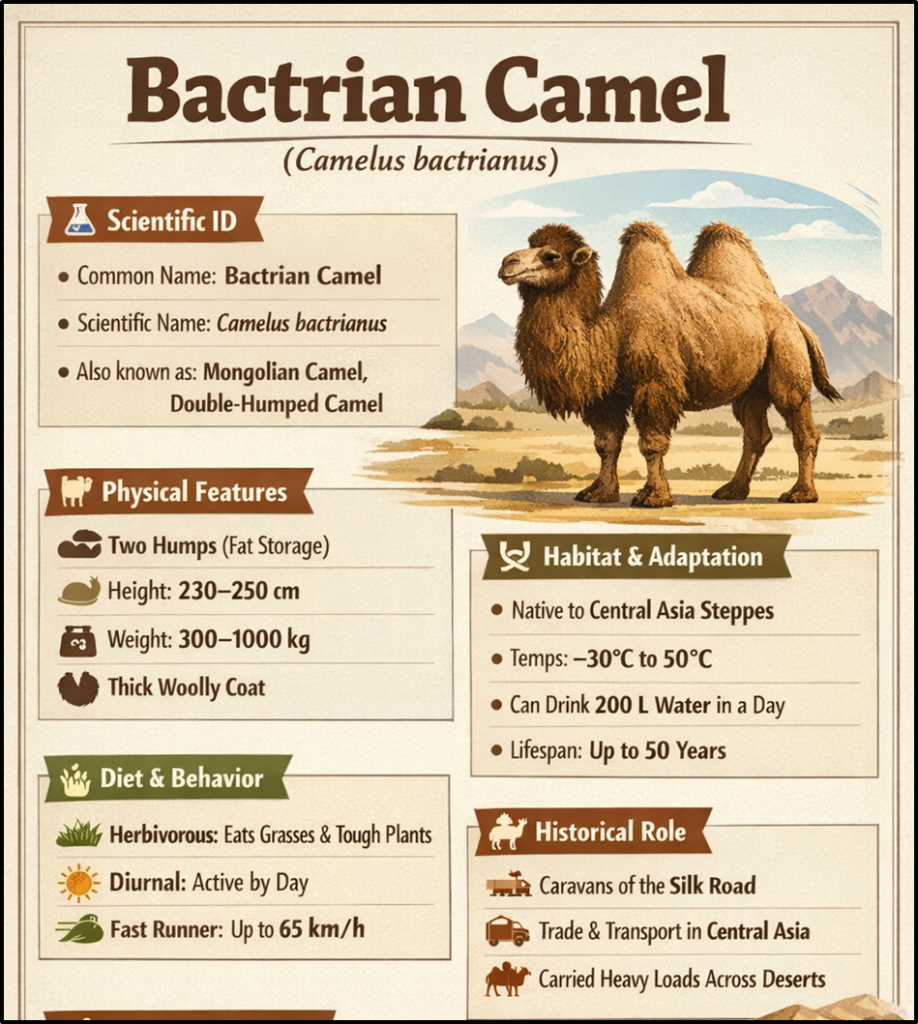
Bactrian camels
- Bactrian camels in India are a rare and unique population of double-humped camels found exclusively in the Nubra Valley of Ladakh. Hence statement I is correct.
- Locally known as Mundri camels, they are living relics of the ancient Silk Route.
- There are only about 365 to 400 of these camels remaining in India.
- Unlike the single-humped dromedaries of Rajasthan, Bactrian camels thrive in extreme cold, surviving temperatures as low as -40°C. Hence statement II is incorrect.
- The Two Humps humps store fat, not water, which the camels metabolise for energy during sparse winters. Hence statement III is correct.
- They can consume saline water and even snow to meet their hydration needs.
- They are diurnal (active by day) and rest at night.
- They have double rows of long eyelashes and sealable nostrils to block sand and snow, plus broad feet that act like natural snowshoes.
Military and Cultural Significance
Republic Day Debut: In January 2026, two Bactrian camels named ‘Galwan’ and ‘Nubra’ made history by marching in the Republic Day Parade as part of the Army’s animal contingent.
Strategic Assets: The Indian Army uses them for patrolling the Line of Actual Control (LAC). They can carry up to 170–250 kg at altitudes of 17,000 feet, outperforming traditional mules in high-altitude logistics.
Tourism: In Hunder, Nubra Valley, camel safaris have become a major tourist attraction, which has helped revive the population from near extinction.
| PYQ REFERENCE: Q. What is/are unique about ‘Kharai camel’ a breed found in India? (2016) 1. It is capable of swimming up to three kilometres in seawater. 2. It survives by grazing on mangroves. 3. It lives in the wild and cannot be domesticated. Select the correct answer using the code given below. (a) 1 and 2 only (b) 3 only (c) 1 and 3 only (d) 1, 2 and 3 |
7. With reference to fishing cats, which one of the following statements is not correct?
(a) They have Water-resistant fur which keeps the body dry when swimming or stalking prey.
(b) The males are larger than females.
(c) In India, it occurs only along river basins of Mahanadi, Godavari and Krishna.
(d) It is listed as vulnerable on the IUCN Red List.
Answer: (c) In India, it occurs only along river basins of Mahanadi, Godavari and Krishna.
Explanation:
In NEWS: The odd feline – The fishing cat’s decline is not an isolated conservation woe. It is a symptom
Fishing cat:
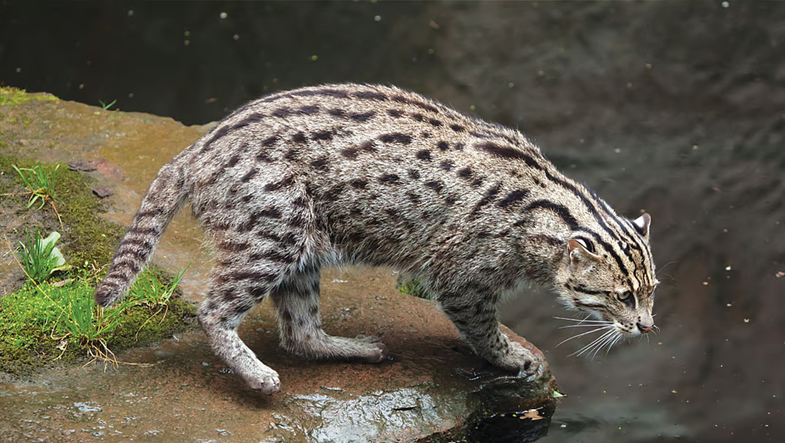
- The fishing cat (Prionailurus viverrinus) is a medium-sized wild cat found in South and Southeast Asia.
- It has deep yellowish-grey fur with black lines and spots, and its body length ranges from about 57 cm to 78 cm with a 20–30 cm tail.
- Males are larger than females, weighing approximately 8–17 kg, while females weigh about 5–9 kg.
- The fishing cat lives mainly in and around wetlands, including rivers, streams, oxbow lakes, swamps, and mangrove forests, where it hunts primarily for fish.
- It also feeds on other animals such as birds, insects, small rodents, molluscs, reptiles (including snakes), amphibians, and carrion.
- The species is thought to be primarily nocturnal and is a good swimmer capable of swimming long distances and even underwater.
- It is listed as vulnerable on the IUCN Red List due to significant declines in population, largely from wetland destruction and human persecution.
- Its geographic distribution is broad but discontinuous, with records from Pakistan, India, Nepal, Bangladesh, and Sri Lanka in South Asia and scattered populations in Southeast Asia.
Special Adaptations
- Semi-webbed feet – help with wading through wetlands.
- Water-resistant fur – keeps the body dry when swimming or stalking prey.
- Thick tail as a rudder – aids in swimming.
- Ear adaptations – inner lobules can close when diving to keep water out.
- These traits allow it to hunt fish and other prey in rivers, marshes, and swamps.
Distribution in India
- In India, the fishing cat’s range extends from the Indus basin eastward along the Ganga–Brahmaputra floodplains and delta into parts of Bangladesh.
- It also occurs south along other river basins like the Mahanadi, Godavari and Krishna, marking its southern distribution limit.
Hence option (c) is correct.
| PYQ REFERENCE: (2023) Q. Which one of the following makes a tool with a stick to scrape insects from a hole in a tree or a log of wood? (a) Fishing cat (b) Orangutan (c) Otter (d) Sloth bear |
Source: https://www.downtoearth.org.in/wildlife-biodiversity/the-odd-feline
8. Consider the following statements:
1. All the Char Dham temples are located in Uttarakhand.
2. All the Char Dham temples have Lord Shiva as its primary deity.
Which of the statements given above is/are correct?
(a) 1 only
(b) 2 only
(c) Both 1 and 2
(d) Neither 1 nor 2
Answer: (a) 1 only
Explanation:
In NEWS: Char Dham temples seek to prohibit entry of non-Hindus
The Char Dham refers to four sacred Hindu pilgrimage sites in India. Visiting them is considered highly auspicious and spiritually cleansing. All the Char Dham temples are situated in the Himalayas of Uttarakhand. Hence statement 1 is correct. They are:
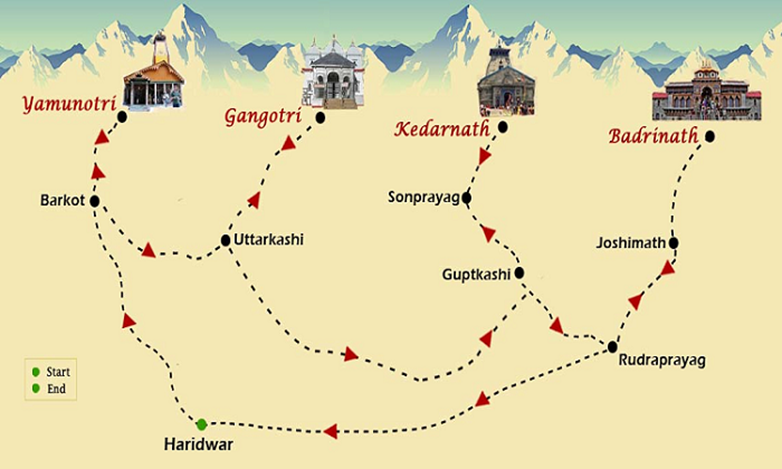
Badrinath (Lord Vishnu)
- Deity: Lord Vishnu in the form of Badrinarayan. Hence statement 2 is incorrect.
- Location: Situated at 3,133 meters (10,279 ft) in the Garhwal region of Uttarakhand, between the Nar and Narayan mountain ranges, along the Alaknanda River.
- Religious Significance:
- One of the Divya Desams, sacred shrines of Vishnu mentioned in Tamil Vaishnavite texts.
- Pilgrims believe visiting Badrinath helps attain moksha (liberation from the cycle of life and death).
- Historical Note: The present temple was reconstructed by Adi Shankaracharya in the 9th century CE, although the site has been revered for thousands of years.
- Unique Feature: The sacred hot spring Tapt Kund near the temple is believed to have healing properties.
Kedarnath (Lord Shiva)
- Deity: Lord Shiva, in the form of Kedarnath Jyotirlinga.
- Location: Located near the Mandakini River at an altitude of 3,583 meters (11,755 ft) in the Himalayas.
- Religious Significance:
- One of the 12 Jyotirlingas, which are the holiest shrines of Shiva in India.
- Pilgrims seek spiritual purification and liberation by offering prayers to Kedarnath.
- Historical Note: The temple is believed to have been originally built by the Pandavas from the Mahabharata, with its current structure attributed to Adi Shankaracharya.
- Unique Feature: Snow‑capped peaks surround the temple, giving it a serene and mystical environment. The area is accessible only for 6 months, due to heavy snowfall.
Gangotri (Goddess Ganga)
- Deity: Goddess Ganga, personified as the sacred river Ganges. Hence statement 2 is incorrect.
- Location: Situated at 3,041 meters (9,977 ft) in Uttarkashi district, along the Bhagirathi River, which originates from the Gangotri Glacier.
- Religious Significance:
- The temple commemorates the descent of the Ganges from heaven to earth, as per Hindu mythology.
- Pilgrims perform ritual ablutions in the Bhagirathi River, believing it cleanses sins and purifies the soul.
- Historical Note: The original temple was built in the 18th century by Gorkhas, and later reconstructed.
- Unique Feature: Gangotri is a source pilgrimage site, with the glacier nearby being considered the physical origin of the holy Ganges.
Yamunotri (Goddess Yamuna)
- Deity: Goddess Yamuna, the personification of the Yamuna River. Hence statement 2 is incorrect.
- Location: Situated at 3,293 meters (10,810 ft) in the western Garhwal region of Uttarakhand, near the bandarpunch range of the Himalayas.
- Religious Significance:
- The temple marks the source of the Yamuna River, which flows through important pilgrimage cities like Mathura and Vrindavan.
- Pilgrims bathe in the hot water springs of Yamunotri, which are believed to have healing and purifying properties.
- Historical Note: The temple is believed to have been established in the 19th century.
- Unique Feature: Surrounded by rugged mountains and glaciers, Yamunotri is both spiritually and scenically significant.
| PYQ REFERENCE: (1996) Q. Which one of the following temples figured in the news regarding the institution of the Devadasi? (a) Jagannath temple, Puri (b) Pashupatinath temple, Kathmandu (c) Kandariya Mahadev temple, Khajuraho (d) Chausath Yogini temple, Bhedaghat |
9. With reference to Lala Lajpat Rai, which of the following statements is/are correct?
1. He wrote the book ‘Young India’ in 1916.
2. He founded the Servants of the People Society in 1921.
3. He led a peaceful protest march in Lahore against the Simon Commission in 1928.
Select the correct answer using the code given below.
(a) 1 only
(b) 2 and 3 only
(c) 1 and 3 only
(d) 1, 2 and 3
Answer: (d) 1, 2 and 3
Explanation:
In NEWS: Prime Minister pays homage to Punjab Kesari Lala Lajpat Rai
Lala Lajpat Rai:
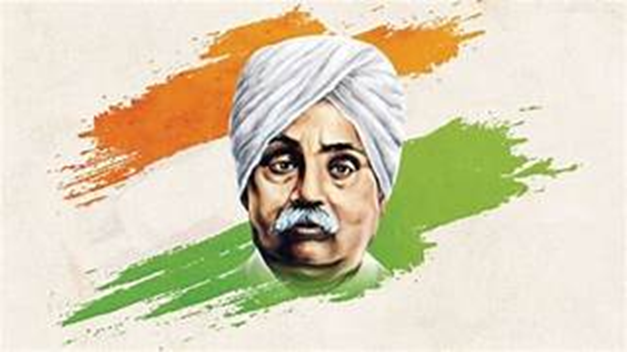
- Lala Lajpat Rai (28 January 1865 – 17 November 1928) was a prominent Indian nationalist leader, politician, author, and freedom fighter during the struggle against British colonial rule.
- He is popularly known as “Punjab Kesari” (the Lion of Punjab) for his fierce patriotism and leadership.
- Rai initially studied law at Government College, Lahore, where he became influenced by the Arya Samaj reform movement and began his involvement in nationalist politics.
- Rai was one of the leading members of the Indian National Congress and part of the famous “Lal‑Bal‑Pal” trio (with Bal Gangadhar Tilak and Bipin Chandra Pal), a group known for promoting militant nationalism and opposition to British rule.
- He strongly advocated for Swaraj (self‑rule), the Swadeshi movement (use of Indian goods), and social reforms, believing that Indians should take pride in their own culture and capacities.
- Rai also founded the Servants of the People Society in 1921 to promote public service and social welfare work. Hence statement 2 is correct.
- He was a prolific writer and speaker, contributing to newspapers and writing books like The Story of My Deportation (1908) and Young India (1916). His works critiqued British policies and inspired patriotic sentiment among Indians. Hence statement 1 is correct.
- In 1928, when the British government set up the Simon Commission, a body with no Indian members to review constitutional reforms. Rai led a peaceful protest march in Lahore demanding “Simon Go Back!” Hence statement 3 is correct.
- During this protest, he was brutally assaulted by police (lathi charge) under the British police superintendent James A. Scott. Rai suffered severe injuries but continued to address supporters with the famous line, “Every blow aimed at me is a nail in the coffin of British rule in India.”
- Rai did not fully recover from those injuries and died on 17 November 1928. His death sparked widespread outrage and intensified the Indian struggle for independence.
| PYQ REFERENCE: (2018) Q. He wrote biographies of Mazzini, Garibaldi, Shivaji and Shrikrishna ; stayed in America for some time; and was also elected to the Central Assembly. He was (a) Aurobindo Ghosh (b) Bipin Chandra Pal (c) Lala Lajpat Rai (d) Motilal Nehru |
Source: https://www.pib.gov.in/PressReleasePage.aspx?PRID=2219418®=3&lang=1
10. The Narmada river flows to the west, while most other large peninsular rivers flow to the east. Why?
1. It occupies a linear rift valley.
2. It flows between the Vindhyas and the Satpuras.
3. The land slopes to the west from Central India
Select the correct answer using the code given below.
(a) 1 only
(b) 2 and 3
(c) 1 and 3
(d) None
Answer: (a) 1 only
Explanation:
- The Narmada flows west because it occupies a linear rift valley (graben) formed by tectonic faulting, giving it a westward gradient. The valley’s slope dictates the river’s direction, overriding the general eastward slope of the Peninsular plateau. Hence 1 is correct.
- It flows between the Vindhyas and the Satpuras is true geographically, but the location alone doesn’t determine flow; the slope of the rift valley does. Hence 2 is incorrect.
- The Peninsular plateau generally slopes eastward, so the Narmada’s westward flow is a local feature due to tectonics, not regional slope. Hence 3 is incorrect.