

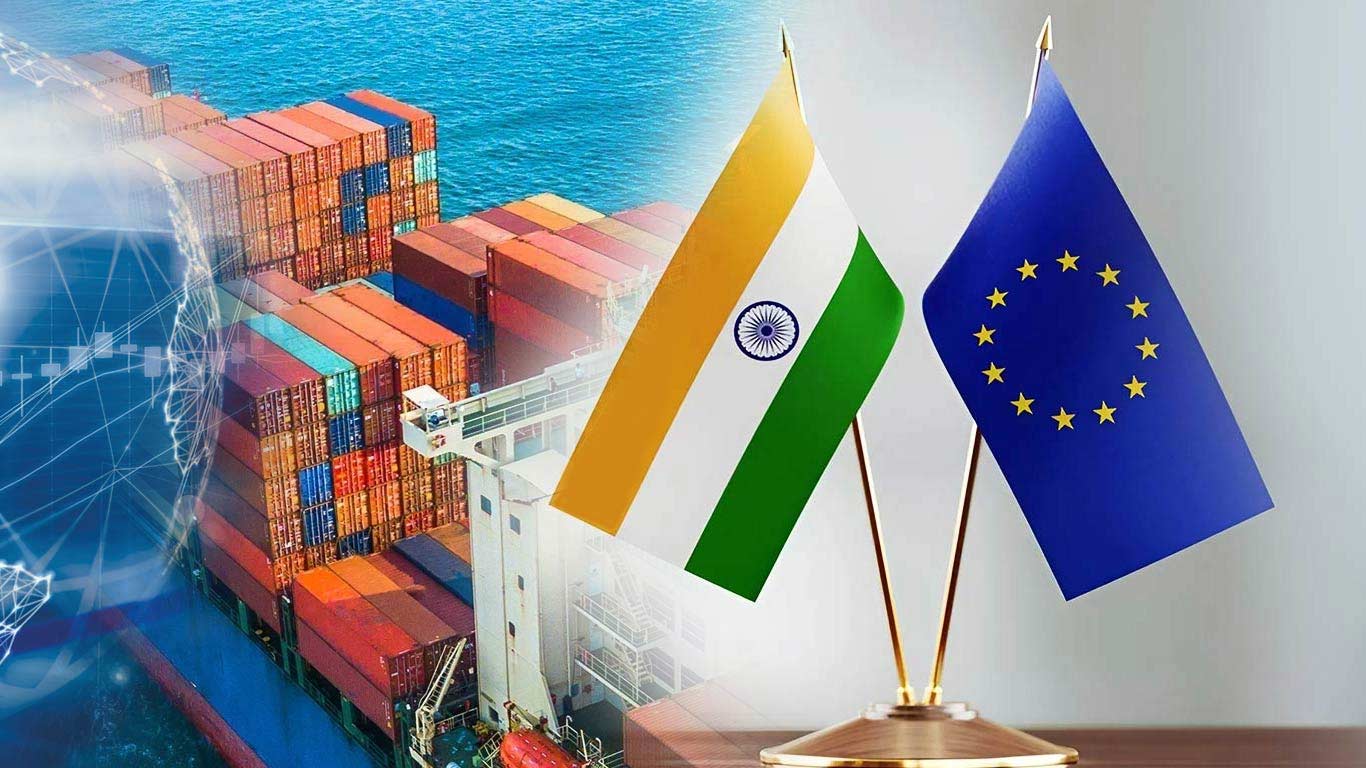
1. “The recently concluded India–EU Free Trade Agreement marks a strategic shift in India’s global trade engagement.” Discuss its economic significance, strategic implications, and challenges in implementation.
| Syllabus: General Studies – II: Bilateral, regional and global groupings and agreements involving India and/or affecting India’s interests |
IN NEWS: ‘India–EU Free Trade Agreement Concluded: A Strategic Breakthrough in India’s Global Trade Engagement. Mother of all deals’: India and the EU finalise FTA
The conclusion of the India–European Union Free Trade Agreement (FTA) in January 2026 marks India’s largest and most comprehensive trade pact, covering two economies that together account for around 25% of global GDP and nearly one-third of global trade. Beyond tariff reductions, the agreement reflects a strategic shift in India’s global trade engagement, combining economic integration with geopolitical and supply-chain considerations.
Economic Significance
1. Unprecedented market access for Indian exports
- The EU will eliminate tariffs on 99.5% of Indian exports by trade value, with over 90% entering duty-free from day one.
- Labour-intensive exports worth USD 33 billion including textiles, apparel, leather, marine products, gems and jewellery will gain immediate competitiveness, supporting employment generation, MSMEs, women and artisans.
2. Boost to services trade and mobility
- The EU has made commitments across 144 services sub-sectors, including IT/ITeS, professional services, education and financial services.
- A future-ready mobility framework enables movement of intra-corporate transferees, contractual service suppliers and independent professionals, strengthening India’s services exports (already USD 83 billion in 2024).
3. Integration into Global Value Chains (GVCs)
Reduced tariffs on EU machinery, electronics and medical devices will lower input costs, enhance productivity and reinforce the Make in India initiative.
Strategic Implications
1. Diversification of trade partnerships
The FTA reduces India’s vulnerability to protectionist measures and tariff weaponisation, particularly amid uncertainty in U.S. trade policy.
2. Strengthening rules-based trade order
The agreement signals a joint commitment to open, predictable and rules-based trade, at a time of global economic fragmentation.
3. Addressing emerging global issues
Provisions on Carbon Border Adjustment Mechanism (CBAM) ensure technical cooperation, MFN-based flexibilities and financial support, safeguarding India’s export interests.
4. Geopolitical alignment
Along with FTAs with the UK and EFTA, the deal effectively opens the entire European market, positioning India as a trusted economic and strategic partner.
Challenges in Implementation
- Non-tariff barriers such as SPS norms and technical standards may continue to restrict market access.
- Adjustment pressures on sensitive sectors, particularly automobiles and high-end manufacturing.
- CBAM compliance costs for carbon-intensive exports.
- Limited awareness, compliance capacity and scale of MSMEs to fully utilise FTA benefits.
The India–EU FTA represents a paradigm shift from transactional trade to strategic economic partnership, aligned with India’s vision of Viksit Bharat 2047. Effective implementation, regulatory preparedness and domestic competitiveness will be critical to translating its vast potential into sustained and inclusive growth.
| PYQ REFERENCE Q. Evaluate the economic and strategic dimensions of India’s Look East Policy in the context of the post Cold War international scenario. (2016) |
https://www.pib.gov.in/PressReleasePage.aspx?PRID=2219065®=3&lang=1
2. The recent depreciation of the Indian rupee is driven more by geopolitical factors than by economic fundamentals. Analyse the causes of the rupee’s fall and suggest suitable policy responses to address the situation.
| Syllabus: General Studies – III: Indian Economy and issues relating to planning, mobilization of resources, growth, development and employment. |
IN NEWS: The solution to the falling rupee lies in diplomacy
The recent depreciation of the Indian rupee has occurred despite robust macroeconomic fundamentals, indicating that geopolitical developments rather than economic weaknesses are driving currency movements. This marks a shift from conventional exchange-rate dynamics in emerging economies.
Causes of the Rupee’s Fall:
1. Geopolitically driven capital outflows (primary factor):
- Net capital flows turned negative at $3.9 billion during April–December 2025, compared to +$10.6 billion in the same period of 2024.
- This reversal followed the imposition of cumulative 50% tariffs by the U.S. on Indian exports, reflecting the growing weaponisation of trade policy.
2. Investor risk aversion and confidence shock:
Although India’s GDP growth is estimated at 7.4% and CPI inflation stood at 1.33% (end-2025) well below the RBI’s target band foreign portfolio investors exited due to policy uncertainty, not weak fundamentals.
3. Limited role of external imbalance:
India’s current account deficit was only 0.76% of GDP in H1 2025-26, significantly lower than 1.35% in the previous year, ruling out balance-of-payments stress as the trigger.
4. Self-reinforcing depreciation cycle:
A ~6% fall in the rupee since April 2025 increased hedging costs and expectations of further depreciation, accelerating equity market sell-offs and capital flight.
Devaluation Is Not an Effective Remedy
- High import dependence: Crude oil alone accounts for ~25% of merchandise imports, making depreciation inflationary.
- Rising import content of exports limits export competitiveness gains.
- REER misalignment absent: India’s inflation is lower than that of many advanced economies, reducing the justification for currency weakening.
Policy Responses and Way Forward
1. Economic diplomacy:
Resolving trade tensions with the U.S. is critical; easing tariff uncertainty can reverse capital outflows and stabilise the rupee, as seen in post-trade deal currency recoveries globally.
2. RBI’s calibrated intervention:
With forex reserves exceeding $600 billion, the RBI can smooth volatility without targeting a fixed exchange rate.
3. Communication and confidence building:
Clear RBI guidance on managing disorderly movements can anchor expectations and curb speculative pressures.
4. Structural resilience:
Promoting stable FDI inflows, deepening bond markets, and reducing reliance on volatile portfolio flows can strengthen external stability.
When currency depreciation is driven by geopolitical uncertainty rather than macroeconomic stress, diplomacy, confidence management, and calibrated intervention, not devaluation constitute the most effective policy response.
| PYQ REFERENCE Q. How would the recent phenomena of protectionism and currency manipulations in world trade affect macroeconomic stability of India? (2018) |