


1. The 16th Finance Commission recommended which of the following regarding Local Bodies?
1. Grants to Panchayats are tied to improving sanitation and waste-management standards.
2. Urban local bodies may receive performance-linked grants for improving own-source revenue.
3. Local body grants should be directly transferred to elected bodies without routing through State Consolidated Funds.
Select the correct answer using the code below:
(a) 1 and 2 only
(b) 2 and 3 only
(c) 1 and 3 only
(d) 1, 2 and 3
Answer: (a) 1 and 2 only
Explanation:
In NEWS: What can local bodies expect from the 16th Finance Commission?
16th Finance Commission (FC):
Constitutional Basis
- Established under Article 280 of the Constitution.
- Constituted every five years to recommend:
- Vertical devolution (Centre to States)
- Horizontal devolution (among States)
- Grants-in-aid
- Measures to strengthen local bodies and disaster management
Recommendations:
- The 16th Finance Commission retained the vertical devolution of 41% of the divisible tax pool to the States.
- The 16th Finance Commission recommended altering the criteria and weights used for horizontal devolution among States.
- The 16th Finance Commission recommended a separate share of the divisible pool exclusively for Local Bodies.
- The 16th Finance Commission recommended that grants to Local Bodies continue to be routed through the State governments.
- The 16th Finance Commission recommended continuation of grants to Local Bodies for basic services such as sanitation and waste management.
Local Body Grants
- The 16th FC recommended tied grants to rural local bodies for improving sanitation and waste-management systems. Hence statement 1 is correct.
- The 16th FC recommended performance-linked grants to urban local bodies for improving their own-source revenues. Hence statement 2 is correct.
- The 16th FC recommended direct transfer of Local Body grants to elected Panchayats and Municipalities (not elected bodies) without routing through the State Consolidated Fund. Hence statement 3 is incorrect.
- The 16th FC emphasised property-tax reforms as a part of performance-linked funding to municipalities.
- The 16th FC highlighted that revenue-expenditure mismatch in panchayats justifies continued Union-to-State-to-local transfers.
Fiscal Architecture
- The 16th FC recommended continuation of the State Disaster Risk Management Fund (SDRMF).
- The 16th FC proposed changes to the weightage of “demographic performance” in tax devolution.
- The 16th FC recommended a permanent institutional mechanism for resolving Centre–State fiscal disputes.
- The 16th FC recommended equalisation-based principles for health and education sectors.
- The 16th FC recommended increasing the share of performance-based grants relative to basic grants.
| PYQ REFERENCE: (2025) Q. Which of the following statements with regard to recommendations of the 15th Finance Commission of India are correct? I. It has recommended grants of 4,800 crores from the year 2022-23 to the year 2025-26 for incentivizing States to enhance educational outcomes. II. 45% of the net proceeds of Union taxes are to be shared with States. III. 45,000 crores are to be kept as performance-based incentive for all States for carrying out agricultural reforms. IV. It reintroduced tax effort criteria to reward fiscal performance. Select the correct answer using the code given below. (a) I, II and III (b) I, II and IV (c) I, III and IV (d) II, III and IV |
2. With reference to the recent ‘The World Happiness Report 2025’ consider the following statements:
1. It is published by the United Nations Development Programme (UNDP).
2. It uses objective indicators like crime, education, and urbanisation.
3. India ranks in the bottom third, while Pakistan often ranks slightly higher despite weaker economic performance.
How many of the above statements are correct?
(a) Only one
(b) Only two
(c) All three
(d) None
Answer: (a) Only one
Explanation:
In NEWS: Unpacking the global ‘happiness’ rankings
The World Happiness Report 2025:
- The World Happiness Report (WHR) is published by the Wellbeing Research Centre at Oxford University (earlier with SDSN). Hence statement 1 is incorrect.
- The WHR ranks countries according to subjective wellbeing, not material prosperity.
- It covers over 130 countries, depending on Gallup data availability.
- The Report distinguishes among emotional wellbeing, life satisfaction, and quality of life. Hence statement 2 is incorrect.
- WHR categorises happiness across age groups, including trends among youth and elderly.
- It highlights institutional trust, fairness, and community strength as key components of subjective wellbeing.
Recent Trends
- Nordic countries – Finland, Denmark, Iceland, Sweden—consistently top the rankings due to high institutional trust and strong welfare systems.
- The United States has fallen sharply in recent editions despite its high income levels.
- India ranks in the bottom third, while Pakistan often ranks slightly higher despite weaker economic performance. Hence statement 3 is correct.
- WHR 2025 notes that youth globally report declining social connections, with nearly 19% saying they have no one to rely on.
| PYQ REFERENCE: (2019) Q. The Global Competition Report is published by the (a) International Monetary Fund (b) United Nations Conference on Trade and Development (c) World Economic Forum (d) World Bank |
Source: https://www.thehindu.com/opinion/op-ed/unpacking-the-global-happiness-rankings/article70295706.ece
3. With reference to the ‘Protection of Plant Variety and Farmers’ Rights Act (PPV&FRA Act)’ which among the following statements are correct?
I. Farmers cannot sell branded seeds of protected varieties under the Act.
II. Farmers can register their own varieties, only if they are new or novel.
III. A farmer cannot be prosecuted for infringement unless it is proven that they knowingly violated the Act.
IV. Breeders receive exclusive rights to produce, sell, market, distribute, import and export the protected variety.
Select the correct answer using the code given below:
(a) I, II and III
(b) I, II and IV
(c) I, III and IV
(d) II, III and IV
Answer: (c) I, III and IV
Explanation:
In NEWS: What changes are planned for the plant variety Act?
Protection of Plant Variety and Farmers’ Rights Act (PPV&FRA Act):
- The PPV&FRA Act, 2001 establishes a sui generis system of plant variety protection in India.
- The Act was enacted to comply with TRIPS Agreement Article 27.3(b).
- Under the Act, new, extant, farmers’ and essentially derived varieties (EDVs) can all be registered.
- Registration of varieties is based on the DUS criteria — Distinctness, Uniformity, and Stability.
- The PPV&FR Authority is the central body responsible for registering plant varieties and maintaining the National Register.
Farmers’ and Breeders’Rights
- Farmers have the right to save, use, sow, resow, exchange, share and sell unbranded seed of protected varieties.
- Farmers cannot sell branded seeds of protected varieties under the Act. Hence statement I is correct.
- Farmers can register their own varieties, even if they are not new or novel. Hence statement II is incorrect.
- A farmer cannot be prosecuted for infringement unless it is proven that they knowingly violated the Act. Hence statement III is correct.
- Breeders receive exclusive rights to produce, sell, market, distribute, import and export the protected variety. Hence statement IV is correct.
- The protection period is 18 years for trees and vines and 15 years for other crops.
| PYQ REFERENCE: (2019) Q. Consider the following statements: 1. According to the Indian Patents Act, a biological process to create a seed can be patented in India. 2. In India, there is no Intellectual Property Appellate Board. 3. Plant varieties are not eligible to be patented in India. Which of the statements given above is/are correct? (a) 1 and 3 only (b) 2 and 3 only (c) 3 only (d) 1,2 and 3 |
4. Consider the following statements:
I. India is the second-largest producer of textiles and garments after China.
II. India is the largest producer of cotton globally.
III. India is the largest producer of jute in the world.
IV. India is the second-largest producer of silk.
V. India has one of the largest installed spinning capacities in the world.
How many of the above statements are correct?
(a) Only two
(b) Only three
(c) Only four
(d) All five
Answer: (d) All five
Explanation:
In NEWS: Textile, apparel export see sharp decline in October; government rescinds QCO on viscose fibres
Textile Sector in India
- The textile and apparel industry contributes around 2.3% to India’s GDP.
- It accounts for 11–12% of India’s total exports.
- India’s textile sector is the second-largest employer after agriculture.
- The sector provides direct employment to ~45 million people and indirect employment to ~100 million.
- India’s share in the global textile trade is around 4–5%.
India’s Global Position
- India is the second-largest producer of textiles and garments after China.
- India is the largest producer of cotton globally.
- India is the largest producer of jute in the world.
- India is the second-largest producer of silk.
- India has one of the largest installed spinning capacities in the world.
Hence all the statements are correct.
5. Consider the following statements regarding the Ginkgo-toothed Beaked Whale:
1. It is a deep-diving cetacean species belonging to the family Ziphiidae.
2. It is listed as Endangered on the IUCN Red List.
3. It is known primarily from stranding records rather than live sightings.
Which of the above statements is/are correct?
(a) 1 and 2 only
(b) 2 and 3 only
(c) 1 and 3 only
(d) 1, 2 and 3
Answer: (c) 1 and 3 only
Explanation:
In NEWS: What are ginkgo-toothed beaked whales, spotted in the wild by researchers for the first time?
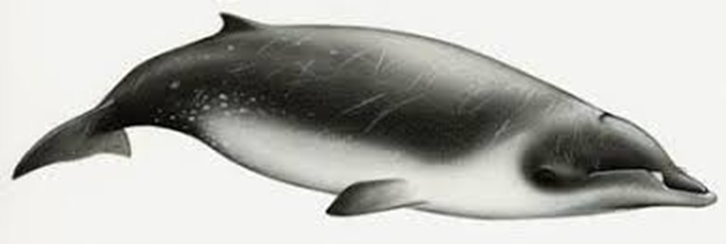
Ginkgo-toothed beaked whales:
- They are a deep-diving cetacean species belonging to the family Ziphiidae. Hence statement 1 is correct.
- Scientifically known as Mesoplodon ginkgodens.
- Named due to their ginkgo leaf shaped teeth, present mainly in adult males.
- Distribution is poorly known, but strandings indicate presence in Indo-Pacific tropical and warm-temperate waters.
- Mostly known from strandings, as live sightings are extremely rare. Hence statement 3 is correct.
- The diet consists primarily of deep-sea squid along with fish and crustaceans.
- Classified as Data Deficient (DD) by the IUCN Red List. Hence statement 2 is incorrect.
- Major threats include bycatch, marine noise pollution, and naval sonar.
- Very limited information exists on their population, breeding, and behavior.
Source: https://indianexpress.com/article/explained/ginkgo-toothed-beaked-whales-10372400/
6. Which of the following best describes the ‘YUVA AI for ALL’ initiative?
(a) A national programme to train government officials in advanced AI model development.
(b) A free, self-paced AI literacy course designed to give citizens basic understanding of Artificial Intelligence.
(c) A scheme to promote AI-based startups through financial incentives and incubation support.
(d) A curriculum framework for introducing AI as a compulsory subject in schools.
Answer: (b) A free, self-paced AI literacy course designed to give citizens basic understanding of Artificial Intelligence.
Explanation:
In NEWS: Government of India launches ‘YUVA AI for ALL’ – a free national course to help everyone understand Artificial Intelligence
YUVA AI for ALL:
- It is a free national course launched by the Ministry of Electronics and Information Technology (MeitY) under the IndiaAI Mission.
- The initiative aims to empower 1 crore (10 million) citizens with foundational AI skills.
- The course duration is 4.5 hours, and it is self-paced.
- It focuses on ethical, responsible, and inclusive use of Artificial Intelligence. Hence option (b) is correct.
- The course is available on platforms like FutureSkills Prime, iGOT Karmayogi, and multiple ed-tech platforms.
- Learners receive an official Government of India certificate upon completion.
- The content includes real-life Indian examples and explains AI basics, safe usage, and real-world applications.
- It consists of six short modules, covering introduction to AI, its impact on education and work, safe AI practices, and future opportunities.
- The initiative targets students, professionals, and general learners across the country.
- Organisations, schools, and universities can partner with IndiaAI to promote and integrate the course.
- The course was designed by Jaspreet Bindra, an AI expert and founder of AI & Beyond and Tech Whisperer Ltd.
- It forms part of India’s efforts toward becoming an AI-powered nation and aims to bridge the digital divide.
| PYQ REFERENCE: (2025) Q. Consider the following statements regarding AI Action Summit held in Grand Palais, Paris in February 2025: I. Co-chaired with India, the event builds on the advances made at the Bletchley Park Summit held in 2023 and the Seoul Summit held in 2024. II. Along with other countries, US and UK also signed the declaration on inclusive and sustainable AI. Which of the statements given above is/are correct? (a) I only (b) II only (c) Both I and II (d) Neither I nor II |
Source: https://www.pib.gov.in/PressReleasePage.aspx?PRID=2191334
7. Consider the following statements:
Statement-I : India is the world’s third-largest methane emitter after China and the U.S.
Statement-II : According to the UNEP report, India contributes around 31 million tonnes of methane annually, accounting for nearly 9% of global methane emissions.
Which one of the following is correct in respect of the above statements?
(a) Both Statement-I and Statement-II are correct and Statement-II is the correct explanation for Statement-I
(b) Both Statement-I and Statement-II are correct and Statement-II is not the correct explanation for Statement-I
(c) Statement-I is correct but Statement-II is incorrect
(d) Statement-I is incorrect but Statement-II is correct
Answer: (a) Both Statement-I and Statement-II are correct and Statement-II is the correct explanation for Statement-I
Explanation:
In NEWS: Crop-residue burning turning India into global methane hotspot, UN report warns
Crop-Residue Burning & Methane:
- A 2025 UNEP report warns that India has become a global methane hotspot, mainly due to crop-residue burning.
- India is the world’s third-largest methane emitter after China and the U.S.
- India contributes around 31 million tonnes of methane annually, accounting for nearly 9% of global methane emissions.
- Global methane emissions currently stand at 360 million tonnes per year.
- The G20 countries, including India, are responsible for 65% of global methane emissions.
- Major methane sources in India: livestock (enteric fermentation + manure), rice cultivation, and crop-residue burning.
- Methane emissions from waste burning in India increased from 4.5 MT in 1995 to 7.4 MT in 2020 (a 64% rise).
- Methane from rice cultivation in India is projected to increase by 8% between 2020 and 2030.
- India generated 20 MT of methane from agriculture in 2020 and 4.5 MT from the energy sector.
Hence Both Statement-I and Statement-II are correct and Statement-II is the correct explanation for Statement-I
| PYQ REFERENCE: (2019) Q. Consider the following: 1. Carbon Monoxide 2. Methane 3. Ozone 4. Sulphur dioxide Which of the above are released into atmosphere due to the burning of crop/ biomass residue? (a) 1 and 2 only (b) 2,3 and 4 only (c) 1 and 4 only (d) 1,2,3 and 4 |
8. Consider the following statements regarding the Himalayan Black Bear:
1. It is found only in the higher Himalayan region above 3,500 metres.
2. It undergoes long, deep hibernation similar to polar bears.
3. Under the Wildlife Protection Act, 1972, it is classified as ‘vermin’ under Schedule V.
Which of the statements given above is/are correct?
(a) 1 and 2 only
(b) 3 only
(c) 2 and 3 only
(d) None of these statements
Answer: (d) None of these statements
Explanation:
In NEWS: Shoot-at-sight orders for Himalayan black bears in Uttarakhand district as global warming messes up ursids’ hibernation schedules
- In three months, the state recorded 71 bear attacks, killing 6 humans and 60 livestock.
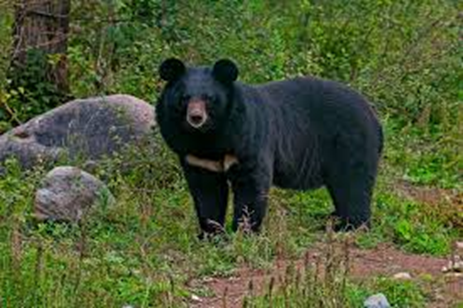
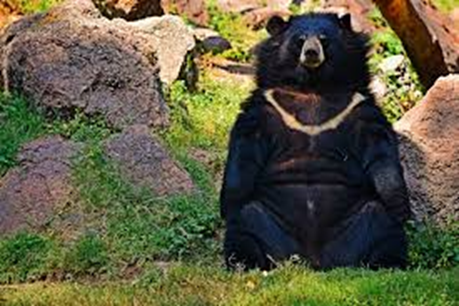
Himalayan Black Bear:
- The Himalayan black bear (Ursus thibetanus laniger) is a subspecies of the Asiatic black bear.
- It is found in Kashmir, Himachal Pradesh, Uttarakhand, Nepal, and Arunachal Pradesh.
- The species also inhabits warmer foothill forests (not above 3,500 m), including Rajaji NP and Corbett TR. Hence statement 1 is incorrect.
- It is listed as Vulnerable on the IUCN Red List.
- Under the Wildlife Protection Act, 1972, it is protected under Schedule I. Hence statement 3 is incorrect.
- Climate change induced warm winters have disrupted bear hibernation cycles.
- Himalayan black bears’ hibernation is shallow and shorter than that of polar bears. Hence statement 2 is incorrect.
- In warmer regions, Himalayan black bears do not hibernate.
- Human – bear conflict has increased steadily over the last 25 years in Uttarakhand.
- A total of 1,972 people have been attacked by bears in Uttarakhand since 2000.
- Similar climate-linked bear conflicts are reported from Japan and Canada.
| PYQ REFERENCE: (2018) Q. The Red Panda is naturally found in which of the following regions? 1. Eastern Himalayas 2. Central China 3. Southern India Select the correct answer using the code given below: (a) 1 only (b) 1 and 2 only (c) 2 and 3 only (d) 1, 2 and 3 |
9. Consider the following statements:
1. BrahMos is a supersonic cruise missile jointly developed by India and Russia.
2. It is considered the world’s fastest operational supersonic cruise missile.
Which of the statements given above is/are correct?
(a) 1 only
(b) 2 only
(c) Both 1 and 2
(d) Neither 1 nor 2
Answer: (c) Both 1 and 2
Explanation:
In NEWS: Indonesian Defence Minister to visit Delhi for talks on BrahMos
BrahMos:
- BrahMos is a supersonic cruise missile jointly developed by India (DRDO) and Russia (NPOM). Hence statement 1 is correct.
- It is named after the Brahmaputra and Moskva rivers.
- It is considered the world’s fastest operational supersonic cruise missile. Hence statement 2 is correct.
- The missile follows a two-stage configuration: solid-propellant booster (1st stage) and liquid-fuelled ramjet (2nd stage).
Performance & Capabilities
- Has an operational speed of Mach 2.8–3.0, making interception extremely difficult.
- The original range was 290 km but newer versions have 450–500 km range; trials for 800+ km are ongoing.
- Warhead capacity: 200–300 kg, conventional only.
- The guidance system includes Inertial Navigation System (INS) and active radar homing.
- Features sea-skimming and terrain-hugging flight, reducing radar detectability.
- Achieves CEP ~ 1 meter, making it highly accurate.
Launch Platforms
- Can be launched from Land, Ship, Air, and Submarine platforms.
- India is among the few nations with a fighter jet–launched supersonic cruise missile (BrahMos-A on Su-30MKI).
Variants
- Block I: Land attack version.
- Block II: High-precision strikes in urban/complex terrains.
- Block III: Steep-dive capability for mountain warfare.
- BrahMos-A: Air-launched version with reduced weight.
- BrahMos-NG (Next Generation): Under development; lighter, faster (~Mach 3.5).
- BrahMos-II: Hypersonic (Mach 6–7), under development.
Strategic Importance
- Enhances India’s precision-strike and deterrence capabilities.
- Strengthens A2/AD (Anti-Access/Area Denial) capabilities in the Indian Ocean.
- Key asset against high-value, time-sensitive targets.
- Supports Make in India through higher indigenous content (70%+ in new variants).
- Forms a major part of India’s defence export push; Philippines is first buyer.
| PYQ REFERENCE: (2023) Q. Consider the following statements: 1. Ballistic missiles are jet-propelled at subsonic speeds throughout their flights, while cruise missiles are rocket-powered only in the initial phase of flight. 2. Agni-V is a medium-range supersonic cruise missile, while BrahMos is a solid-fuelled intercontinental ballistic missile. Which of the statements given above is/are correct? (a) 1 only (b) 2 only (c) Both 1 and 2 (d) Neither 1 nor 2 |
10. In the Government of India Act 1919, the functions of Provincial Government were divided into “Reserved” and “Transferred” subjects. Which of the following were treated as “Reserved” subjects?
1. Administration of Justice
2. Local Self-Government
3. Land Revenue
4. Police
Select the correct answer using the code given below:
(a) 1, 2 and 3
(b) 2,3 and 4
(c) 1,3 and 4
(d) 1, 2 and 4
Answer: (c) 1,3 and 4
Explanation:
Under the Government of India Act, 1919 (Montagu–Chelmsford Reforms), dyarchy was introduced in the provinces.
Subjects were divided into:
| Reserved Subjects (under Governor and Executive Council) | Transferred Subjects (under Ministers responsible to the legislature) |
| Administration of Justice Police Land Revenue Law and order Irrigation Finance Press Labour Mines Factories | Local Self-Government (LSG) Public health Education Agriculture Public works Cooperative societies |
Hence Option (c) 1,3 and 4 are correct.