

1. With reference to the United Nations Commission for Social Development (CSocD), consider the following statements:
1. It is one of the functional commissions of the United Nations Economic and Social Council.
2. All the members of the UN General Assembly are members of this commission.
3. Its members serve for a term of four years.
4. It serves as an intergovernmental advisory body on global social development issues.
Which of the statements given above is/are correct?
(a) 1 and 2 only
(b) 3 only
(c) 1, 3 and 4 only
(d) 2, 3 and 4 only
Answer: (c) 1, 3 and 4 only
Explanation:
In NEWS: India highlights Rights-Based, Inclusive and People-Centric development approach at the 64th session of the UN Commission for social development being held at the United Nations Headquarters, New York, USA
UN Commission for social development:
- The Commission for Social Development (CSocD) is one of the eight functional commissions of the United Nations Economic and Social Council (ECOSOC). Hence statement 1is correct.
- It serves as a key intergovernmental advisory body on global social development issues. Hence statement 4 is correct.
- It was established on 16 February 1946 by ECOSOC.
- It was originally called the Social Commission; renamed in 1966.
- It is headquartered in New York, USA.
- CSocD convenes annually at the UN Headquarters in New York, typically in February for about two weeks.
Membership & Structure
- Members: 46 Member States, elected by ECOSOC with equitable geographic representation. Hence statement 2 is incorrect.
- Members serve four-year terms. Hence statement 3 is correct.
- The Commission elects a Bureau (Chair + Vice-Chairs) to guide its work.
Functions:
- CSocD’s core role is to advise and assist ECOSOC on social development policies.
- It focuses especially on issues not covered by specialised agencies and supports the implementation of global social development commitments.
- After the World Summit for Social Development (Copenhagen, 1995), CSocD became the principal UN body for following up on the Copenhagen Declaration and Programme of Action, which emphasizes people-centered development.
- During sessions, Member States, civil society, and other stakeholders discuss thematic social development priorities, adopt resolutions, and issue policy recommendations.
- Since 1995, the Commission has taken up priority themes each year, reflecting current global social challenges — e.g., poverty eradication, social integration, housing, and social protection.
Its mandate includes:
- Improving international understanding of social development through sharing of information.
- Identifying emerging issues affecting global social progress.
- Advising on social policies designed to promote welfare and reduce inequality.
- Recommending measures to ECOSOC to enhance social development outcomes.
| PYQ REFERENCE: (2022) Q. With reference to the “United Nations Credentials Committee”, consider the following statements: 1. It is a committee set up by the UN Security Council and works under its supervision. 2. It traditionally meets in March, June and September every year. 3. It assesses the credentials of all UN members before submitting a report to the General Assembly for approval. Which of the statements given above is/are correct? (a) 3 only (b) 1 and 3 (c) 2 and 3 (d) 1 and 2 |
Source: https://www.pib.gov.in/PressReleasePage.aspx?PRID=2222911®=3&lang=1
2. With reference to Active Pharmaceutical Ingredients (APIs), consider the following statements:
I. APIs are the components of a medicine that produce the intended therapeutic effect.
II. In the Financial Year 2024-25, China accounted for more than 70% of India’s API imports.
Which of the statements given above is/are correct?
(a) I only
(b) II only
(c) Both I and II
(d) Neither I nor II
Answer: (c) Both I and II
Explanation:
In NEWS: India’s dependence on imported APIs
India’s dependence on imported APIs:
- India is a global leader in generic medicines, but import-dependent for bulk drugs/APIs.
- In the Financial Year 2024-25, India imported 200 categories of APIs, bulk drugs, and drug intermediates worth approximately USD 4.35 billion, as per HSN (Harmonised System of Nomenclature) based import data.
- China accounted for about 73.7% of these imports. Hence statement II is correct.
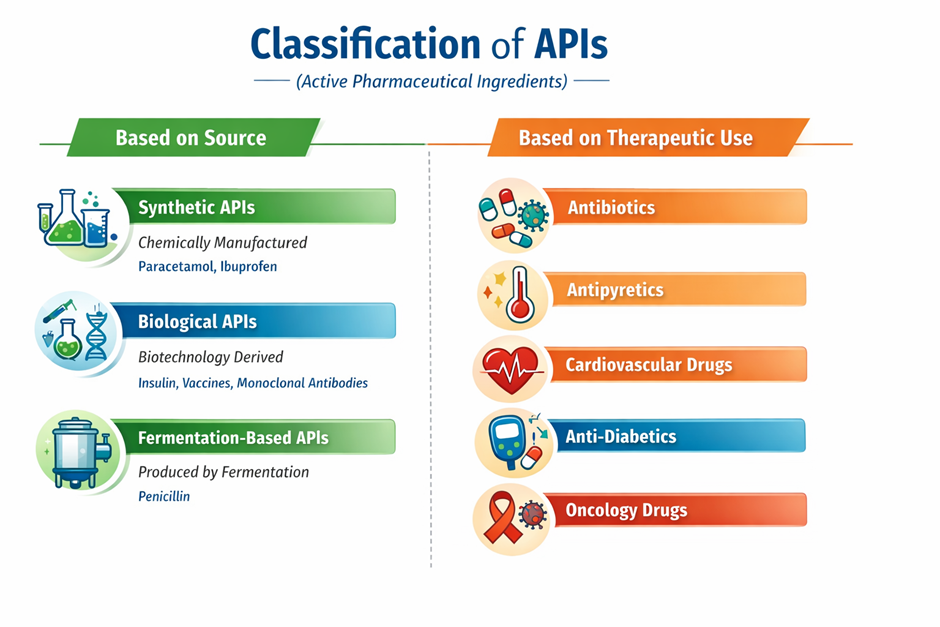
- Therapeutic segments with high imports dependence include antibiotics, anti-fungal, anti-amoebic, gastrointestinal disorders, antidiabetic, endocrine and hormonal disorders, cardiovascular, oncology, female infertility, contraception, neurology/substance use disorders and essential amino acid deficiency.
- Potential risks related to import of APIs arising from geopolitical uncertainties include Single-Source vulnerability, Price volatility and predatory pricing.
Active Pharmaceutical Ingredient:
- An Active Pharmaceutical Ingredient (API) is the biologically active component of a medicine that produces the intended therapeutic effect. Hence statement I is correct.
- Without the API, a medicine has no curative or preventive value.
- APIs are combined with excipients (inactive substances) to make finished dosage forms like tablets, capsules, syrups, injections.
- Example:
- Paracetamol → API
- Tablet coating, binders → Excipients
| PYQ REFERENCE: Q. Which of the following are the reasons for the occurrence of multi-drug resistance in microbial pathogens in India? (2019) 1. Genetic predisposition of some people 2. Taking incorrect doses of antibiotics to cure diseases 3. Using antibiotics in livestock farming 4. Multiple chronic diseases in some people Select the correct answer using the code given below. (a) 1 and 2 (b) 2 and 3 only (c) 1, 3 and 4 (d) 2, 3 and 4 |
Source: https://www.pib.gov.in/PressReleasePage.aspx?PRID=2222528®=3&lang=1
3. How many of the following are the hydropower projects in operation between India and Bhutan?
1. Chukha Hydroelectric Project
2. Kurichhu Hydroelectric Project
3. Ratle Hydroelectric Project
4. Basochhu Hydroelectric Project
5. Tala Hydroelectric Project
Select the correct answer using the code given below.
(a) Only two
(b) Only three
(c) Only four
(d) Only five
Answer: (c) Only four
Explanation:
In NEWS: India and Bhutan to Strengthen Cooperation in the Power Sector
Indo–Bhutan hydropower cooperation:
- Indo–Bhutan hydropower cooperation dates back to 1961, with a formal hydroelectric power cooperation agreement signed in 2006.
- Projects are developed mainly under the Inter-Governmental model and Joint Venture / PPP models.
Strategic Importance
For Bhutan:
- Major source of national revenue
- Supports economic development
For India:
- Access to clean, renewable electricity
- Strengthens regional energy security
- Deepens neighbourhood diplomacy
Major India–Bhutan Hydropower Projects
Commissioned Projects
- Chukha Hydroelectric Project – 336 MW
- First Indo-Bhutan hydropower project
- Laid the foundation of cooperation (operational since the 1980s)
- Kurichhu Hydroelectric Project – 60 MW
- Basochhu Hydroelectric Project – 64 MW
- Phase I: 24 MW
- Phase II: 40 MW
- Tala Hydroelectric Project – 1,020 MW
- One of the largest projects
- Major contributor to Bhutan’s revenue through power exports
Hence only four are correct. Ratle is built on River Chenab.
Under Construction / Advanced Stage
- Punatsangchhu-I Hydroelectric Project – 1,200 MW
- Emphasis on early commissioning
- Punatsangchhu-II Hydroelectric Project – 1,020 MW
- Focus on commercial optimisation of power output
- Mangdechhu Hydroelectric Project – 720 MW
- Strengthens Bhutan’s export capacity to India
Proposed / Planned Projects
- Sankosh Hydropower Project – ~2,560 MW (largest proposed)
- Discussed as part of future cooperation roadmap
- Strategic for long-term energy security
| PYQ REFERENCE: (2024) Q. Recently, the term “pumped-storage hydropower” is actually and appropriately discussed in the context of which one of the following? (a) Irrigation of terraced crop fields (b) Lift irrigation of cereal crops (c) Long duration energy storage (d) Rainwater harvesting system |
Source: https://www.pib.gov.in/PressReleasePage.aspx?PRID=2222533®=3&lang=1
4. Consider the following statements with respect to Bankia/Bankei Rice:
1. It is a traditional indigenous red rice variety cultivated in the wetland fringes of Chilika Lake.
2. It is flood – tolerant and performs well under erratic monsoon and climate variability.
3. Its tall crop structure supports fish breeding and bird habitats.
4. It is known for its high glycaemic index.
How many of the statements given above are correct?
(a) Only one
(b) Only two
(c) Only three
(d) All the four
Answer: (c) Only three
Explanation:
In NEWS: Promoting Chilika red rice can help enhance food and livelihood security around India’s first Ramsar Site
Chilika Red Rice (Bankia/Bankei Rice)
- It is a traditional indigenous red rice variety cultivated in the wetland fringes of Chilika Lake, Odisha (India’s first Ramsar site). Hence statement 1 is correct.
Agro-ecological features:
- Flood- and waterlogging-tolerant; suited to wetland ecosystems
- Grown largely without chemical fertilisers or pesticides
- Performs well under erratic monsoon and climate variability
- Hence statement 2 is correct.
Nutritional value:
- Rich in dietary fibre, iron, folic acid, minerals and antioxidants (anthocyanins)
- Low glycaemic index → beneficial for diabetics. Hence statement 4 is incorrect.
- Ecological significance:
- Tall crop structure supports fish breeding and bird habitats Hence statement 3 is correct.
- Encourages biodiversity-friendly agriculture
- Represents “wise use” of wetlands under Ramsar principles
Livelihood importance:
- Cultivated by small and marginal farmers around Chilika (e.g., Mangalajodi region)
- Enhances food security + supplementary income
- Preserves traditional knowledge systems
| PYQ REFERENCE: (2022) Q. “System of Rice Intensification” of cultivation, in which alternate wetting and drying of rice fields is practised, results in : 1. Reduced seed requirement 2. Reduced methane production 3. Reduced electricity consumption Select the correct answer using the code given below: (a) 1 and 2 only (b) 2 and 3 only (c) 1 and 3 only (d) 1, 2 and 3 |
5. Which among the following statements is/are correct with respect to Crafoord Prize:
1. The Crafoord Prize is awarded by the United Nations.
2. The prize recognises scientific fields not covered under the Nobel Prizes.
3. In 2026, the Crafoord Prize in Geosciences was awarded to Veerabhadran Ramanathan for his contributions to climate science.
Select the correct answer using the code given below:
(a) 1 only
(b) 2 and 3 only
(c) 3 only
(d) 1 and 2 only
Answer: (b) 2 and 3 only
Explanation:
In NEWS: Ramanathan was awarded the 2026 Crafoord Prize in Geosciences by the Royal Swedish Academy of Sciences, often called the “Nobel Prize for Earth sciences.”
Crafoord Prize in Geosciences 2026:
- The Crafoord Prize is awarded by the Royal Swedish Academy of Sciences. Hence statement 1 is incorrect.
- It was established in 1980 through a donation by Holger Crafoord and Anna-Greta Crafoord.
- The prize recognises scientific fields not covered under the Nobel Prizes. Hence statement 2 is correct.
- Geosciences is one of the disciplines covered under the Crafoord Prize.
- The Crafoord Prize in Geosciences is often referred to as the “Nobel of Geosciences”.
- The prize is not awarded in all fields every year; disciplines are covered on a rotational basis.
- Other fields included under the Crafoord Prize are Astronomy, Mathematics, Biosciences (with emphasis on ecology), and Polyarthritis (rheumatoid arthritis).
- In 2026, the Crafoord Prize in Geosciences was awarded to Veerabhadran Ramanathan. Hence statement 3 is correct.
- He was awarded for his pioneering contributions to climate science, particularly for demonstrating the strong greenhouse effects of trace gases such as CFCs.
- His research also highlighted the role of aerosols and atmospheric brown clouds in influencing global and regional climate systems.
| PYQ REFERENCE: (2021) Q. Consider the following statements in respect of the Laureus World Sports Award which was instituted in the year 2000: 1. American golfer Tiger Woods was the first winner of this award. 2. The award was received mostly by ‘Formula One’ players so far. 3. Roger Federer received this award maximum number of times compared to others. Which of the above statements are correct? (a) 1 and 2 only (b) 2 and 3 only (c) 1 and 3 only (d) 1, 2 and 3 |
6. Consider the following statements with respect to the National List of Essential Medicines in India:
1. It is published by the Department of Pharmaceuticals under the Ministry of Chemical & Fertilizers.
2. The list has undergone four revisions since its inception in 1996.
3. A medicine needs prior license or approval from the Drugs Controller General of India (DCGI) before inclusion in the list.
Which of the statements given above is/are correct?
(a) 1 only
(b) 2 and 3 only
(c) 2 only
(d) 1, 2 and 3
Answer: (b) 2 and 3 only
Explanation:
In NEWS: Non-inclusion of cancer medication under price control
National List of Essential Medicines (NLEM)
- The National List of Essential Medicines (NLEM) is a dynamic list of drugs published by the Ministry of Health and Family Welfare (MoHFW) that identifies medicines essential for the priority healthcare needs of India’s population. Hence statement 1 is incorrect.
- India first published its NLEM in 1996, and it has been periodically revised to reflect changing disease patterns, new evidence, and treatment needs.
- Subsequent revisions occurred in 2003, 2011, 2015, and most recently in 2022. Hence statement 2 is correct.
The main objectives of NLEM are to:
- Identify medicines that address priority public health needs.
- Promote rational use of medicines in clinical practice.
- Ensure affordable access to essential drugs for all sections of society.
- Guide procurement and supply in public healthcare systems.
- Serve as a basis for pricing policy and regulation.
To be included in the NLEM, a medicine must:
- Be useful in treating diseases that are a public health problem in India.
- Be licensed/approved by the Drugs Controller General of India (DCGI). Hence statement 3 is correct.
- Demonstrate proven efficacy and safety profiles.
- Be cost-effective compared to other therapeutic alternatives.
Source: https://www.pib.gov.in/PressReleasePage.aspx?PRID=2222520®=3&lang=1
7. With reference to Periyar Tiger Reserve, consider the following statements:
1. Periyar Tiger Reserve (PTR) is a protected area located in the Eastern Ghats of Tamil Nadu.
2. It was established as a Tiger Reserve in 1978 under Project Tiger.
3. It acts as an important watershed for Kerala and Tamil Nadu.
4. It is designated as a Biosphere Reserve under UNESCO’s Man and Biosphere Programme.
Which of the statements given above are correct?
(a) 1, 2 and 4 only
(b) 1 and 3 only
(c) 2 and 3 only
(d) 1, 2, 3 and 4
Answer: (c) 2 and 3 only
Explanation:
In NEWS: Conserve or perish – Periyar Tiger Reserve has rewritten Indian conservation by turning poachers into protectors and conflict into coexistence
Periyar Tiger Reserve:
- Periyar Tiger Reserve (PTR) is a protected area located in the Western Ghats of Kerala. Hence statement 1 is incorrect.
- It was established as a Tiger Reserve in 1978 under Project Tiger. Hence statement 2 is correct.
- The reserve is named after the Periyar River, which flows through the region.
- It is centred around the Periyar Lake, an artificial reservoir created by the Mullaperiyar Dam.
- Periyar Tiger Reserve lies in the Cardamom Hills and forms part of the Western Ghats biodiversity hotspot.
- It is one of the most well-managed tiger reserves in India, known for strong community participation.
Ecological Significance
- Dominant vegetation type: Tropical evergreen and semi-evergreen forests
- Also includes:
- Moist deciduous forests
- Grasslands
- Acts as an important watershed for Kerala and Tamil Nadu. Hence statement 3 is correct.
Fauna (Important Species)
- Tiger
- Asian Elephant
- Leopard
- Gaur
- Sambar
- Nilgiri langur
- Lion-tailed macaque
Conservation & Governance
- Managed by the Kerala Forest Department.
- Known for eco-development programmes involving local communities.
- Promotes voluntary relocation and livelihood-based conservation.
- Part of the Western Ghats UNESCO World Heritage region (serial site).
Note: It is not separately designated as a Biosphere Reserve under UNESCO’s Man and Biosphere Programme. Hence statement 4 is incorrect.
| PYQ REFERENCE: (2020) Q. Which of the following Protected Areas are located in Cauvery basin? 1. Nagarhole National Park 2. Papikonda National Park 3. Sathyamangalam Tiger Reserve 4. Wayanad Wildlife Sanctuary Select the correct answer using the code given below: (a) 1 and 2 only (b) 3 and 4 only (c) 1, 3 and 4 only (d) 1, 2, 3 and 4 |
Source: https://www.downtoearth.org.in/wildlife-biodiversity/conserve-or-perish
8 With reference to the National Panchayat Advancement Index (PAI), consider the following statements:
1. The National Panchayat Advancement Index (PAI) is a performance assessment framework for Gram Panchayats in India which is prepared and released by the Ministry of Panchayati Raj.
2. Tripura topped the Panchayat Advancement Index (PAI) 2.0 at the national level.
Which of the statements given above is/are correct?
(a) 1 only
(b) 2 only
(c) Both 1 and 2
(d) Neither 1 nor 2
Answer: (c) Both 1 and 2
Explanation:
In NEWS: Tripura Tops National Panchayat Advancement Index
National Panchayat Advancement Index (PAI):
- The National Panchayat Advancement Index (PAI) is a performance assessment framework for Gram Panchayats in India.
- It is prepared and released by the Ministry of Panchayati Raj. Hence statement 1 is correct.
- PAI measures the quality of grassroots governance and effectiveness of Panchayati Raj Institutions.
- The index evaluates Gram Panchayats on parameters such as transparency, decentralised planning, service delivery and accountability.
- PAI 2.0 is the upgraded version of the Panchayat performance assessment framework.
- PAI 2.0 relies on digitally submitted and verified data from Gram Panchayats.
- The index covers nearly 2.5 lakh Gram Panchayats across the country.
- PAI is a ranking and benchmarking tool, not a funding or grant-disbursement mechanism.
- Gram Panchayats are the basic units of rural local self-government under Part IX of the Constitution.
- PAI supports the objectives of the 73rd Constitutional Amendment Act by strengthening decentralised governance.
- The index promotes competitive federalism at the grassroots level.
- PAI is not a constitutional body and not a statutory authority.
PAI 2.0 – 2023–24 Highlights:
- Tripura topped the Panchayat Advancement Index (PAI) 2.0 at the national level. Hence statement 2 is correct.
- All 1,176 Gram Panchayats in Tripura achieved 100% data submission and verification.
- Jugal Kishore Nagar Village Committee from Sepahijala district, Tripura, ranked first nationally.
- South Nalchar Gram Panchayat and Chesrimai Gram Panchayat, both from Sepahijala district, ranked among the top five nationally.
- The clustering of top-ranked Panchayats indicates systemic governance efficiency, not isolated performance.
| PYQ REFERENCE: (2015) Q. The fundamental object of Panchayati Raj system is to ensure which among the following? 1. People’s participation in development 2. Political accountability 3. Democratic decentralisation 4. Financial mobilisation Select the correct answer using the code given below: (a) 1, 2 and 3 only (b) 2 and 4 only (c) 1 and 3 only (d) 1, 2, 3 and 4 |
Source: https://www.gktoday.in/tripura-tops-national-panchayat-advancement-index/
9. With reference to the suspension of Members of Parliament (MPs), consider the following statements:
I. The presiding officer is vested with the authority to suspend the Members of the Parliament.
II. A suspended Member of Parliament is barred from participating in the proceedings of the House for a specified period.
III. A suspended Member loses his/her Membership of the Parliament.
Which of the statements given above are correct?
(a) I and III only
(b) I and II only
(c) I, II and III
(d) II and III only
Answer: (b) I and II only
Explanation:
In NEWS: Parliament Budget Session Day 5 Highlights: Eight Opposition Lok Sabha MPs suspended for ‘creating ruckus’
Suspension of Members of Parliament (MPs)
- Suspension is a disciplinary action by which an MP is barred from participating in the proceedings of the House for a specified period due to disorderly conduct. Hence statement II is correct.
Authority to Suspend
- Presiding Officer:
- Lok Sabha: Speaker
- Rajya Sabha: Chairman (Vice-President of India) Hence statement I is correct.
Rules Governing Suspension
Lok Sabha
- Rule 373:
- The Speaker may direct an MP to withdraw for the remainder of the day.
- Rule 374:
- For grave disorder, MP can be suspended for up to 5 sittings or the remainder of the session.
- Rule 374A:
- Automatic suspension of an MP for five sittings or the remainder of the session, without a vote, for grave disorder.
Rajya Sabha
- Rule 255:
- The chairman may direct an MP to withdraw for the rest of the day.
- Rule 256:
- MP can be suspended for a period not exceeding the remainder of the session (requires a motion).
Grounds for Suspension:
- Persistent disruption of proceedings
- Wilful obstruction of business
- Disregard of authority of the Chair
- Grave disorderly conduct
Rights During Suspension
- Suspended MP
- Cannot participate in debates
- Cannot vote
- Cannot sit in the House
- Suspension does not disqualify the MP or affect membership. Hence statement III is incorrect.
| PYQ REFERENCE: Q. Consider the following statements: I. If any question arises as to whether a Member of the House of the People has become subject to disqualification under the 10th Schedule,the President’s decision in accordance with the opinion of the Council of Union Ministers shall be final. II. There is no mention of the word ‘political party’ in the Constitution of India. Which of the statements given above is/are correct? (a) I only (b) II only (c) Both I and II (d) Neither I nor II |
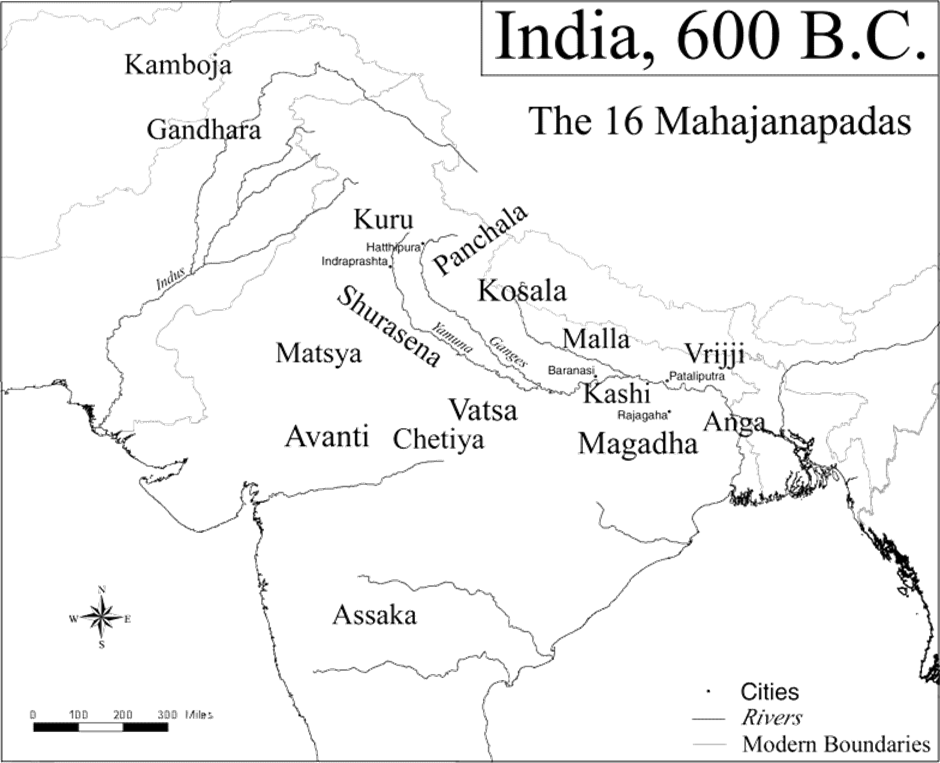
10. With reference to ancient India (600–322 BC), consider the following pairs:
| Territorial region | River flowing in the region |
| I. Asmaka | Godavari |
| II. Kamboja | Vipas |
| III. Avanti | Mahanadi |
| IV. Kosala | Sarayu |
How many of the pairs given above are correctly matched?
(a) Only one
(b) Only two
(c) Only three
(d) All the four
Answer: (b) Only two
Explanation:
- Asmaka (Assaka or Ashmaka) was located in the Deccan region, on the banks of the Godavari. Pair 1 is correct.
- Kamboja was located in the north-west (around Afghanistan / Gandhara region). Vipas (Beas) flows in the Punjab region, not associated with Kamboja. Pair 2 is incorrect.
- Avanti was centred around Ujjain, associated mainly with the Narmada (and Shipra). Mahanadi flows in eastern India (Odisha–Chhattisgarh). Pair 3 is incorrect.
- Kosala (capital: Ayodhya) lay along the Sarayu river. Pair 4 is correct.