


1. Under the Risk-Based Premium framework for deposit insurance in India, which of the following banks continue to pay the card rate premium?
1. Local Area Banks
2. Payments Banks
3. Urban Cooperative Banks under Prompt Corrective Action (PCA)
Select the correct answer using the code below:
(a) 1 only
(b) 1 and 2 only
(c) 2 and 3 only
(d) 1, 2 and 3
Answer: (d) 1, 2 and 3
Explanation:
In NEWS: RBI unveils risk-based deposit insurance premium; safest banks to pay 8 paise per ₹100 from April 2026
Risk-Based Premium (RBP) Framework for Deposit Insurance:
General Background
- Deposit insurance in India is administered by the Deposit Insurance and Credit Guarantee Corporation (DICGC).
- DICGC functions under the Reserve Bank of India (RBI).
- Deposit insurance has been operational in India since 1962.
- Earlier, DICGC followed a flat-rate premium system.
- The current card rate premium is 12 paise per ₹100 of assessable deposits (AD).
- The DICGC Act, 1961 allows differential premium rates for different categories of insured banks.
Risk-Based Premium (RBP) Framework
- The RBP framework was approved by the RBI Central Board in December 2025.
- It aims to incentivize better risk management by banks.
- Banks with stronger financial health may pay lower premiums.
- The framework will be implemented from April 1, 2026.
- The framework will be reviewed at least once every three years.
Special Provisions
- Rating override policy exists in case of adverse developments after initial risk rating.
- Banks must maintain confidentiality of ratings and premium amounts.
- Local Area Banks (LABs) and Payments Banks continue to pay the card rate due to data limitations.
- Urban Cooperative Banks (UCBs) under Supervisory Action Framework (SAF) or Prompt Corrective Action (PCA) will continue at card rate until exit. Hence all are correct.
| PYQ REFERENCE: (2013) Q. Which of the following grants/grant direct credit assistance to rural households? 1. Regional Rural Banks 2. National Bank for Agriculture and Rural Development 3. Land Development Banks Select the correct answer using code given below. (a) 1 and 2 only (b) 2 and 3 only (c) 1 and 3 only (d) 1, 2 and 3 |
https://m.rbi.org.in/Scripts/BS_PressReleaseDisplay.aspx?prid=62183
2. With reference to Denotified Tribes (DNTs) in India, consider the following statements:
1. Denotified Tribes are communities that were previously notified as “criminal tribes” under the Criminal Tribes Act, 1871 during British rule.
2. All Denotified Tribes are included under the Scheduled Tribes category in India.
Which of the statements given above is/are correct?
(a) 1 only
(b) 2 only
(c) Both 1 and 2
(d) Neither 1 nor 2
Answer: (a) 1 only
Explanation:
In NEWS: Denotified tribes seek constitutional recognition, separate Census entry
Denotified tribes, nomadic tribes, semi-nomadic tribes seek ‘separate column’ in 2027 caste census, claiming they have been politically misclassified among SC, ST, OBC groups; they want sub-classification to highlight backwardness within grouping
Denotified Tribes (DNTs):
- Denotified Tribes are communities that were previously notified as “criminal tribes” under the Criminal Tribes Act, 1871 during British rule. Hence statement 1 is correct.
- The Criminal Tribes Act enabled colonial authorities to register, monitor, and restrict the movement of certain communities.
- The Criminal Tribes Act was repealed after Independence in 1952, and affected communities were “denotified.”
- After denotification, several states enacted Habitual Offenders Acts, which continued surveillance of some communities.
- Denotified Tribes include communities that were historically stigmatized due to colonial policies.
- Nomadic Tribes (NTs) refer to communities with a traditionally mobile lifestyle.
- Semi-Nomadic Tribes (SNTs) refer to groups that partially settled but retain periodic mobility.
- DNT/NT/SNT communities are not a single constitutional category.
- Many DNT communities are classified under SC, ST, or OBC categories depending on state lists. Hence statement 2 is incorrect.
- Some communities remain outside any formal reservation category.
- Traditional occupations of DNT communities include pastoralism, performing arts, trade, craft work, and itinerant services.
- Major challenges include social stigma, lack of identity documents, poor access to welfare schemes, and educational deprivation.
Committees and Institutional Measures
- The Renke Commission studied socio-economic conditions of Denotified, Nomadic and Semi-Nomadic Tribes.
- The Idate Commission (National Commission for Denotified, Nomadic and Semi-Nomadic Tribes) recommended policy interventions and focused welfare measures.
- The Development and Welfare Board for Denotified, Nomadic and Semi-Nomadic Communities functions under the Ministry of Social Justice and Empowerment.
| PYQ REFERENCE: (2024) Q. Consider the following statements: 1. It is the Governor of the State who recognizes and declares any community of that State as a Scheduled Tribe. 2. A community declared as a Scheduled Tribe in a State need not be so in another State. Which of the statements given above is/are correct? (a) 1 only (b) 2 only (c) Both 1 and 2 (d) Neither 1 nor 2 |
3. With reference to the Motion of Thanks in the Indian Parliament, consider the following statements:
1. The Motion of Thanks is a formal motion expressing gratitude to the Parliament by the President.
2. The defeat of the Motion of Thanks in Lok Sabha is considered a serious matter and may imply loss of confidence in the government.
3. Both Lok Sabha and Rajya Sabha discuss and vote on the Motion of Thanks separately.
Which of the statements given above is/are not correct?
(a) 1 only
(b) 1 and 2 only
(c) 3 only
(d) 1, 2 and 3
Answer: (a) 1 only
Explanation:
In NEWS: Rajya Sabha adopts the Motion of Thanks amid protests by Opposition
Motion of Thanks:
Constitutional Basis
- The Motion of Thanks is associated with the President’s Address under Article 87 of the Constitution.
- The President addresses both Houses of Parliament assembled together at:
- The first session after each general election.
- The first session of every year.
- The Motion of Thanks is moved in each House separately after the President’s Address.
Nature and Procedure
- The Motion of Thanks is a formal motion expressing gratitude to the President for the Address. Hence statement 1 is incorrect.
- The President’s Address is drafted by the Council of Ministers, hence debate on Motion of Thanks reflects discussion on government policies.
- One member moves the motion and another member seconds it.
- Members of Parliament may discuss:
- Policies and programmes of the government.
- National and international issues.
- Matters included or omitted in the Address.
- Amendments to the Motion of Thanks can be moved by MPs.
- Amendments may highlight:
- Criticism of government policies.
- Issues not mentioned in the Address.
- Debate on Motion of Thanks generally lasts several days.
- The debate concludes with a reply usually by the Prime Minister (or senior minister).
- After discussion, the motion is put to vote.
Significance
- Passing of the Motion of Thanks indicates parliamentary approval of the government’s policies.
- Defeat of the Motion of Thanks in Lok Sabha is considered a serious matter and may imply loss of confidence in the government. Hence statement 2 is correct.
- It serves as one mechanism through which Lok Sabha can test the government’s majority.
- The scope of discussion on Motion of Thanks is very wide compared to many other parliamentary debates.
- Both Lok Sabha and Rajya Sabha discuss and vote on the Motion separately. Hence statement 3 is correct.
- The Motion of Thanks corresponds to the British parliamentary practice known as the “Speech from the Throne” debate.
| PYQ REFERENCE: (2014) Q. Consider the following statements regarding a No-Confidence Motion in India: 1. There is no mention of a No-Confidence Motion in the Constitution of India. 2. A Motion of No-Confidence can be introduced in the Lok Sabha only. Which of the statements given above is / are correct? (a) 1 only (b) 2 only (c) Both 1 and 2 (d) Neither 1 nor 2 |
4. With reference to key Indian AI initiatives, consider the following pairs:
| Initiative | Description |
| 1. IndiaAI Mission | National framework to develop AI ecosystem |
| 2. BHASHINI | AI-powered multilingual language translation platform |
| 3. AIRAWAT | Quantum communication satellite programme |
| 4. National Supercomputing Mission | High-performance computing infrastructure |
Which of the pairs given above are correctly matched?
(a) 1, 2 and 4 only
(b) 1 and 3 only
(c) 2 and 3 only
(d) 1, 2, 3 and 4
Answer: (a) 1, 2 and 4 only
Explanation:
In NEWS: Seven Chakras of India – AI Impact Summit 2026. . Driving Global Collaboration Across Seven Themes of AI Impact
India–AI Impact Summit 2026:
- India–AI Impact Summit 2026 is an international AI summit hosted by India.
- It is the first global Artificial Intelligence summit hosted in the Global South.
- The summit aims to promote collaborative AI governance involving developed and developing countries.
- It focuses on leveraging AI for inclusive growth, sustainable development, and societal transformation.
- Over 100 countries are expected to participate, highlighting global cooperation.
- The summit promotes ethical, safe, and responsible AI aligned with democratic values.
- It supports India’s vision of becoming a global AI innovation hub.
Core Guiding Principles (Three Sutras)
- People
- Planet
- Progress
Seven Chakras (Seven Thematic Pillars)
- Human Capital
- Inclusion for Social Empowerment
- Safe and Trusted AI
- Science and Research
- Resilience, Innovation and Efficiency
- Democratising AI Resources
- AI for Economic Development and Social Good
Key Indian AI Initiatives Linked
- IndiaAI Mission: National framework to develop AI ecosystem.
- BHASHINI: AI-powered language translation platform supporting Indian languages.
- AIRAWAT: AI supercomputing infrastructure for research. Hence pair 3 is incorrect.
- IndiaAI Safety Institute: Focus on responsible and safe AI deployment.
- National Supercomputing Mission: High-performance computing support.
- AI Data Labs: Facilitate AI experimentation and innovation.
| PYQ REFERENCE: (2025) Q. Consider the following statements regarding AI Action Summit held in Grand Palais, Paris in February 2025: I. Co-chaired with India, the event builds on the advances made at the Bletchley Park Summit held in 2023 and the Seoul Summit held in 2024. II. Along with other countries, the US and UK also signed the declaration on inclusive and sustainable AI. Which of the statements given above is/are correct? (a) I only (b) II only (c) Both I and I (d) Neither I nor II |
Source: https://www.pib.gov.in/PressReleasePage.aspx?PRID=2225069®=3&lang=1
5. With reference to Blyth’s tragopan, consider the following statements:
1. It is a species of pheasant found in the Eastern Himalayan region.
2. It is listed under Schedule I of the Wildlife (Protection) Act, 1972.
3. It is classified as Critically Endangered on the IUCN Red List.
Which of the statements given above is/are correct?
(a) 1 and 2 only
(b) 2 only
(c) 1 and 3 only
(d) 1, 2 and 3
Answer: (a) 1 and 2 only
Explanation:
In NEWS: More than a dazzle – This living tapestry is an indicator species for some of Asia’s most biodiverse and least-explored mountain ecosystems
Blyth’s Tragopan:
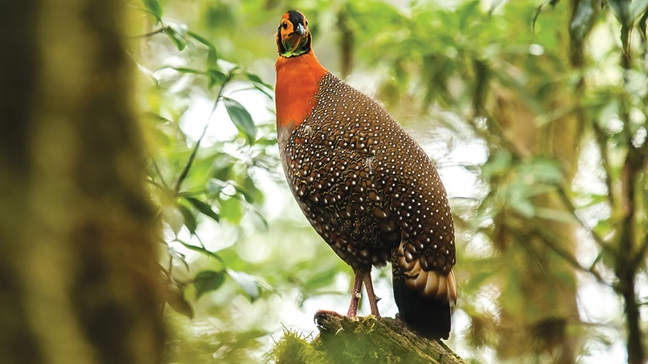
- Blyth’s tragopan is a species of pheasant found in the Eastern Himalayas and Northeast India. Hence statement 1 is correct.
- It belongs to the genus Tragopan under the pheasant family (Phasianidae).
- It is one of the four tragopan species found in India (Western tragopan, Satyr tragopan, Temminck’s tragopan, Blyth’s tragopan).
- The male is brightly coloured with crimson breast, scarlet plumage and distinctive facial skin.
- During breeding display, the male raises blue horns and inflates a colourful throat lappet.
- The female is smaller and camouflaged with grey-brown plumage.
Habitat and Distribution
- Found across Bhutan, Arunachal Pradesh, Nagaland, Mizoram, Manipur, northern Myanmar, southeastern Tibet and parts of China.
- It inhabits montane forests including rhododendron forests, broadleaf woodland and bamboo thickets.
- Shows altitudinal migration:
- Descends to lower elevations (~1400 m) in winter.
- Moves to higher elevations (~3300 m) in summer.
- Often found in dense undergrowth and mid-elevation forest zones.
Behavioural Features
- Typically solitary or seen in small groups.
- Shy and elusive species.
- Active during dawn and dusk for foraging.
Conservation Status
- Listed under Schedule I of the Wildlife (Protection) Act, 1972. Hence statement 2 is correct.
- Included in Appendix I of CITES.
- Classified as Vulnerable on the IUCN Red List. Hence statement 3 is incorrect.
- Estimated population is fewer than 10,000 individuals.
Threats
- Habitat fragmentation due to hydroelectric projects and infrastructure development.
- Shifting cultivation (jhum cultivation).
- Hunting and poaching for food and feathers.
- Loss of undisturbed broadleaf forest habitat.
Conservation Significance
- Considered an indicator species of Eastern Himalayan biodiversity and intact montane forest ecosystems.
- Found in protected areas such as Dihang-Dibang Biosphere Reserve (Arunachal Pradesh).
- Community conservation and ecotourism are important conservation strategies.
| PYQ REFERENCE: (2025) Q. Regarding Peacock tarantula (Gooty tarantula), consider the following statements: I. It is an omnivorous crustacean. II. Its natural habitat in India is only limited to some forest areas. III. In its natural habitat, it is an arboreal species. Which of the statements given above is/are correct? (a) I only (b) I and III (c) II only (d) II and III |
Source: https://www.downtoearth.org.in/wildlife-biodiversity/more-than-a-dazzle
6. Bannerghatta National Park is known for which of the following?
1. The Suvarnamukhi stream flows through the park.
2. Important for elephant conservation as it lies within an elephant corridor
3. High-altitude alpine ecosystem
Select the correct answer using the code given below:
(a) 1 and 2 only
(b) 2 only
(c) 1 and 3 only
(d) 1, 2 and 3
Answer: (a) 1 and 2 only
Explanation:
In NEWS: Shrinking shock absorbers of Bannerghatta National Park in Bengaluru
Bannerghatta National Park:
- Bannerghatta National Park is located in Karnataka.
- It lies near Bengaluru city (approximately 22 km south of Bengaluru).
- The park was established in 1974.
- It forms part of the Eastern Ghats landscape.
- The park is contiguous with forest ranges connecting to the Nilgiri Biosphere Reserve landscape through forest corridors.
Geography & Habitat
- Terrain consists of dry deciduous forests, scrub forests and grasslands. Hence statement 3 is incorrect.
- The park includes hills, valleys and seasonal streams.
- The Suvarnamukhi stream flows through the park. Hence statement 1 is correct.
- Elevation varies, contributing to habitat diversity.
Flora
- Dominated by southern tropical dry deciduous forests.
- Common tree species include sandalwood, neem, tamarind and eucalyptus (plantations).
Fauna
- Major mammals include Asian elephant, leopard, sloth bear, gaur, spotted deer and wild boar.
- Important for elephant conservation as it lies within an elephant corridor. Hence statement 2 is correct.
- Supports diverse bird species, reptiles and butterflies.
Special Features
- Bannerghatta Biological Park is located within/adjacent to the national park.
- It includes a zoo, safari park, butterfly park and rescue centre.
- The butterfly park is among the first of its kind in India.
Conservation Significance
- Acts as a green buffer for Bengaluru.
- Important for human–wildlife conflict management due to proximity to urban areas.
- Part of larger elephant migration routes.
| PYQ REFERENCE: (2020) Q. With reference to India’s Desert National Park, which of the following statements are correct? 1. It is spread over two districts. 2. There is no human habitation inside the Park. 3. It is one of the natural habitats of the Great Indian Bustard. Select the correct answer using the code given below: (a) 1 and 2 only (b) 2 and 3 only (c) 1 and 3 only (d) 1, 2 and 3 |
7. Consider the following characteristics:
1. Tallest flying bird in the world
2. Grey body with red bare skin on head and upper neck
3. Usually found in freshwater wetlands and agricultural fields
4. State bird of Uttar Pradesh
Which of the following birds is best described above?
(a) Great Indian Bustard
(b) Sarus Crane
(c) Demoiselle Crane
(d) Painted Stork
Answer: (b) Sarus Crane
Explanation:
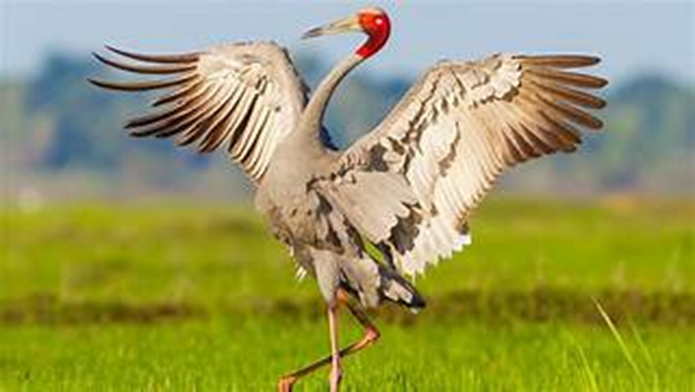
In NEWS: A flock of Sarus Cranes on the outskirts of Lucknow in Uttar Pradesh on Wednesday. Census data on Wednesday showed a significant rise in the number of the State bird, the tallest flying bird in the world. with Etawah forest division topping the list with 3,304 cranes.
Sarus Crane:
- Sarus Crane (Antigone antigone) is the tallest flying bird in the world.
- It belongs to the family Gruidae.
- It is the State bird of Uttar Pradesh.
- It is native to the Indian subcontinent, Southeast Asia and parts of Australia.
- In India, major populations are found in Uttar Pradesh, Rajasthan, Gujarat and Madhya Pradesh.
Habitat
- Prefers wetlands, marshes, floodplains, shallow lakes and agricultural fields.
- Often found near human habitation and agricultural landscapes.
- Relies on shallow freshwater wetlands for breeding.
Physical Characteristics
- Known for long legs, long neck and grey body.
- Distinctive red bare skin on head and upper neck.
- Strong pair bonding; usually seen in pairs.
Behaviour
- Non-migratory (resident species in India).
- Known for elaborate courtship dances.
- Builds nests in shallow wetlands.
Conservation Status
- IUCN Red List Status: Vulnerable.
- Protected under Schedule I of the Wildlife (Protection) Act, 1972.
- Listed under CITES Appendix II.
Threats
- Wetland loss and habitat fragmentation.
- Agricultural intensification.
- Power line collisions.
- Human disturbance and encroachment.
Hence option (b) is correct.
| PYQ REFERENCE: (2014) Q. If you walk through countryside, you are likely to see some birds stalking alongside the cattle to seize the insects disturbed by their movement through grasses. Which of the following is/are such bird/birds? 1. Painted Stork 2. Common Myna 3. Black-necked Crane Select the correct answer using the code given below. (a) 1 and 2 (b) 2 only (c) 2 and 3 (d) 3 only |
8. Which of the following countries participates with India in Exercise KHANJAR?
(a) Kazakhstan
(b) Kyrgyzstan
(c) Tajikistan
(d) Uzbekistan
Answer: (b) Kyrgyzstan
Explanation:
In NEWS: INDIA – KYRGYZSTAN JOINT SPECIAL FORCES EXERCISE KHANJAR COMMENCES IN ASSAM
Exercise KHANJAR:
- Exercise KHANJAR is a joint special forces military exercise conducted between India and Kyrgyzstan. Hence option (b) is correct.
- It is an annual bilateral exercise held alternatively in India and Kyrgyzstan.
- The exercise primarily involves Special Forces units from both countries.
- The Indian contingent is generally represented by troops from the Parachute Regiment (Special Forces) of the Indian Army.
- The Kyrgyzstan side is represented by the ILBRIS Special Forces Brigade.
- The main objective of Exercise KHANJAR is to enhance cooperation in Counter-Terrorism (CT) operations.
- Training focuses on operations in urban and mountainous terrain.
- Key operational components include:
- Special forces tactics
- Sniping skills
- Complex building intervention (CQB – Close Quarter Battle)
- Mountain warfare skills.
- The exercise aims to promote interoperability, exchange of best practices, and joint operational understanding.
- Exercise KHANJAR contributes to strengthening India–Central Asia defence cooperation.
- It also supports collaboration against international terrorism and extremism.
- The 13th edition of Exercise KHANJAR (2026) is being conducted at Missamari, Assam.
Source: https://www.pib.gov.in/PressReleasePage.aspx?PRID=2223244®=3&lang=1
9. Consider the following statements:
Statement-I: Vizhinjam port aims to reduce India’s dependence on foreign transshipment ports such as Colombo, Singapore, and Dubai.
Statement-II: Vizhinjam port is strategically important for its location on the east coast of the Bay of Bengal.
Which one of the following is correct in respect of the above statements?
(a) Both Statement-I and Statement-II are correct and Statement-II is the correct explanation for Statement-I
(b) Both Statement-I and Statement-II are correct, and Statement-II is not the correct explanation for Statement-I
(c) Statement-I is correct but Statement-II is incorrect
(d) Statement-I is incorrect but Statement-II is correct
Answer: (c) Statement-I is correct but Statement-II is incorrect
Explanation:
In NEWS: Vizhinjam port sets new operational benchmarks in Jan.
Vizhinjam International Seaport:
- Vizhinjam International Seaport is located near Thiruvananthapuram in Kerala, on the Arabian Sea coast. Hence statement II is incorrect.
- It is developed under a Public-Private Partnership (PPP) between the Kerala Government and Adani Ports and Special Economic Zone Limited (APSEZ).
- The port is designed primarily as a container transshipment hub.
- Vizhinjam is strategically located close to major international east-west shipping routes.
- The port has natural deep draft conditions, enabling large container vessels to dock.
- In January 2026, the port recorded:
- Highest monthly container throughput of 1,23,092 TEUs.
- Handling of 62 vessels (highest in a single month).
- Highest Gross Crane Rate (GCR) of 30.12 container lifts/hour.
- The port began commercial operations recently (around 2024–25 period).
- Vizhinjam port aims to reduce India’s dependence on foreign transshipment ports such as Colombo, Singapore, and Dubai. Hence statement I is correct.
- It has moved to the 83rd position globally among container ports by handling volume.
| PYQ REFERENCE: (2023) Q. Consider the following pairs: Port Well known as 1. Kamarajar Port First major port in India registered as a company 2. Mundra Port Largest privately owned port in India 3. Visakhapatnam Largest container port in Port India How many of the above pairs are correctly matched? (a) Only one pair (b) Only two pairs (c) All three pairs (d) None of the pairs |
10. The famous female figurine known as ‘Dancing Girl’, found at Mohenjo-daro, is made of
(a) carnelian
(b) clay
(c) bronze
(d) gold
Answer: (c) bronze
Explanation:
- The “Dancing Girl” is a famous artefact from the Indus Valley Civilization, discovered at Mohenjo-daro.
- It is a bronze statuette made using the lost-wax casting technique (cire perdue). Hence option (c) is correct.
- The figurine represents advanced metallurgical skills and artistic excellence of the Harappan people.