


1. With reference to the No-Confidence Motion in the Indian Parliament, consider the following statements:
1. The No-Confidence Motion is explicitly mentioned in the Constitution of India.
2. The constitution of India, under article 75 mentions the principle of collective responsibility of the Council of Ministers to the parliament.
3. The No-Confidence Motion requires the special majority with half of the state ratification to pass the motion.
How many of the statements given above are correct?
(a) Only one
(b) Only two
(c) All three
(d) None
Answer: (d) None
Explanation:
In NEWS: Opposition considering no-confidence motion to remove LS Speaker Birla
No-Confidence Motion:
- A No-Confidence Motion is a motion moved in the Lok Sabha to express that the House no longer has confidence in the Council of Ministers.
- It is based on the principle of collective responsibility of the Council of Ministers to the Lok Sabha (Article 75(3) of the Constitution). Hence statement 2 is incorrect.
Constitutional Basis
- Not explicitly mentioned as “No-Confidence Motion” in the Constitution. Hence statement 1 is incorrect.
- Derived from:
- Article 75(3): Council of Ministers shall be collectively responsible to the Lok Sabha.
- Procedure governed by:
- Rule 198 of Lok Sabha Rules of Procedure.
Procedure
- A member gives written notice before the sitting begins.
- The Speaker reads the motion and asks for support.
- At least 50 members must support the motion for it to be admitted.
- The speaker schedules discussion (usually within 10 days).
- Debate takes place.
- Voting is conducted.
Outcome
- If passed by a simple majority: Hence statement 3 is incorrect.
- The Council of Ministers must resign.
- The Prime Minister submits resignation to the President.
- If defeated:
- The government continues in power.
Who can introduce? Any Lok Sabha member who is not a minister (usually opposition members).
Key Features
- Can be moved only in Lok Sabha, not Rajya Sabha.
- Need not specify reasons.
- Tests majority support of the government.
Difference from Other Motions
| Motion | Purpose |
| No-confidence motion | Removes government by proving loss of majority |
| Confidence motion | Government proves majority voluntarily |
| Censure motion | Criticizes specific policies/actions |
| Adjournment motion | Draws attention to urgent matter |
Important Examples (India)
- 1963: First No-Confidence Motion against Nehru government.
- 1979: Morarji Desai government fell.
- 1999: Vajpayee government lost by 1 vote.
- 2018: Motion against NDA government (defeated).
| PYQ REFERENCE: (2014) Q. Consider the following statements regarding a No-Confidence Motion in India: 1. There is no mention of a No-Confidence Motion in the Constitution of India. 2. A Motion of No-Confidence can be introduced in the Lok Sabha only. Which of the statements given above is / are correct? (a) 1 only (b) 2 only (c) Both 1 and 2 (d) Neither 1 nor 2 |
2. Consider the following statements:
1. The Prime Minister of India is the chairman of all the three funds namely PM CARES Fund, PM National Relief Fund (PMNRF) and National Defence Fund (NDF).
2. PM CARES, PM NRF and NDF are voluntary donationals, whereas Consolidated Fund, Contingency Fund and Public Account Fund are collected through the Taxes, loans, Government corpus and Public deposits.
3. PM CARES, PM NRF and NDF have independent audits, whereas Consolidated Fund, Contingency Fund and Public Account Fund are audited by the Comptroller and Auditor General of India.
Which of the statements given above is/are correct?
(a) 1 and 2 only
(b) 2 and 3 only
(c) 1 and 3 only
(d) 1, 2 and 3
Answer: (d) 1, 2 and 3
Explanation:
In NEWS: PMO cites parliamentary rules to bar questions on PM CARES, PM NRF and defence funds
Background context
- The PMO informed Lok Sabha Secretariat that questions regarding PM CARES Fund, PMNRF and National Defence Fund (NDF) are not admissible under certain parliamentary rules.
- Reason: These funds are based on voluntary contributions and are not financed from the Consolidated Fund of India.
About PM CARES Fund, PMNRF, NDF
PM CARES Fund
- PM CARES stands for Prime Minister’s Citizen Assistance and Relief in Emergency Situations Fund.
- It was established on 27 March 2020 during the COVID-19 pandemic.
- It is registered as a Public Charitable Trust.
- The Prime Minister is the ex-officio Chairman.
- Defence, Home and Finance Ministers are ex-officio Trustees.
- It aims to provide relief during emergencies and disaster situations.
- The fund consists entirely of voluntary contributions.
- It does not receive budgetary support from the Consolidated Fund of India.
- Donations qualify for 100% tax exemption under Section 80G.
- Contributions qualify as CSR expenditure under the Companies Act.
- Foreign donations are permitted (FCRA exemption).
- Audited by independent auditors, not by CAG.
Prime Minister’s National Relief Fund (PMNRF)
- Established in January 1948.
- Initially created to assist displaced persons after Partition.
- Used for relief during natural disasters, accidents and emergencies.
- Not constituted by Parliament.
- Recognized as a trust under the Income Tax Act.
- The PM is the Chairman.
- Operates from the Prime Minister’s Office.
- Funded entirely through voluntary donations.
- Does not receive budgetary support.
- Conditional donations are not accepted.
- Eligible for tax exemption benefits.
National Defence Fund (NDF)
- Established for welfare of Armed Forces personnel and dependents.
- The PM is the Chairperson.
- Defence, Finance and Home Ministers are members.
- The Finance Minister acts as Treasurer.
- Accounts maintained with RBI.
- Funded entirely by voluntary public contributions.
- No budgetary support from government funds.
Why Parliament Questions Not Admissible
- Lok Sabha Rule 41(2)(viii): Questions should relate to matters primarily concerning Government of India.
- Rule 41(2)(xvii): Questions should not relate to bodies not primarily responsible to the Government.
- These funds are based on voluntary contributions and not financed through the Consolidated Fund of India.
Constitutional Funds of India
1. Consolidated Fund of India (Article 266)
- Includes government revenues, loans and receipts.
- All expenditure requires Parliamentary approval.
2. Contingency Fund of India (Article 267)
- For urgent unforeseen expenditure.
- Placed at the disposal of the President.
- Current corpus around ₹30,000 crore.
3. Public Account of India (Article 266)
- Includes provident funds, deposits, small savings.
- Parliamentary approval not required for withdrawal.
REVISION TABLE
| Fund | Nature | Source | Audit | Constitutional? |
| PM CARES | Public charitable trust | Voluntary donations | Independent auditor | No |
| PMNRF | Trust | Voluntary donations | Independent | No |
| NDF | Welfare fund | Voluntary donations | Independent | No |
| Consolidated Fund | Govt fund | Taxes, loans | CAG | Yes |
| Contingency Fund | Emergency fund | Govt corpus | CAG | Yes |
| Public Account | Deposits | Public deposits | CAG | Yes |
Hence all the statements are correct.
| PYQ REFERENCE: (2011) Q. All revenues received by the Union Government by way of taxes and other receipts for the conduct of Government business are credited to the (a) Contingency Fund of India (b) Public Account (c) Consolidated Fund of India (d) Deposits and Advances Fund |
3. Consider the following statements regarding Asiatic lions:
1. Asiatic Lion is one of the five big cats found in India.
2. As per the recent data, the population of Asiatic Lions in India has decreased in 2025 compared to the 2020 population.
3. Gujarat is the only state with wild Asiatic lions in India
4. They are classified as Endangered on the IUCN Red List and Schedule I in the Wildlife Protection Act, 1972
Which of the statements given above is/are correct?
(a) 1 and 2 only
(b) 3 and 4 only
(c) 1, 2, 3 and 4
(d) 1, 3 and 4 only
Answer: (d) 1, 3 and 4 only
Explanation:
In NEWS: Asiatic Lion population in India grew by over 200 in 5 years
- The population of Asiatic Lion in the country has increased to 891 in 2025 from 674 in 2020, Kirti Vardhan Singh, Union minister of state for Environment, Forest and Climate Change said in the Rajya Sabha. Hence statement 2 is incorrect.
- As per the information received from Gujarat, the lion population has inhabited new areas like notified forest areas, river corridors as well as revenue wastelands.
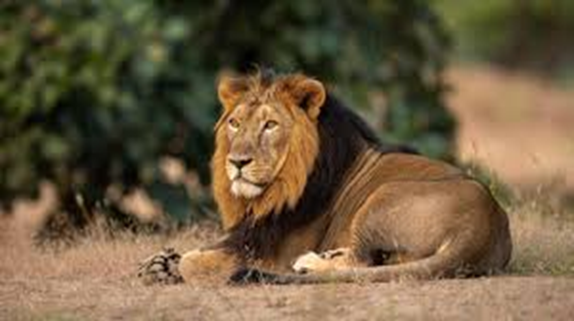
Asiatic Lion (Panthera leo persica):
- Asiatic Lion is a subspecies of lion scientifically known as Panthera leo persica.
- It is one of the five big cats found in India. Hence statement 1 is correct.
- Historically, Asiatic lions ranged from the Middle East to India.
- Currently found only in Gir landscape of Gujarat, India. Hence statement 3 is correct.
Habitat and Distribution
- Main habitat: Gir National Park and Wildlife Sanctuary and surrounding landscape.
- The distribution includes Gir Protected Area, Girnar, Mitiyala, Pania and adjoining regions.
- Prefers dry deciduous forests, scrub forests and savannah-type grasslands.
Conservation Status
- IUCN Red List: Listed under Endangered (Asiatic population).
- Wildlife Protection Act, 1972: Schedule I species. Hence statement 4 is correct.
- Included under Appendix I of CITES.
Physical Characteristics
- Smaller mane compared to African lions.
- Prominent belly fold (distinctive feature).
- Social animals living in prides.
Threats: Habitat fragmentation, Disease outbreaks, Human-wildlife conflict, Risk due to single population concentration.
| PYQ REFERENCE: (2019) Q. Consider the following statements: 1. Asiatic lion is naturally found in India only. 2. Double-humped camel is naturally found in India only. 3. One-horned rhinoceros is naturally found in India only. Which of the statements given above is/are correct? (a) 1 only (b) 2 only (c) 1 and 3 only (d) 1, 2 and 3 |
4. With reference to nuclear power projects in India, consider the following pairs:
Nuclear Project – State
1. Rawatbhata – Rajasthan
2. Kudankulam – Tamil Nadu
3. Gorakhpur – Haryana
4. Kaiga – Andhra Pradesh
How many of the pairs given above are correctly matched?
(a) Only one
(b) Only two
(c) Only three
(d) All four
Answer: (c) Only three
Explanation:
In NEWS: Government informed Parliament about the expansion of nuclear power capacity.
Target to increase nuclear capacity to 22,480 MW by 2031–32.
Expansion of Nuclear Power Capacity:
Current Nuclear Power Status
- Present installed nuclear power capacity: 8,780 MW.
- Total operating reactors: 24 nuclear reactors (excluding RAPS-1).
- Nuclear energy forms part of India’s clean energy transition and energy security strategy.
Reactors Under Implementation
- Total: 17 nuclear reactors.
- Total capacity: 13,100 MW.
- Expected completion progressively by 2031–32.
Projects under Construction/Commissioning
- Rawatbhata (RAPP-8), Rajasthan.
- Kudankulam (Units 3 & 4; Units 5 & 6), Tamil Nadu.
- Gorakhpur Haryana Anu Vidyut Pariyojana (GHAVP-1 & 2).
Projects under Pre-project Activities
- Kaiga (Units 5 & 6), Karnataka.
- Gorakhpur (Units 3 & 4), Haryana.
- Chutka (Units 1 & 2), Madhya Pradesh.
- Mahi Banswara (Units 1–4), Rajasthan.
Fast Breeder Reactor Programme
- Prototype Fast Breeder Reactor (PFBR):
- Capacity: 500 MWe.
- Location: Kalpakkam, Tamil Nadu.
- Implemented by BHAVINI (Bharatiya Nabhikiya Vidyut Nigam Ltd.).
- Additional twin Fast Breeder Reactor projects planned at Kalpakkam.
- Part of India’s three-stage nuclear power programme.
| PYQ REFERENCE: (2022) Q. Consider the following pairs: Reservoirs States 1. Ghataprabha — Telangana 2. Gandhi Sagar — Madhya Pradesh 3. Indira Sagar — Andhra Pradesh 4. Maithon — Chhattisgarh How many pairs given above are not correctly matched? (a) Only one pair (b) Only two pairs (c) Only three pairs (d) All four pairs |
Source: https://sansad.in/getFile/annex/270/AU641_TJDVzl.pdf?source=pqars
5. With reference to the growing strategic and defence cooperation between India and Greece, consider the following statements regarding the strategic significance of Greece for India:
1. Greece is located at the crossroads of Europe, Asia and Africa, near critical maritime chokepoints in the Eastern Mediterranean.
2. Greece’s membership in both the European Union and NATO enhances India’s engagement with Euro-Atlantic security structures.
3. Greece provides India with strategic access to the Black Sea through direct territorial connectivity.
4. Greece possesses one of the world’s largest merchant shipping fleets, enhancing its maritime influence.
Which of the statements given above are correct?
(a) 1 and 2 only
(b) 1, 2 and 4 only
(c) 3 and 4 only
(d) 1, 2, 3 and 4
Answer: (b) 1, 2 and 4 only
Explanation:
In NEWS: India & Greece decide to expand their respective indigenous defence industries through partnership under Agenda 2030
India – Greece Defence Cooperation:
- India and Greece signed a Joint Declaration of Intent to strengthen defence industrial cooperation as part of a long-term strategic partnership.
- The partnership aims to expand indigenous defence manufacturing by aligning India’s Aatmanirbhar Bharat initiative with Greece’s Agenda 2030 defence reforms.
- A five-year roadmap is proposed to enhance collaboration in defence technology, production, and industrial capacity building.
- Both countries exchanged a Bilateral Military Cooperation Plan for 2026, outlining future military engagements and exercises.
- India and Greece emphasised cooperation in maritime security, reflecting their shared heritage as ancient seafaring nations.
- Greece announced the deployment of an International Liaison Officer at the Information Fusion Centre–Indian Ocean Region (IFC-IOR) located in Gurugram.
- The IFC-IOR serves as a regional maritime information-sharing hub to improve maritime domain awareness in the Indian Ocean Region.
- The defence partnership is aimed at strengthening regional peace, security, and strategic cooperation between the two countries.
Strategic Significance of Greece:
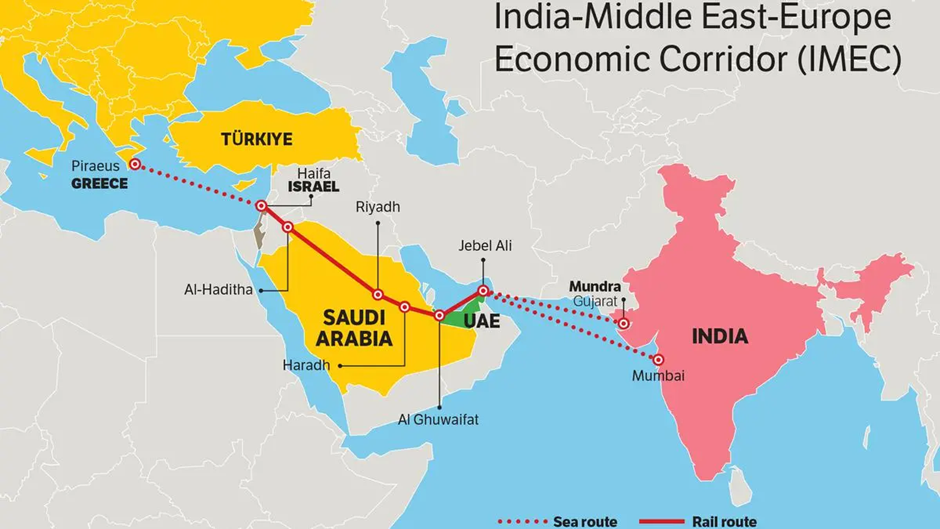
- Greece is strategically located at the crossroads of Europe, Asia, and Africa, making it a key gateway to the European Union. Hence statement 1 is correct.
- Its position in the Eastern Mediterranean gives it control over important maritime trade routes and sea lanes.
- Greece possesses one of the world’s largest merchant shipping fleets, enhancing its maritime influence. Hence statement 4 is correct.
- The country is emerging as an energy transit hub due to Eastern Mediterranean gas resources and LNG infrastructure.
- Greece plays a key role in regional security dynamics, especially in relation to Eastern Mediterranean geopolitics and Turkey.
- Membership in both NATO and the European Union enhances Greece’s strategic value in defence and diplomacy. Hence statement 2 is correct.
- Greece supports maritime security cooperation and connectivity initiatives linking the Indo-Pacific and Europe.
- Strategic ports such as Piraeus strengthen global supply chains and Europe-Asia trade connectivity.
- Greece holds geopolitical importance in balancing external influences, including China’s investments in European infrastructure.
Note:
- India does not share any land border or territorial corridor with Greece. Greece cannot provide “direct territorial access” to any region for India.
- The Black Sea is connected to the Mediterranean through the Turkish Straits (Bosporus & Dardanelles). Control and access to the Black Sea are governed primarily by Turkey, not Greece.
Hence statement 3 is incorrect.
| PYQ REFERENCE: (2019) Q. Recently, India signed a deal known as ‘Action Plan for Prioritization and Implementation of Cooperation Areas in the Nuclear Field’ with which of the following countries? (a) Japan (b) Russia (c) The United Kingdom (d) The United States of America |
6. With reference to the Regional Rapid Transit System (RRTS), consider the following statements:
I. Regional Rapid Transit System (RRTS) is a semi-high-speed, rail-based regional commuter transport system designed for high frequency, high capacity and reduced travel time.
II. Unlike metro systems, RRTS is meant primarily for intercity regional travel over longer distances.
III. The Chennai–Bangalore corridor is India’s first Regional Rapid Transit System (RRTS) corridor.
How many of the above statements are correct?
(a) Only one
(b) Only two
(c) All three
(d) None
Answer: (b) Only two
Explanation:
In NEWS: What is the new RRTS project in Kerala?
- Kerala govt has approved a Regional Rapid Transit System to facilitate high-speed rail travel from Thiruvananthapuram to Kasaragod, addressing perceived Central govt neglect of previous proposals.
- Covering 583 km at an estimated cost of ₹1.92 lakh crore, the project aims to improve State connectivity and integrate with existing metro systems, with a phased completion target of 2036
Regional Rapid Transit System (RRTS):
- Regional Rapid Transit System (RRTS) is a semi-high-speed, rail-based regional commuter transport system. It aims to connect cities and suburban areas within a metropolitan region with high-speed transit.
- The system is designed for high frequency, high capacity and reduced travel time between regional nodes. Hence statement I is correct.
- The maximum operational speed of RRTS trains is around 160 km/h.
- RRTS corridors have dedicated tracks separated from conventional railway and metro systems.
- The project in the National Capital Region (NCR) is implemented by the National Capital Region Transport Corporation (NCRTC).
- NCRTC is a joint venture of the Government of India and participating State Governments such as Delhi, Uttar Pradesh, Haryana and Rajasthan.
- The Delhi – Meerut corridor is India’s first RRTS corridor, with Namo Bharat trains operating on it. Hence statement III is incorrect.
- Other planned corridors include Delhi–Alwar and Delhi–Panipat.
- RRTS aims to reduce congestion, improve regional connectivity and lower vehicular emissions.
- It promotes transit-oriented development and balanced regional growth.
- Unlike metro systems, RRTS is meant primarily for intercity regional travel over longer distances. Hence statement II is correct.
| PYQ REFERENCE: (2018) Q. With reference to the Indian Regional Navigation Satellite System (IRNSS), consider the following statements: 1. IRNSS has three satellites in geostationary and four satellites in geosynchronous orbits. 2. IRNSS covers the entire India and about 5500 sq. km beyond its borders. 3. India will have its own satellite navigation system with full global coverage by the middle of 2019. Which of the statements given above is/are correct? (a) 1 only (b) 1 and 2 only (c) 2 and 3 only (d) None |
7. Which of the following factors contribute to increasing seaweed blooms?
1. Rising sea surface temperatures.
2. Nutrient enrichment from agricultural runoff.
3. Increased nitrogen and phosphorus inputs from rivers.
Select the correct answer using the code given below:
(a) 1 only
(b) 1 and 2 only
(c) 2 and 3 only
(d) 1, 2 and 3
Answer: (d) 1, 2 and 3
Explanation:
In NEWS: Drastic seaweed growth threatens marine life and fishing — but also offers opportunities
Seaweed Blooms (Sargassum):
- Seaweed blooms refer to excessive growth and accumulation of marine macroalgae.
- Large seaweed blooms are increasing globally in size, frequency and geographic spread.
- Observed across tropical and temperate oceans.
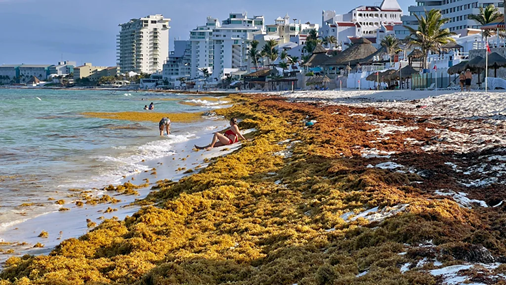
- Free-floating seaweeds can travel long distances and accumulate along coastlines.
Sargassum Seaweed
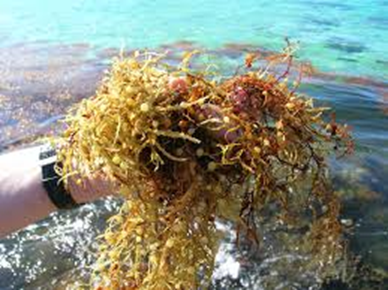
- Sargassum is a genus of brown macroalgae.
- Some species are attached to the seabed, while others are free-floating.
- Sargassum natans and Sargassum fluitans are fully free-floating species.
- Floating ability due to air-filled sacs called pneumatocysts.
- Major blooms observed in the tropical Atlantic since around 2011.
- Large accumulations reported in the Caribbean, Gulf of Mexico and West Africa.
Causes of Increasing Seaweed Blooms
- Rising sea surface temperatures.
- Nutrient enrichment from agricultural runoff.
- Increased nitrogen and phosphorus inputs from rivers.
- Changes in ocean circulation patterns.
- Atmospheric anomalies like North Atlantic Oscillation.
- Human-induced pollution contributes to eutrophication.
Hence all the statements are correct.
Ecological Impacts
- Large mats block sunlight affecting seagrasses and coral reefs.
- Decomposition reduces oxygen levels causing hypoxia.
- Alters marine ecosystem balance.
- Impacts turtle nesting beaches and hatchling survival.
- Can stress fish and invertebrates.
Economic and Social Impacts
- Disruption to fisheries.
- Negative effects on coastal tourism.
- Interference with coastal livelihoods and recreation.
- Increased cleanup costs for coastal communities.
Positive Roles of Seaweed
- Provides habitat for marine organisms.
- Absorbs carbon dioxide through photosynthesis.
- Potential uses:
- Fertiliser
- Pharmaceuticals
- Building materials
- Biofuel production
| PYQ REFERENCE: (2011) Q. There is a concern over the increase in harmful algal blooms in the seawaters of India. What could be the causative factors for this phenomenon? 1. Discharge of nutrients from the estuaries. 2. Run-off from the land during the monsoon. 3. Upwelling in the seas. Select the correct answer from the codes given below: (a) 1 and 3 (b) 1 and 2 only (c) 2 and 3 only (d) 1, 2 and 3 |
8. ‘Bastar Pandum’, recently seen in news, is associated with:
(a) Classical dance festival of Odisha
(b) Tribal cultural festival of Chhattisgarh
(c) Buddhist monastic celebration in Ladakh
(d) Harvest festival of Assam
Answer: (b) Tribal cultural festival of Chhattisgarh
Explanation:
In NEWS: Prime Minister congratulates people of Chhattisgarh for special celebration of ‘Bastar Pandum’ festival
‘Bastar Pandum’ Festival:
- Bastar Pandum is a cultural festival celebrated in the Bastar region of Chhattisgarh. Hence option (b) is correct.
- The festival showcases the rich tribal culture, traditions, art forms and heritage of the Bastar region.
- It highlights indigenous tribal customs, folk dances, music, handicrafts and local rituals.
- The festival aims to promote tribal identity, cultural preservation and community participation.
- Bastar region is known for its diverse tribal communities such as Gond, Maria, Muria and Halba tribes.
- Bastar Pandum promotes tourism and helps strengthen local livelihoods and economic development.
- The festival also symbolizes peace, development and cultural pride in a region previously associated with Left Wing Extremism.
- It is supported by government initiatives to promote tribal heritage and regional cultural festivals.
| PYQ REFERENCE: (2018) Q. Consider the following pairs: Tradition — State 1. Chapchar Kut Festival — Mizoram 2. Khongjom Parba ballad — Manipur 3. Thang-Ta Dance — Sikkim Which of the pairs given above is/are correct? (a) 1 only (b) 1 and 2 (c) 1 and 2 (d) 2 and 3 |
Source: https://www.pib.gov.in/PressReleasePage.aspx?PRID=2225672®=3&lang=1
9. Which of the following pairs is correctly matched?
Joint Exercise – Partner Country
1. KHANJAR – Kyrgyzstan
2. HARIMAU SHAKTI – Malaysia
3. Yudh Abhyas – USA
Select the correct answer using the code given below:
(a) 1 and 2 only
(b) 2 and 3 only
(c) 1 and 3 only
(d) 1, 2 and 3
Answer: (d) 1, 2 and 3
Explanation:
In NEWS: INDIA–MALAYSIA TO PARTICIPATE IN JOINT MILITARY TRAINING EXERCISE HARIMAU SHAKTI IN THE DESERTS OF RAJASTHAN
Exercise HARIMAU SHAKTI:
- Exercise HARIMAU SHAKTI is a bilateral joint military exercise between India and Malaysia. Hence pair 1 is correct.
- It is conducted between the Indian Army and Royal Malaysian Army.
- The exercise is held annually and alternately in India and Malaysia.
- The 5th edition (2025) was conducted at Mahajan Field Firing Range, Rajasthan.
- The Indian contingent was mainly represented by troops from the DOGRA Regiment.
- The Malaysian contingent was represented by the 25th Battalion, Royal Malaysian Army.
- The exercise focuses on Sub-Conventional Operations under Chapter VII of the UN Mandate.
- Major objectives include:
- Counter-terrorism operations
- Joint patrolling and tactical drills
- Heliborne operations
- Cordon and search missions
- Casualty evacuation.
- Training also includes:
- Army Martial Arts Routine (AMAR)
- Combat reflex shooting
- Yoga sessions.
- The aim is to enhance interoperability, operational coordination, and defence cooperation between the two countries.
Note:
HARIMAU SHAKTI – Malaysia
Yudh Abhyas – USA
Hence pair 2 and 3 are correct.
Source: https://www.pib.gov.in/PressReleasePage.aspx?PRID=2199345®=3&lang=1
10. Which one of the following is a work attributed to playwright Bhasha?
(a) Kavyalankara
(b) Natyashastra
(c) Madhyama-vyayoga
(d) Mahabhashya
Answer: (c) Madhyama-vyayoga
Explanation:
- Bhasa (ancient Sanskrit playwright) is known for several classical plays, including:
- Svapnavasavadatta
- Pratijnayaugandharayana
- Urubhanga
- Madhyama-vyayoga
Other Options:
- (a) Kavyalankara – Written by Bhamaha (poetics work).
- (b) Natyashastra – Written by Bharata Muni (treatise on dramaturgy).
- (d) Mahabhashya – Written by Patanjali (commentary on Panini’s grammar).