


1. With reference to the removal procedure of the speaker of Lok Sabha, consider the following statements.
1. The Speaker of Lok Sabha can be removed by a resolution passed by the Lok Sabha by a majority of the total membership of the House excluding the vacant seats.
2. A motion of removal of the Speaker of Lok Sabha cannot be moved without giving 14 days advance notice to the Speaker.
3. The motion of removal can be considered and discussed only when it has the support of at least 50 percent of members of the house.
4. When a resolution for the removal of the Speaker of Lok Sabha is under consideration of the House, he/she can preside at the sitting of the House.
Which of the statements given above are correct?
(a) 1 and 2 only
(b) 1, 2 and 3
(c) 3 and 4 only
(d) 2 and 4 only
Answer: (a) 1 and 2 only
Explanation:
In NEWS: Speaker to stay away from Lok Sabha proceedings till Opposition’s petition against him is disposed of
Removal of Lok Sabha Speaker:
Constitutional Provision
- Removal of the Lok Sabha Speaker is governed by Article 94(c) of the Constitution of India.
- The Speaker can be removed by a resolution passed by a majority of all the then members of the House (effective majority).
Effective majority = Majority of total membership excluding vacancies.
Ways Speaker Vacates Office (Article 94)
- Ceases to be a member of Lok Sabha.
- Resigns voluntarily.
- Removed by resolution of Lok Sabha.
Removal of Speaker of Lok Sabha:
- The Speaker of Lok Sabha can be removed by a resolution passed by the Lok Sabha by an Effective Majority (i.e. a majority of the total membership of the House excluding the vacant seats). Hence statement 1 is correct.
- A motion of removal of the Speaker of Lok Sabha can be moved only after giving 14 days’ advance notice to the Speaker. Hence statement 2 is correct.
- This motion of removal can be considered and discussed only when it has the support of at least 50 members. Hence statement 3 is incorrect.
- When a resolution for the removal of the Speaker of Lok Sabha is under consideration of the House, he/she cannot preside at the sitting of the House, though he/she may be present in the House. Hence statement 4 is incorrect.
- However, he/she can speak and take part in the proceedings of the House at such a time and vote in the first instance, though not in the case of an equality of votes.
Historical Context
- Motions against Speakers occurred in:
- 1954 (G.V. Mavalankar)
- 1966 (Hukam Singh)
- 1987 (Balram Jakhar)
None resulted in removal.
| PYQ REFERENCE: (2012) Q. Regarding the office of the Lok Sabha Speaker, consider the following statements: 1. He/She holds the office during the pleasure of the President. 2. He/She need not be a member of the House at the time of his/her election but has to become a member of the House within six months from the date of his/ her election. 3. If he/she intends to resign, the letter of his/her resignation has to be addressed to the Deputy Speaker. Which of the statements given above is/are correct? (a) 1 and 2 only (b) 3 only (c) 1, 2 and 3 (d) None |
2. Which of the following is/are functions of the National Medicinal Plants Board?
1. Promotion of in-situ and ex-situ conservation of medicinal plants
2. Encouraging the protection of patent rights and IPR
3. Regulation of pharmaceutical drug pricing
Select the correct answer using the code given below:
(a) 1 only
(b) 1 and 2 only
(c) 2 and 3 only
(d) 1, 2 and 3
Answer: (b) 1 and 2 only
Explanation:
In NEWS: 25 years of the National Medicinal Plants Board
National Medicinal Plants Board
- In order to promote the medicinal plants sector, the Government of India has set up the National Medicinal Plants Board (NMPB) on 24th November 2000.
- Currently the board is working as a section of the Ministry of AYUSH (Ayurveda, Yoga & Naturopathy, Unani, Siddha & Homoeopathy), Government of India.
Functions of the Board:
- Advise concerned Ministries/ Departments/ Organizations/ State/ UT Governments on policy matters relating to schemes and programs for development of medicinal plants.
- Provide guidance in the formulation of proposals, schemes and programs etc. to be taken-up by agencies having access to land for cultivation and infrastructure for collection, storage and transportation of medicinal plants.
- Assessment of demand / supply position relating to medicinal plants both within the country and abroad.
- Identification, Inventorisation and Quantification of medicinal plants.
- Promotion of in-situ / ex-situ conservation and cultivation of medicinal plants. Hence 1 is correct.
- Promotion of co-operative efforts among collectors and growers and assisting them to store, transport and market their produce effectively.
- Setting up of a data-base system for inventorisation, dissemination of information and facilitating the prevention of Patents being obtained for medicinal use of plants which is in the public domain.
- Organize training programs for capacity building of stakeholders on medicinal plants (including cultivation, conservation, GAPs, GFCPs, GMPs, Storage, PHM and market information).
- Matters relating to import / export of raw material, as well as value added products either as medicine, food supplements or as herbal cosmetics including adoption of better techniques for marketing of product to increase their reputation for quality and reliability in the country and abroad.
- Undertaking and awarding Scientific, Technological research and cost-effectiveness studies.
- Development of protocols for cultivation and quality control.
- Encouraging the protection of patent rights and IPR. Hence 2 is correct.
Key Initiatives & Schemes
- Central Sector Scheme: Supports “Conservation, Development, and Sustainable Management of Medicinal Plants” through various project-based grants.
- e-Charak Portal: An online platform and mobile app for trading and information exchange between farmers, traders, and industries.
- Species Campaigns: Launches national awareness programs for high-value herbs like Ashwagandha, Amla, and Shatavari.
- Herbal Gardens: Promotes the establishment of school, institutional, and public herbal gardens to sensitize the public about traditional knowledge.
- Regional-cum-Facilitation Centres (RCFCs): Six regional hubs provide technical support and coordinate with 37 State Medicinal Plants Boards (SMPBs).
| PYQ REFERENCE: (2022) Q. With reference to the “Tea Board” in India, consider the following statements: 1. The Ten Board is a statutory body. 2. It is a regulatory body attached to the Ministry of Agriculture and Farmers Welfare. 3. The Tea Board’s Head Office is situated in Bengaluru. 4. The Board has overseas offices at Dubai and Moscow. Which of the statements given above are correct? (a) 1 and 3 (b) 2 and 4 (c) 3 and 4 (d) 1 and 4 |
Source: https://www.pib.gov.in/PressReleasePage.aspx?PRID=2226284®=3&lang=1
https://nmpb.nic.in/content/introduction
3. Consider the following statements regarding Ayushman Sahakar Scheme:
1. It is implemented by the National Health Authority.
2. It provides financial assistance in the form of loans to cooperative societies in the healthcare sector.
3. Only multi-state cooperative societies are eligible under the scheme.
How many of the statements given above are correct?
(a) Only one
(b) Only two
(c) All the three
(d) None
Answer: (a) Only one
Explanation:
In NEWS: Ayushman Sahakar Scheme
Ayushman Sahakar Scheme
- Ayushman Sahakar is a scheme launched by the National Cooperative Development Corporation (NCDC). Hence statement 1 is incorrect.
- NCDC is a statutory body (1963) under the Ministry of Cooperation.
- The scheme provides financial assistance to cooperative societies working in the healthcare sector. Hence statement 2 is correct.
- It aligns with the National Health Policy (2017) to strengthen healthcare infrastructure and services.
Objectives
- Promote affordable and holistic healthcare through cooperative institutions.
- Strengthen AYUSH healthcare facilities.
- Support cooperatives in achieving National Health Policy goals.
- Enable participation in the National Digital Health Mission.
- Provide comprehensive healthcare including:
- Education
- Insurance
- Medical services
- Community participation and accountability.
Eligible Entities
- Any cooperative society registered under:
- State Cooperative Societies Act, or
- Multi-State Cooperative Societies Act. Hence statement 3 is incorrect.
- Bye-laws must allow activities related to healthcare/hospital/health education.
Activities Covered
1. Infrastructure Development
- Hospitals, medical colleges, AYUSH centres
- Yoga wellness centres
- Diagnostic labs, blood banks
- Mental healthcare, elderly care, palliative care
- Emergency services/trauma centres
- Physiotherapy and rehabilitation centres
- Maternal and child healthcare services
- Telemedicine and digital health infrastructure.
2. Healthcare Services
- Mobile clinics
- Laboratory and diagnostic services
- AYUSH pharmaceutical manufacturing
- Health insurance (IRDA accredited).
3. Financial Support
- Infrastructure creation and expansion
- Working capital
- Margin money for operations.
Financial Assistance Features
- Assistance provided as:
- Term loan.
- Investment loan.
- Loan tenure:
- Up to 8 years
- Includes 1–2 years moratorium.
- Interest incentive:
- 1% lower interest rate if women members are the majority (with timely repayment).
Funding Pattern
- Support through:
- State Government route, or
- Direct funding to cooperatives.
- Typical pattern:
- Loan component + Society’s share contribution.
- Can be combined with subsidies/grants from government schemes.
| PYQ REFERENCE: (2022) Q. With reference to Ayushman Bharat Digital Mission, consider the following statements: 1. Private and public hospitals must adopt it. 2. As it aims to achieve universal health coverage, every citizen of India should be part of it ultimately. 3. It has seamless portability across the country. Which of the statements given above is/are correct? (a) 1 and 2 only (b) 3 only (c) 1 and 3 only (d) 1, 2 and 3 |
Source: https://www.pib.gov.in/PressReleasePage.aspx?PRID=2226402®=3&lang=1
4. With reference to the Ken–Betwa Link Project, consider the following statements:
1. It is the first river interlinking project under India’s National Perspective Plan for interlinking rivers.
2. The project covers the states such as Maharashtra, Madhya Pradesh and Uttar Pradesh.
3. Both Ken and Betwa rivers are tributaries of the Chambal River.
How many of the statements given above are correct?
(a) Only one
(b) Only two
(c) All three
(d) None
Answer: (a) Only one
Explanation:
In NEWS: Ken-Betwa linking project protest turns violent; 3 cases filed
Ken–Betwa Link Project:
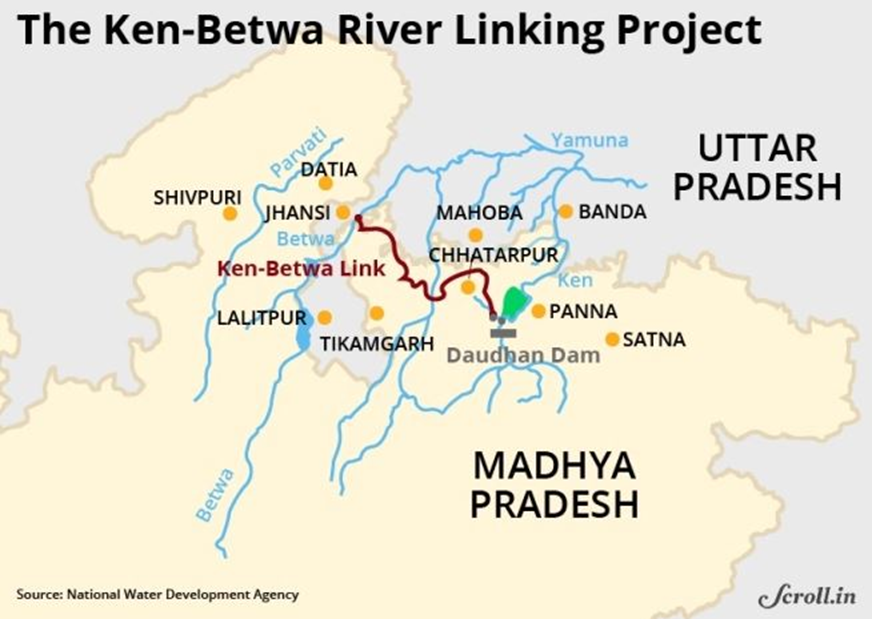
- The Ken–Betwa Link Project is the first river interlinking project under India’s National Perspective Plan for interlinking rivers. Hence statement 1 is correct.
- It aims to transfer water from the Ken River (considered surplus basin) to the Betwa River (water-deficit basin).
- The project is located in Madhya Pradesh and Uttar Pradesh. Hence statement 2 is incorrect.
- Both Ken and Betwa rivers are tributaries of the Yamuna River. Hence statement 3 is incorrect.
- Objective: Provide irrigation, drinking water supply, and hydroelectric power generation.
- Implemented by the National Water Development Agency (NWDA) under the Ministry of Jal Shakti.
- Includes construction of Daudhan Dam and a canal system.
- Intended to address water scarcity in the Bundelkhand region.
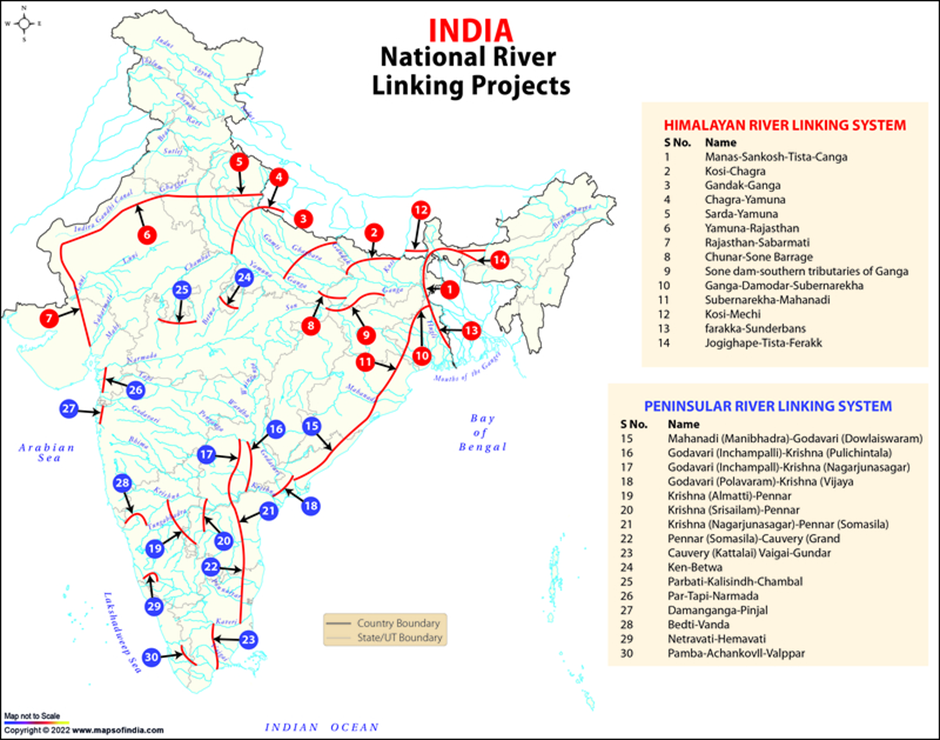
- Part of the broader Interlinking of Rivers (ILR) Programme.
- Environmental concerns include impact on the Panna Tiger Reserve and biodiversity.
Other river linking projects:
5. The Bharatiya Antariksh Station is primarily intended for which of the following purposes?
I. Microgravity research in materials science and biotechnology
II. Space medicine experiments
III. Testing technologies for deep-space missions
Select the correct answer using the code given below:
(a) I and II only
(b) II and III only
(c) I and III only
(d) I, II and III
Answer: (d) I, II and III
Explanation:
In NEWS: PARLIAMENT QUESTION
Bharatiya Antariksh Station
- Bharatiya Antariksh Station (BAS) is a proposed modular Indian space station being developed by ISRO to enable long-duration human spaceflight missions.
- The station is planned to weigh around 52 tonnes and orbit at an altitude of approximately 400–450 km above Earth in Low Earth Orbit.
- The first module is expected to be launched by 2028 using the LVM3 launch vehicle, while full completion of the station is targeted around 2035.
- The space station is designed to accommodate a nominal crew of 3–4 astronauts, with a maximum short-duration capacity of six astronauts.
- BAS will consist of five main modules including a base module, core docking module, science research module, laboratory module, and a common berthing module.
- The station will include indigenous technologies such as Environmental Control and Life Support Systems (ECLSS), docking mechanisms, robotic arms, and spacewalk support systems.
- BAS is expected to enable advanced experiments in microgravity, including research in materials science, biotechnology, and space medicine. Hence I and II are correct.
- The station will also serve as a testing platform for technologies needed for future deep-space missions, including possible lunar exploration initiatives. Hence III is correct.
- Power supply technologies under development include fuel cell power systems and advanced lithium-ion batteries tested through orbital experiment missions.
- India is developing indigenous docking systems and robotic technologies to support on-orbit assembly and operations of the station.
| PYQ REFERENCE: (2025) Q. Consider the following space missions: I. Axiom-4 II. SpaDeX III. Gaganyaan How many of the space missions given above encourage and support microgravity research? (a) Only one (b) Only two (c) All three (d) None |
Source: https://www.pib.gov.in/PressReleasePage.aspx?PRID=2226233®=3&lang=1
6. ANEEL fuel, recently in news, is associated with which among the following?
(a) Solar photovoltaic technology
(b) Thorium-based nuclear fuel
(c) Hydrogen fuel cell technology
(d) Biofuel blending programme
Answer: (b) Thorium-based nuclear fuel
Explanation:
In NEWS: PARLIAMENT QUESTION: DEPLOYMENT OF ANEEL
ANEEL:
- ANEEL – Advanced Nuclear Energy for Enriched Life, is a thorium-based fuel developed by Chicago-based Clean Core Thorium Energy (CCTE) for use in existing Pressurized Heavy-Water Reactors (PHWRs). Hence option (b) is correct.
- It combines thorium with High-Assay Low-Enriched Uranium (HALEU) to achieve higher burn-up, significantly reducing nuclear waste by over 85% and lowering power costs.
- NTPC Limited is collaborating with CCTE to explore its development and deployment in India to boost energy security and promote cleaner energy.
- It is a mixture of thorium and HALEU (uranium enriched between 5% and 20%).
- It is designed for existing 220 MWe and 700 MWe PHWRs without requiring major reactor modifications.
- It achieves a burn-up of 60 GWd/MT, significantly higher than conventional natural uranium fuel (7 GWd/MT), reducing the required number of fuel bundles.
- Its benefits are lower operational costs (20–30% reduction), significantly less waste, and enhanced proliferation resistance.
- It aligns with India’s three-stage nuclear program by facilitating the early use of India’s vast thorium reserves.
| PYQ REFERENCE: (2012) Q. To meet its rapidly growing energy demand, some opine that India should pursue research and development on thorium as the future fuel of nuclear energy. In this context, what advantage does thorium hold over uranium? 1. Thorium is far more abundant in nature than uranium. 2. On the basis of unit mass of mined mineral, thorium can generate more energy compared to natural uranium 3. Thorium produces less harmful waste compared to uranium. Which of the statement(s) given above is/are correct? (a) 1 only (b) 2 and 3 only (c) 1 and 3 only (d) 1, 2 and 3 |
7. Which among the following best describes the term “wet dress rehearsal” conducted prior to a rocket launch?
(a) A simulation of launch procedures without loading propellants
(b) A full launch simulation including fueling of the rocket with propellants
(c) Testing of only ground communication systems after launch
(d) A trial conducted only after mission failure
Answer: (b) A full launch simulation including fueling of the rocket with propellants
Explanation:
In NEWS: What is a wet dress rehearsal?
Wet Dress Rehearsal:
- A wet dress rehearsal is a full simulation of launch-day procedures conducted before an actual rocket launch.
- It tests the integrated functioning of personnel, hardware, software, and timelines.
- Cryogenic propellants are loaded into the rocket during a wet dress rehearsal. Hence option (b) is correct.
- The rehearsal includes countdown operations and fueling procedures.
- It helps identify technical issues such as leaks, system malfunctions, or operational gaps.
- Ground systems and vehicle systems are tested together as a unified launch sequence.
- Communication systems and coordination between launch control teams are validated.
- It reduces risks by detecting problems prior to the actual launch.
Dry Dress Rehearsal:
- A dry dress rehearsal simulates launch procedures without loading propellants.
- Vehicle and ground systems are powered and tested using simulated inputs.
- Used to check operational flow, decision-making, and communication protocols.
- Helps identify logical or procedural issues without fuel-related risks.
| PYQ REFERENCE: (2022) Q. Which one of the following statements best reflects the idea behind the “Fractional Orbital Bombardment System” often talked about in media? (a) A hypersonic missile is launched into space to counter the asteroid approaching the Earth and explode it in space. (b) A spacecraft lands on another planet after making several orbital motions. (c) A missile is put into a stable orbit around the Earth and deorbits over a target on the Earth. (d) A spacecraft moves along a comet with the same speed and places a probe on its surface. |
8. With reference to Brahmi script, consider the following statements:
1. It emerged around the 3rd century BCE and was widely used during the Mauryan period.
2. Brahmi script is written from right to left.
3. The script was deciphered by James Prinsep in the 19th century.
Which of the statements given above is/are correct?
(a) 1 only
(b) 2 and 3 only
(c) 1 and 3 only
(d) 1, 2 and 3
Answer: (c) 1 and 3 only
Explanation:
In NEWS: Tamil Brahmi inscriptions in Egypt point to ancient trade links
- Researchers identified ~30 ancient Indian inscriptions inside rock-cut tombs in Egypt’s Valley of the Kings (Theban Necropolis).
- About 20 inscriptions are in Tamil-Brahmi, while others are in Prakrit and Sanskrit.
- These inscriptions are dated to roughly 1st–3rd century CE.
- The name “Cikai Korran” appears repeatedly (around 8 times) across several tombs.
- The presence of this Tamil name in Egypt indicates that people from ancient Tamilakam travelled far beyond Indian ports.
- It provides archaeological evidence supporting historical accounts of maritime trade between South India and the Roman world.
Brahmi script:
- Brahmi is one of the earliest known writing systems of ancient India.
- It emerged around the 3rd century BCE and was widely used during the Mauryan period. Hence statement 1 is correct.
- The script is best known from the inscriptions of Emperor Ashoka, especially rock and pillar edicts.
- Brahmi is written from left to right. Hence statement 2 is incorrect.
- It is an alphasyllabary (abugida), where each consonant carries an inherent vowel sound.
- Additional vowel signs are added to modify pronunciation.
- The script was deciphered in 1837 by James Prinsep.Hence statement 3 is correct.
- Brahmi became the parent script of most modern Indian writing systems, including Devanagari, Tamil, Telugu, Kannada, Bengali, and others.
- Regional variations of Brahmi developed across different parts of India over time.
- Tamil-Brahmi is an early adaptation used to write the Tamil language during the Sangam period.
- Brahmi inscriptions provide important evidence for ancient administration, religion, trade, and cultural history in India.
| PYQ REFERENCE: (2019) Q. In which of the following relief sculpture inscriptions is ‘Ranyo Ashoka’ (King Ashoka) mentioned along with the stone portrait of Ashoka? (a) Kanganahalli (b) Sanchi (c) Shahbazagrhi (d) Sohgaura |
9. With reference to Exercise “Vayu Shakti”, consider the following statements:
1. It is a biennial firepower demonstration conducted by the Indian Air Force.
2. It is conducted at the Pokhran firing range in Rajasthan.
Which of the statements given above is/are correct?
(a) 1 only
(b) 2 only
(c) Both 1 and 2
(d) Neither 1 nor 2
Answer: (c) Both 1 and 2
Explanation:
In NEWS: Rafale, Su-30, Tejas to be part of ‘Vayu Shakti’ at Pokhran, will highlight Operation Sindoor success
Exercise Vayu Shakti:
- Exercise Vayu Shakti is a biennial firepower demonstration conducted by the Indian Air Force (IAF). Hence statement 1 is correct.
- It is held at the Pokhran firing range in Rajasthan. Hence statement 2 is correct.
- The exercise showcases the full spectrum of combat capabilities, including fighter, transport, and helicopter operations.
- Demonstrates IAF’s ability in precision targeting, airspace dominance, and multi-domain operations.
- Includes day, dusk, and night missions.
- Features integrated operations with other forces such as the Indian Army.
Aircraft Participating
- Fighter aircraft: Rafale, Su-30MKI, MiG-29, LCA Tejas, Jaguar, Mirage-2000
- Helicopters: Apache, Chinook, LCH Prachand, ALH Mk-IV, Mi-17 IV, Chetak
- Transport aircraft: C-130J, C-17, C-295 (C-295 debut highlighted)
- Remotely Piloted Aircraft (RPA)
Weapon Systems Showcased
- Akash Surface-to-Air Missile system (Indian SAM system)
- SpyDer air defence system
- Short Range Loitering Munitions (SRLM)
- Counter Unmanned Aerial Systems (CUAS)
10. With reference to ancient India, Gautama Buddha was generally known by which of the following epithets?
1. Nayaputta
2. Shakyamuni
3. Tathagata
Select the correct answer using the code given below:
(a) 1 only
(b) 2 and 3 only
(c) 1, 2 and 3
(d) None of the above are epithets of Gautama Buddha
Answer: (b) 2 and 3 only
Explanation:
1. Nayaputta: “Nayaputta” (Nataputta) is associated with Mahavira (Jain Tirthankara), not Gautama Buddha. Hence 1 is incorrect.
2. Shakyamuni: Means “Sage of the Shakya clan”; a common epithet of Gautama Buddha.
3. Tathagata: Frequently used by Buddha to refer to himself; means “Thus-gone” or “Thus-come one.”