


1. Which among the following statements are correct with respect to the Comptroller and Auditor General (CAG) of India?
1. The CAG is a constitutional authority established under Article 148 of the Constitution of India.
2. The CAG holds office for a term of five years or until the age of 60 years, whichever is earlier.
3. The CAG can only be removed through a process similar to the removal of a Supreme Court judge.
4. The CAG audits and accounts all receipts and expenditures of the Union and State governments.
Select the correct answer using the code given below:
(a) 1 and 3 only
(b) 1 and 4 only
(c) 2 and 3 only
(d) 2 and 4 only
Answer: (a) 1 and 3 only
Explanation:
In NEWS: CAG issues advisory to standardise govt. expenditure classification across India
Comptroller and Auditor General (CAG) of India:
Constitutional Basis
- The CAG is established under Article 148 of the Constitution of India.
- It is a constitutional authority responsible for auditing government accounts. Hence statement 1 is correct.
- Serves as an independent institution to ensure accountability in financial administration.
Appointment and Tenure
- Appointed by the President of India.
- Holds office for a term of six years or until the age of 65 years, whichever is earlier. Hence statement 2 is incorrect.
- Can only be removed through a process similar to the removal of a Supreme Court judge (impeachment by Parliament). Hence statement 3 is correct.
Role and Functions
- Audits all receipts and expenditures of the Union and State governments.
- Audits autonomous bodies and government companies under Article 151.
- Reports findings to Parliament or State Legislatures for action.
- Conducts performance audits to assess economy, efficiency, and effectiveness of government programs.
- Provides recommendations for improving financial management and governance.
Note: The CAG does not maintain accounts; it only audits them. The accounting is done by the Controller General of Accounts (CGA). Hence statement 4 is incorrect.
Powers and Autonomy
- Has authority to access all government accounts and records.
- Can conduct audits of government entities, PSUs, and authorities funded by public money.
- Works independently of the executive branch to maintain impartiality and transparency.
Reports
- Presents reports to Parliament or State Legislatures through the President or Governor.
- Reports are classified as: Audit Reports on Finance, Performance, Compliance, and Commercial entities.
| PYQ REFERENCE: (2012) Q. In India, other than ensuring that public funds are used efficiently and for their intended purpose, what is the importance of the office of the Comptroller and Auditor General (CAG)? 1. CAG exercises exchequer control on behalf of the Parliament when the President of India declares a national emergency/financial emergency. 2. CAG reports on the execution of projects or programs by the ministers are discussed by the Public Accounts Committee. 3. Information from CAG reports can be used by investigating agencies to press charges against those who have violated the law while managing public finances. 4. While dealing with the audit and accounting of government companies, CAG has certain judicial powers for prosecuting those who violate the law. Which of the statements given above is/are correct? (a) 1, 3 and 4 only (b) 2 only (c) 2 and 3 only (d) 1, 2, 3 and 4 |
2. The Integrated Child Development Services (ICDS) Scheme focuses on which of the following?
1. Health and nutrition of young children
2. Early childhood education
3. Support to pregnant and lactating mothers
4. Employment guarantee for care workers
Select the correct answer using the code given below:
(a) 1 and 2 only
(b) 1, 2 and 3 only
(c) 2, 3 and 4 only
(d) 1, 2, 3 and 4
Answer: (b) 1, 2 and 3 only
Explanation:
In NEWS: Recognise the critical role of the childcare worker
The Integrated Child Development Services (ICDS) Scheme:
- The Integrated Child Development Services (ICDS) Scheme was launched in 1975.
- Its main objective is the holistic development of children below six years, pregnant women, and lactating mothers.
- Core services include supplementary nutrition, immunization, health check-ups, referral services, and pre-school non-formal education.
- Anganwadi Centres (AWCs) are the implementing units, run by Anganwadi workers and helpers.
- Currently, there are over 1.4 million Anganwadi Centres in India.
- The Palna Scheme provides crèches for children below three years.
- Beneficiaries include children (0–6 years), pregnant and lactating women, and adolescent girls.
- ICDS is a centrally sponsored scheme with cost-sharing between Centre and States.
- The scheme addresses malnutrition, early childhood education, and maternal and child health.
- ICDS is one of the largest early childhood care programmes in the world.
Note: It does not provide an employment guarantee for care workers. Hence statements 1, 2 and 3 are correct.
| PYQ REFERENCE: (2023) Q. Consider the following statements in the context of interventions being undertaken under Anaemia Mukt Bharat Strategy : 1. It provides prophylactic calcium supplementation for pre-school children, adolescents and pregnant women. 2. It runs a campaign for delayed cord clamping at the time of childbirth. 3. It provides for periodic deworming. to children and adolescents. 4. It addresses non-nutritional causes of anaemia in endemic pockets with special focus on malaria, hemoglobinopathies and fluorosis. How many of the statements given above are correct? (a) Only one (b) Only two (c) Only three (d) All four |
3. With reference to Natural farming in India, consider the following statements:
1. National Mission on Natural Farming (NMNF), 2023 is a flagship initiative launched to promote chemical-free agriculture.
2. Natural farming is the farming system that avoids synthetic chemicals, but may use permitted organic inputs.
3. Bharatiya Prakritik Krishi Paddhati (BPKP) aims to promotes Zero Budget Natural Farming (ZBNF)
Which of the statements given above is/are correct?
(a) 1 and 2 only
(b) 2 and 3 only
(c) 1 and 3 only
(d) 1, 2 and 3
Answer: (c) 1 and 3 only
Explanation:
In NEWS: India will become hub of natural farming; science, tradition to lead way: PM
Natural Farming:
- Natural farming is positioned as a 21st-century agricultural imperative, aimed at restoring soil health degraded by excessive chemical fertilisers and pesticides.
- Prime Minister Modi emphasises natural farming as both science-backed and tradition-aligned, combining India’s indigenous knowledge with modern research.
- India aims to emerge as a global hub of natural farming, supported by national missions, scientific institutions and farmer-led initiatives.
- The National Mission on Natural Farming (NMNF) has already influenced lakhs of farmers, with Tamil Nadu bringing ~35,000 hectares under natural and organic farming.
Natural Farming vs Organic Farming
- Natural Farming: Farming method without external inputs; relies entirely on locally available, biological, and regenerative processes.
- Organic Farming: Farming system that avoids synthetic chemicals, but may use permitted organic inputs. Hence statement 2 is incorrect.
Natural Farming Initiatives in India
National Mission on Natural Farming (NMNF), 2023
- Flagship initiative launched to promote chemical-free agriculture. Hence statement 1 is correct.
- Focuses on training, capacity building, and cluster-based natural farming.
- Implemented through National Centre for Organic and Natural Farming (NCONF) and SAUs/KVKs.
- Targets: 1 crore farmers and 10 lakh hectares by 2026–27 (as per policy documents).
Bharatiya Prakritik Krishi Paddhati (BPKP)
- A sub-scheme under Paramparagat Krishi Vikas Yojana (PKVY).
- Promotes Zero Budget Natural Farming (ZBNF). Hence statement 3 is correct.
- Provides financial assistance for:
- On-farm inputs (Jeevamrit, Beejamrit, Ghanjeevamrit),
- Training and certification,
- Resource centres.
| PYQ REFERENCE: (2018) Q. With reference to organic farming in India, consider the following statements: 1.’The National Programme for Organic Production’ (NPOP) is operated under the guidelines and directions of the Union Ministry of Rural Development. 2.’The Agricultural and Processed Food Products Export Development Authority’ (APEDA) functions as the Secretariat for the implementation of NPOP. 3. Sikkim has become India’s first fully organic State. Which of the statements given above is/are correct? (a) 1 and 2 only (b) 2 and 3 only (c) 3 only (d) 1, 2 and 3 |
4. Consider the following statements regarding the issuance of currency and coins in India:
1. The Reserve Bank of India (RBI) is the sole authority to issue banknotes in all denominations.
2. The government produces coins at its four mints in Mumbai, Kolkata, Hyderabad, and Delhi.
3. The Government of India under the RBI Act, 1934 is authorized to issue coins, as it is responsible for designing and minting them.
How many of the above statements are correct?
(a) Only one
(b) Only two
(c) All three
(d) None
Answer: (d) None
Explanation:
In NEWS: Modi releases ₹100 coin and postal stamps in Puttaparthi
Authority for Issuing Currency
- Reserve Bank of India (RBI): Sole authority to issue banknotes in India, except the ₹1 note.
- Government of India: Issues the one rupee note and all coins.
Legal Framework
- RBI Act, 1934: Governs issuance of banknotes.
- Coinage Act, 2011: Governs minting and circulation of coins. Hence statement 3 is incorrect.
- Finance Ministry: Coordinates issuance of ₹1 note, coins, and commemorative coins.
Types of Currency
- Banknotes: All denominations except ₹1, issued by RBI. Hence statement 1 is incorrect.
- Coins: Issued by Government of India; denominations include ₹1, ₹2, ₹5, ₹10, and commemorative coins.
- Commemorative Coins: Legal tender, issued to mark special events, personalities, or milestones, usually in limited circulation.
Minting of Coins
- Mints: Located at Mumbai, Kolkata, Hyderabad, and Noida. Hence statement 2 is incorrect.
- Function: Manufacture coins and supply them to RBI for circulation.
Roles & Responsibilities
- RBI: Manages circulation, denomination, and design of banknotes (except ₹1).
- Finance Ministry / Government of India: Issues ₹1 notes and coins; approves commemorative coins.
| PYQ REFERENCE: (2023) Q. With reference to Central Bank digital currencies, consider the following statements: 1. It is possible to make payments in a digital currency without using the US dollar or SWIFT system. 2. A digital currency can be distributed with a condition programmed into it such as a time-frame for spending it. Which of the statements given above is/are correct? (a) 1 only (b) 2 only (c) Both 1 and 2 (d) Neither 1 nor 2 |
5. With reference to the Commission for Air Quality Management (CAQM), consider the following statements:
1. CAQM is a statutory body established under the Commission for Air Quality Management in NCR and Adjoining Areas Act, 2021.
2. It replaced the earlier Environment Pollution (Prevention & Control) Authority (EPCA)
3. The Commission is headed by a full-time Chairperson, who holds the post for a tenure of three years or until the age of 70.
4. The commission can issue binding directions to state authorities, industries, and agencies.
Which of the statements given above is/are correct?
(a) 1, 2 and 3 only
(b) 2 and 4 only
(c) 1, 3 and 4 only
(d) 1, 2, 3, and 4
Answer: (d) 1, 2, 3, and 4
Explanation:
In NEWS: SC allows CAQM to take ‘proactive’ measures to curb Delhi air pollution
Commission for Air Quality Management (CAQM):
- CAQM is a statutory body established under the Commission for Air Quality Management in NCR and Adjoining Areas Act, 2021. Hence statement 1 is correct.
- It replaced the earlier Environment Pollution (Prevention & Control) Authority (EPCA). Hence statement 2 is correct.
Structure
- The Commission is a high-level body headed by a full-time Chairperson, an official of Secretary or Chief Secretary rank, who holds the post for a tenure of three years or until the age of 70. Hence statement 3 is correct.
- It comprises a multi-member body including:
- Full-time members (technical experts and a central government official).
- Ex-officio members from the Central government and the concerned NCR state governments.
- Technical members from bodies like the CPCB, the Indian Space Research Organisation (ISRO), and NITI Aayog.
- Members from non-governmental organizations working in environment-related fields.
Functions:
- Plan and execute measures to control and prevent air pollution.
- Set emission limits, restrict polluting activities, and monitor compliance.
- Conduct research and investigations into air pollution sources and trends.
- Issue binding directions to state authorities, industries, and agencies. Hence statement 4 is correct.
- Impose environmental compensation or fines on violators.
| PYQ REFERENCE: (2017) Q. Consider the following statements: 1. Climate and Clean Air Coalition (CCAC) to Reduce Short Lived Climate Pollutants is a unique initiative of G2O group of countries. 2. The CCAC focuses on methane, black carbon and hydrofluorocarbons. Which of the statements given above is/are correct? (a) 1 only (b) 2 only (c) Both 1 and 2 (d) Neither 1 nor 2 |
6. Consider the following statements:
1. Integrated Disease Surveillance Programme (IDSP)
2. Antimicrobial Resistance (AMR) Containment
3. Indian SARS-CoV-2 Genomic Consortium (INSACOG)
4. Centre for One Health
5. Zoonosis Division
How many of the above are the key programmes of the National Centre for Disease Control (NCDC) in India?
(a) Only two
(b) Only three
(c) Only four
(d) All five
Answer: (d) All five
Explanation:
In NEWS: NCDC flags study on rising antibiotic resistance in India
National Centre for Disease Control (NCDC):
- The NCDC was originally established as the Central Malaria Bureau in 1909 in Delhi.
- It was renamed the National Institute of Communicable Diseases (NICD) in 1963 and later became National Centre for Disease Control (NCDC).
- Functions under the Ministry of Health and Family Welfare (MoHFW), Government of India.
Mandate / Functions
- Surveillance of communicable diseases across India.
- Prevention and control of outbreaks of infectious diseases.
- Provides training and capacity building in public health and epidemiology.
- Conducts research in microbiology, epidemiology, and public health.
- Supports policy formulation for disease control and health interventions.
Key Programmes and Divisions
- Integrated Disease Surveillance Programme (IDSP): A program aimed at strengthening IT-enabled, decentralized, laboratory-based disease surveillance systems to monitor trends and respond to outbreaks quickly.
- Antimicrobial Resistance (AMR) Containment: A program to monitor AMR trends and promote the responsible use of antibiotics to combat the growing threat of antibiotic resistance.
- Indian SARS-CoV-2 Genomic Consortium (INSACOG): A network of national laboratories established in 2020 to monitor and research genomic variations of the SARS-CoV-2 virus.
- Centre for One Health: A division focused on the interconnectedness of human, animal, and environmental health, particularly concerning zoonotic diseases.
- Zoonosis Division: A specialized division that provides diagnostic and surveillance services for zoonotic diseases, which are diseases that can be transmitted from animals to humans.
Hence all five are correct.
7. Consider the following pairs:
| S.no | Mission | Objective |
| 1 | Swachh Bharat Mission | Eliminate open defecation, promote cleanliness, and manage solid and liquid waste effectively |
| 2 | AMRUT Mission | Ensure that urban households have access to a basic level of water supply and sewerage connections |
| 3 | Jal Jeevan Mission | Provide safe and adequate drinking water through individual household tap connections to every rural household |
Which of the pairs given above are correctly matched?
(a) 1 and 2 only
(b) 2 and 3 only
(c) 1 and 3 only
(d) 1, 2 and 3
Answer: (d) 1, 2 and 3
Explanation:
In NEWS: Waste to Wellness: India’s Sanitation Journey
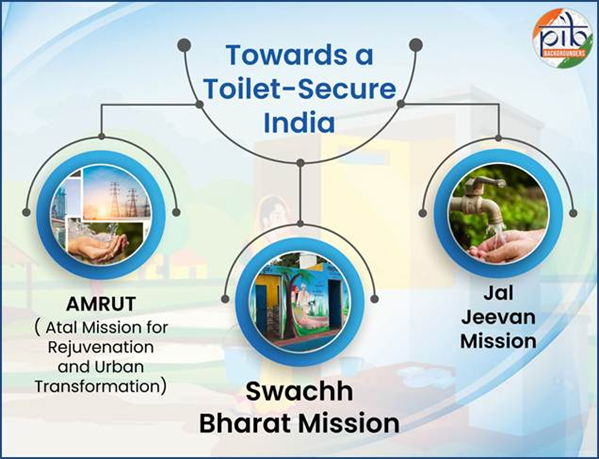
| Mission | Primary Focus | Objective | Rural vs. Urban |
| Swachh Bharat Mission (SBM) | Sanitation and solid waste management | Eliminate open defecation, promote cleanliness, and manage solid and liquid waste effectively | Covers both rural (SBM-Grameen) and urban (SBM-Urban) areas |
| Atal Mission for Rejuvenation and Urban Transformation (AMRUT) | Urban infrastructure, including water supply, sewerage, and drainage | Ensure that urban households have access to a basic level of water supply and sewerage connections | Focuses on urban areas |
| Jal Jeevan Mission (JJM) | Functional household tap water connections | Provide safe and adequate drinking water through individual household tap connections to every rural household | Primarily focuses on rural areas |
Hence all pairs are correctly matched.
Source: https://www.pib.gov.in/PressReleasePage.aspx?PRID=2191618
8. Which one of the following statements best reflects the idea behind the “BIRSA 101” technology recently seen in the news?
(a) A vaccine developed using recombinant DNA technology to prevent Sickle Cell Disease in tribal populations.
(b) A stem-cell transplantation protocol developed for the treatment of hereditary blood disorders.
(c) A population-level genomic screening programme to identify carriers of Sickle Cell Disease in high-risk districts.
(d) A CRISPR-based gene therapy that edits the patient’s own cells to correct the genetic mutation responsible for Sickle Cell Disease.
Answer: (d) A CRISPR-based gene therapy that edits the patient’s own cells to correct the genetic mutation responsible for Sickle Cell Disease.
Explanation:
In NEWS: Union Minister Dr. Jitendra Singh launches India’s first indigenous “CRISPR” based gene therapy for Sickle Cell Disease, which particularly affects India’s tribal population
BIRSA 101 (CRISPR-based Gene Therapy):
- BIRSA 101 is India’s first indigenous CRISPR-based gene therapy developed for Sickle Cell Disease. Hence option (d) is correct.
- The therapy has been developed by CSIR–Institute of Genomics & Integrative Biology (IGIB).
- The CRISPR platform used in BIRSA 101 is based on the enFnCas9 gene-editing system.
- A technology transfer agreement for BIRSA 101 has been signed between CSIR-IGIB and the Serum Institute of India.
- The therapy is named in honour of Bhagwan Birsa Munda on his 150th birth anniversary.
- BIRSA 101 aims to offer a low-cost alternative to global Sickle Cell Disease treatments that cost ₹20–25 crore.
- The therapy particularly targets tribal populations in central and eastern India, where Sickle Cell Disease prevalence is high.
- The initiative supports the government’s vision of making India Sickle Cell–Free by 2047.
- The launch of BIRSA 101 aligns with the goals of Atmanirbhar Bharat in advanced biomedical technologies.
| PYQ REFERENCE: (2019) Q. What is Cas9 protein that is often mentioned in news? (a) A molecular scissors used in targeted gene editing (b) A biosensor used in the accurate detection of pathogens in patients (c) A gene that makes plants pest-resistant (d) A herbicidal substance synthesized in genetically modified crops |
Source: https://www.pib.gov.in/PressReleasePage.aspx?PRID=2191740
9. With reference to recent Geographical Indication (GI) recognitions in India, consider the following:
1. Meerut Bugle
2. Ambaji Marble
3. Panna Diamonds
4. Hyderabad Pearls
Which of the above mentioned products have given Geographical Indication (GI) recognitions in India?
(a) 1 and 2 only
(b) 2, 3 and 4 only
(c) 1, 2 and 3 only
(d) 1, 2, 3 and 4
Answer: (d) 1, 2, 3 and 4
Explanation:
Recent
India has recently seen a surge in geographical indication (GI) recognitions across diverse traditional products, strengthening cultural identity and boosting local economies.
- Meerut’s 140-year-old brass bugles have secured the GI tag, preserving their long-standing association with military bands and giving traditional artisans global visibility.
- Ambaji Marble from Gujarat, known for its fine grain and aesthetic appeal, has also been granted a GI tag, enhancing its export potential and safeguarding its authenticity.
- In Madhya Pradesh, Panna Diamonds—celebrated for their natural brilliance and sourced from one of the country’s oldest diamond belts—have earned GI recognition, providing brand protection and market advantage to local miners.
- Additionally, Hyderabad Pearls, synonymous with the historic “City of Pearls,” have moved closer to securing a GI tag, reinforcing their reputation for handcrafted quality and unique luster.
Hence option (d) 1, 2, 3 and 4 are correct.
| PYQ REFERENCE: Q. Which of the following has/have been accorded ‘Geographical Indication’ status? 1. Banaras Brocades and Sarees 2. Rajasthani Daal-Bati-Churma 3. Tirupathi Laddu Select the correct answer using the code given below: (a) 1 only (b) 2 and 3 only (c) 1 and 3 only (d) 1, 2 and 3 |
10. Consider the following statements:
1. The Montagu-Chelmsford Reforms of 1919 recommended granting voting. rights to all the women above the age of 21.
2. The Government of India Act of 1935 gave women reserved seats in legislature.
Which of the statements given above is/are correct?
(a) 1 only
(b) 2 only
(c) Both 1 and 2
(d) Neither 1 nor 2
Answer: (b) 2 only
Explanation:
1. The 1919 reforms did not recommend universal franchise for women. Limited women’s suffrage was introduced only gradually by provinces from 1921 onwards, and only for restricted categories (property, education, etc.) Hence statement 1 is incorrect.
2. The 1935 Act provided for reservation of seats for women in provincial legislatures. Hence statement 2 is correct.