


1. Consider the following statements with respect to Article 240 of the Indian constitution:
I. Article 240 empowers the President of India to make regulations for certain Union Territories.
II. The regulations made under this article have the same force as Acts of Parliament.
III. The Article applies to Union Territories with a Legislative Assembly.
IV. Recently, Chandigarh was brought under the purview of this Article.
Select the correct answer using the code given below.
(a) I and II
(b) I, II and IV
(c) I and IV
(d) II, III and IV
Answer: (a) I and II
Explanation:
In NEWS: What will it mean for Chandigarh if it is brought under Article 240?
Article 240:
- Article 240 empowers the President of India to make regulations for certain Union Territories. Hence statement I is correct.
- These regulations have the same force as Acts of Parliament. Hence statement II is correct.
- The Article applies to Union Territories that do not have a Legislative Assembly. Hence statement III is incorrect.
- Currently, Article 240 covers UTs such as Andaman & Nicobar Islands, Lakshadweep, Dadra & Nagar Haveli and Daman & Diu, and Ladakh.
- Before gaining a legislature in 1987, Goa, Daman & Diu and Puducherry were also under Article 240.
- Regulations made under Article 240 may amend or repeal any existing law applicable to that UT.
- Article 240(2) states that any regulation made by the President is to be laid before Parliament, but Parliament cannot modify it like a regular Bill.
- These Presidential regulations become necessary where Parliament is not in session or where urgent administrative changes are required in a UT.
- Chandigarh is currently not under Article 240, as it is placed under Article 239 and administered by an Administrator (Punjab Governor). Hence statement IV is incorrect.
- Bringing Chandigarh under Article 240 would allow the Central Government to directly issue regulations for its governance.
| PYQ REFERENCE: (2019) Q. If the President of India exercises his power as provided under Article 356 of the Constitution in respect of a particular State, then (a) the Assembly of the State is automatically dissolved. (b) the powers of the Legislature of that State shall be exercisable by or under the authority of the Parliament. (c) Article 19 is suspended in that State. (d) the President can make laws relating to that State. |
Source: https://indianexpress.com/article/explained/chandigarh-article-240-10382099/
2. Consider the following statements:
Statement-I: Madhya Pradesh has recorded the highest number of farm stubble burning incidents in the country for the second consecutive year.
Statement-II: Many farmers have switched from traditional crops like soybean and black gram to paddy.
Which one of the following is correct in respect of the above statements?
(a) Both Statement-I and Statement-II are correct and Statement-II explains Statement-I
(b) Both Statement-I and Statement-II are correct, but Statement-II does not explain Statement-I
(c) Statement-I is correct, but Statement-II is incorrect
(d) Statement-I is incorrect, but Statement II is correct
Answer: (a) Both Statement-I and Statement-II are correct and Statement-II explains Statement-I
Explanation:
In NEWS: Madhya Pradesh leads in farm stubble burning for second year; Uttar Pradesh and Punjab follow
- Madhya Pradesh (MP) has become the leading state in India for farm stubble-burning for the second year in a row.
- According to data from CREAMS (the Consortium for Research on Agroecosystem Monitoring and Modelling from Space, at IARI), about 14,165 out of ~28,529 crop-residue burning incidents recorded this season (across six states) happened in Madhya Pradesh — nearly half of the total.
- Among 10 worst-affected districts nationwide, 7 are in Madhya Pradesh; topping the list again is Sheopur district.
- Other states like Uttar Pradesh (UP) and Rajasthan have seen marked increases, while traditional hotspots like Punjab and Haryana have seen a substantial drop in stubble-burning incidents.
What’s driving this shift toward Madhya Pradesh
- In districts such as Sheopur, there has been a significant increase in paddy cultivation in recent years; many farmers switched from traditional crops (like soybean, black gram) to paddy.
- Factors such as good monsoon rainfall, improved groundwater availability, and reliable electricity/pumping for irrigation have made paddy cultivation more viable — which in turn has increased the amount of paddy straw to manage post-harvest.
- As paddy area increases, so does the crop residue — and possibly lack of enough crop-residue management infrastructure or incentives may be contributing to burning becoming the easiest disposal method.
Hence both Statement-I and Statement-II are correct and Statement-II explains Statement-I
| PYQ REFERENCE: (2024) Q. Consider the following statements : Statement-I: Many chewing gums found in the market are considered a source of environmental pollution. Statement-II: Many chewing gums contain plastic as gum base. Which one of the following is correct in respect of the above statements? (a) Both Statement-I and Statement-II are correct and Statement-II explains Statement-I (b) Both Statement-I and Statement-II are correct, but Statement-II does not explain Statement-I (c) Statement-I is correct, but Statement-II is incorrect (d) Statement-I is incorrect, but Statement-II is correct |
3. Consider the following statements with respect to the constitution of India:
I. The constitution came into force on 26 January 1950, honouring the Purna Swaraj Declaration.
II. The Constitution was signed by 284 members on 24 January 1950 and Dr. Rajendra Prasad was the first to sign.
III. Originally, the Constitution of India was adopted in only two languages.
Which of the statements given above are correct?
(a) I and Il only
(b) II and III only
(c) I and III only
(d) I, II and III
Answer: (d) I, II and III
Explanation:
In NEWS:
- On 26 November 2025 (Constitution Day), Droupadi Murmu released a digital version of the Constitution of India in nine Indian languages.
- The nine languages are: Malayalam, Marathi, Nepali, Punjabi, Bodo, Kashmiri, Telugu, Odia, and Assamese.
Enactment & Adoption of the Constitution:
Drafting timeline
- The Constitution was drafted between December 1946 – November 1949.
- The Constituent Assembly held 11 sessions over 2 years, 11 months, 18 days.
Date of enactment
- The Constitution was adopted on 26 November 1949
- This is why we celebrate Constitution Day / Samvidhan Divas.
Date of commencement
- It came into force on 26 January 1950
- chosen to honour the Purna Swaraj Declaration (1930). Hence statement I is correct.
Partial commencement
On 26 November 1949, only the following provisions came into effect:
- Citizenship (Part II)
- Elections (Part XV)
- Provisional Parliament (Art. 379–391)
- Temporary & transitional provisions
- Article 394
Final commencement
- The rest of the Constitution came into force on 26 January 1950.
Constituent Assembly
Formation
- Formed under the Cabinet Mission Plan (1946).
- Total seats originally: 389, reduced to 299 after Partition.
Composition
- Members elected by Provincial Assemblies.
- Princely states nominated their members.
Key office bearers
- Dr. Rajendra Prasad – President of the Constituent Assembly.
- Dr. B.R. Ambedkar – Chairman, Drafting Committee.
- B.N. Rau – Constitutional Adviser.
- HC Mookerjee – Vice-President of the Assembly.
Drafting Facts
- Draft Constitution was presented on 4 November 1948.
- The Constituent Assembly debated for 114 days (of total 165 sitting days).
Final document contained:
- 395 Articles, 22 Parts, 8 Schedules.
- (Now expanded to 470+ Articles and 12 Schedules.)
Adoption Ceremony
- The Constitution was signed by 284 members on 24 January 1950.
- Dr. Rajendra Prasad was the first to sign. Hence statement II is correct.
- The Constituent Assembly held its last session on 24 January 1950.
Enforcement & Birth of Republic
- India became a Republic on 26 January 1950.
- Dr. Rajendra Prasad became the first President of India.
Language:
- Originally, the Constitution of India was adopted in only TWO languages:
- English
- Hindi Hence statement III is correct.
- Over time, the Government of India translated the Constitution into all 22 Scheduled Languages for wider accessibility.
- English remains the authoritative legal text under the Authoritative Texts (Central Laws) Act, 1973.
| PYQ REFERENCE: (2023) Q. Consider the following statements in respect of the Constitution Day: Statement-I: The Constitution Day is celebrated on 26th November every year to promote constitutional values among citizens. Statement-II: On 26th November, 1949, the Constituent Assembly of India set up a Drafting Committee under the Chairmanship of Dr. B.R. Ambedkar to prepare a Draft Constitution of India. Which one of the following is correct in respect of the above statements? (a) Both Statement-I and Statement-II are correct and Statement-II is the correct explanation for Statement-I (b) Both Statement-I and Statement-II are correct and Statement-II is not the correct explanation for Statement-I (c) Statement-I is correct but Statement-II is incorrect (d) Statement-I is incorrect but Statement-II is correct |
4. With reference to Indian polity, consider the following statements:
1. The McMahon Line forms the boundary between Arunachal Pradesh and Tibet as a territorial separation.
2. The constitution of India provides special responsibility to the Governor regarding law and order in the administration of Arunachal Pradesh.
3. Arunachal Pradesh became a full-fledged State through the 22nd constitutional amendment in 1986.
Which of the statements given above is/are correct?
(a) 1 and 2 only
(b) 2 and 3 only
(c) 1 and 3 only
(d) 1, 2 and 3
Answer: (a) 1 and 2 only
Explanation:
In NEWS: Arunachal Pradesh is an integral and inalienable part of India: MEA
Arunachal Pradesh as an Integral Part of India:
1. Constitutional Status
- Article 1: India is a “Union of States”; Arunachal Pradesh is one of the States of the Union.
- Article 3: Parliament has exclusive power to form new States or alter boundaries—basis for its creation.
- Article 371H: Provides special provisions for Arunachal Pradesh giving Governor special responsibility for law & order. Hence statement 2 is correct.
- Listed in the First Schedule of the Constitution as a State (since 1987).
2. Historical-Administrative Background
(a) British Period
- The region under the North-East Frontier Tracts (NEFT); later North-East Frontier Agency (NEFA).
- McMahon Line (1914): Boundary between British India & Tibet, accepted by India; China disputes it. Hence statement 1 is correct.
(b) Post-Independence
- NEFA is administered by the Governor of Assam under the External Affairs Ministry.
- 1962: Sino-Indian War – strategic sensitivity.
- 1972: NEFA renamed Union Territory: Arunachal Pradesh.
- 1987: The Constitution (55th Amendment) Act, 1986 inserted Article 371H into the Constitution to provide special provisions for Arunachal Pradesh.
- It was passed alongside the State of Arunachal Pradesh Act, 1986 to prepare the region for full statehood (which happened on 20 February 1987). Hence statement 3 is incorrect.
3. Legal and International Position
India’s Claim
- Based on legal, historical, and administrative continuity.
- McMahon Line is India’s lawful boundary; recognized in international agreements (Simla Convention 1914, though not by China).
- Effective administrative control by India for decades (de facto and de jure sovereignty).
China’s Position
- Calls Arunachal “South Tibet”; opposes visits by Indian leaders.
- Claims areas like Tawang due to Tibetan Buddhist links.
- India rejects this as untenable and historically inaccurate.
| PYQ REFERENCE: (2025) Q. Consider the following pairs: State – Description Arunachal Pradesh – The capital is named after a fort, and the State has two National Parks Nagaland – The State came into existence on the basis of a Constitutional Amendment Act Tripura – Initially a Part ‘C’ State, it became a centrally administered territory in 1956, and later attained full statehood How many of the above pairs are correctly matched? (a) Only one (b) Only two (c) All the three (d) None |
5. With reference to the Chandrayaan-5 / LUPEX mission, consider the following statements:
1. It is a joint lunar mission of India and Japan.
2. The mission aims to detect and quantify water-ice and other volatiles in the lunar south pole region.
3. The rover for the mission is being developed by ISRO.
Which of the statements given above is/are correct?
(a) 1 and 2 only
(b) 2 and 3 only
(c) 1 and 3 only
(d) 1, 2 and 3
Answer: (a) 1 and 2 only
Explanation:
In NEWS: Japanese delegation visits ISRO to review status of Chandrayaan-5/LuPEX mission
Chandrayaan-5:
- Chandrayaan-5, also known as LUPEX (Lunar Polar Exploration Mission), is a joint lunar mission by ISRO (India) and JAXA (Japan). Hence statement 1 is correct.
- The mission aims to land near the Moon’s south pole and explore permanently shadowed regions (PSRs).
- India will provide the lander, and Japan will provide the rover and launch vehicle (H3 rocket). Hence statement 3 is incorrect.
- It will provide the first deep drilling and in-situ volatile analysis in the lunar south pole.
- Data from LUPEX may confirm the presence and depth of water-ice deposits, crucial for future lunar exploration.
- It will expand scientific understanding of polar geology, thermal cycles, and volatile migration on the Moon.
Mission Objectives
- To detect and quantify water-ice and other volatiles in the lunar south pole. Hence statement 2 is correct.
- To drill the lunar surface up to ~1–1.5 meters to collect subsurface samples.
- To conduct in-situ chemical, mineralogical and thermal analysis of the samples.
- To study the lunar polar environment, regolith properties, and surface composition.
- To assess the feasibility of long-term human presence and resource use on the Moon.
Mission Configurations
- Total mass of the mission is estimated at around 6.5 tonnes.
- The lander is developed by ISRO with upgraded capabilities for extreme polar terrain.
- The rover is developed by JAXA and Mitsubishi Heavy Industries.
- International scientific payloads from ESA and NASA are expected.
- Mission life on the lunar surface is expected to be around 100 days, with possible extension.
| PYQ REFERENCE: Q. Consider the following statements: The Mangalyaan launched by ISRO 1. is also called the Mars Orbiter Mission 2. made India the second country to have a spacecraft orbit the Mars after USA 3. made India the only country to be successful in making its spacecraft orbit the Mars in its very first attempt Which of the statement(s) given above is/are correct? (a) 1 only (b) 2 and 3 only (c) 1 and 3 only (d) 1, 2 and 3 |
6. When the Indian rupee depreciates against the US dollar, which of the following is most likely to occur?
(a) Indians studying abroad spend less in rupee terms.
(b) Imports of crude oil become cheaper.
(c) Export-oriented firms earn more in rupee terms.
(d) Foreign portfolio investors increase inflows automatically.
Answer: (c) Export-oriented firms earn more in rupee terms.
Explanation:
In NEWS: At a sharp depreciation of 4.3% against the U.S. Dollar (USD) in this calendar year (January-December 2025), the Indian Rupee (INR) has become the worst performing currency in Asia, forex analysts said. It may further slide to 90 against the USD if the trade deal with the U.S. does not happen in near future, they cautioned.
Impact of Rupee Depreciation:
1. Positive Impacts
(a) Boosts Exports
- Indian goods become cheaper in global markets.
- Beneficial for textiles, IT services, pharmaceuticals, agriculture. Hence option (c) is correct.
(b) Increase in Remittances (NRI)
- NRIs sending money home get more rupees per dollar, boosting household income.
(c) Tourism Competitiveness
- Foreign tourists find India cheaper, supporting hospitality and tourism sectors.
(d) Inflows into Certain Sectors
- Outsourcing and IT services may see higher earnings in rupee terms.
2. Negative Impacts
(a) Higher Import Bill
- Imports become costlier (e.g., crude oil, gold, electronics).
- Worsens Current Account Deficit (CAD).
(b) Fuel Inflation
- Costlier crude oil – higher petrol, diesel, transport costs – overall inflation.
(c) Pressure on Forex Reserves
- RBI may intervene using forex reserves to stabilize the rupee – reserves decline.
(d) Increases External Debt Burden
- India’s external debt (especially commercial borrowings) becomes more expensive to service in rupees.
(e) Corporate Pressure
- Companies dependent on imported raw materials face higher costs → reduced margins.
(f) Outflow of Foreign Investment
- Foreign investors may pull out fearing instability → FPI outflows, stock market correction.
(g) Negative for Outbound Tourism & Foreign Education
- Indians travelling abroad or studying overseas face higher expenses.
| PYQ REFERENCE: (2022) Q. With reference to the Indian economy, consider the following statements: 1. If the inflation is too high, Reserve Bank of India (RBI) is likely to buy government securities. 2. If the rupee is rapidly depreciating, RBI is likely to sell dollars in the market. 3. If interest rates in the USA or European Union were to fall, that is likely to induce RBI to buy dollars. Which of the statements given above are correct? (a) 1 and 2 only (b) 2 and 3 only (c) 1 and 3 only (d) 1, 2 and 3 |
7. Which of the following animals are known to exhibit magnetoreception?
1. Pigeons
2. Sea turtles
3. Honeybees
4. Salmon
Select the correct answer using the code given below:
(a) 1, 2 and 3 only
(b) 2 and 4 only
(c) 1, 2, 3 and 4
(d) 1 and 3 only
Answer: (c) 1, 2, 3 and 4
Explanation:
In NEWS: Why do pigeons have a good sense of direction?
A wide variety of animals detect magnetic fields. This sensory ability helps birds and insects migrate and turtles remember the locations of rich feeding areas.
Magnetoreception – Sense of Earth’s Magnetic Field
Magnetoreception is the ability of organisms to detect Earth’s magnetic field and use it for orientation, navigation, and migration.
Mechanism
- Some animals have magnetite crystals (iron oxide) that act as compasses.
- Others use photoreceptor proteins (cryptochromes) in the eyes that respond to magnetic fields.
- Recent studies show pigeons may sense magnetic fields via electrical currents in the inner ear (vestibular system).
- Brain integration occurs in areas like the vestibular nuclei, mesopallium, and hippocampus for spatial orientation.
Examples in Nature
| Organism | Mechanism | Function |
| Pigeons | Inner-ear electrical currents | Homing & navigation |
| Sea turtles | Magnetite in brain | Long-distance ocean migration |
| Birds (general) | Cryptochromes in retina | Orientation during migration |
| Salmon | Magnetite in nose/olfactory system | River homing |
| Honeybees | Magnetite + sun compass | Foraging |
Hence all are correct.
Significance
- Helps migratory birds, marine turtles, and insects navigate over long distances.
- Understanding it aids in wildlife conservation, tracking migration, and studying effects of electromagnetic pollution.
- Insight into animal sensory biology and evolutionary adaptation.
| PYQ REFERENCE: (2021) Q. Which of the following have species that can establish symbiotic relationship with other organisms? 1. Cnidarians 2. Fungi 3. Protozoa Select the correct answer using the code given below. (a) 1 and 2 only (b) 2 and 3 only (c) 1 and 3 only (d) 1, 2 and 3 |
Source:https://indianexpress.com/article/explained/explained-sci-tech/pigeons-sense-of-direction-10383601/
8. Which of the following policy objectives does the REPM scheme support?
1. Atmanirbhar Bharat
2. Net-Zero 2070 climate targets
3. Reducing India’s import dependence in critical minerals
4. National Hydrogen Mission
Select the correct answer using the code given below:
(a) 1, 2 and 3 only
(b) 1 and 4 only
(c) 2, 3 and 4 only
(d) 1, 2,3 and 4
Answer: (a) 1, 2 and 3 only
Explanation:
In NEWS:
- The Indian Union Cabinet has approved a scheme with a financial outlay of ₹7,280 crore to promote domestic manufacturing of sintered rare-earth permanent magnets (REPMs).
- It is the first-of-its-kind initiative in India aimed at building a fully integrated REPM manufacturing ecosystem.
Main Objectives & What the Scheme Will Do
- Establish a production capacity of 6,000 metric tonnes per annum (MTPA) of REPMs.
- Support the full value chain: from rare-earth oxides → metals → alloys → finished permanent magnets.
- Provide financial incentives: of the total outlay, ₹6,450 crore will be in the form of sales-linked incentives over five years; and ₹750 crore as capital subsidy for setting up plants.
- Allocate capacity to five beneficiaries chosen through a global competitive bidding — each beneficiary can get up to 1,200 MTPA.
- The scheme will span 7 years: first a 2-year gestation period to set up manufacturing facilities, followed by 5 years of incentive disbursement based on sales.
Strategic Significance
- REPMs (rare-earth permanent magnets) are critical inputs for modern technologies: electric vehicles (EVs), renewable energy (wind turbines), electronics, aerospace, defence, medical devices, etc.
- India currently depends heavily on imports for REPMs.
- The scheme aims to reduce import dependence by building domestic supply-chain resilience.
- The scheme aligns with larger policy goals: self-reliant India (Atmanirbhar Bharat), building technological and industrial base, and supporting Net-Zero 2070 climate/energy targets. Hence 1, 2, and 3 are correct.
- With growing demand for EVs and clean energy, domestic demand for magnets is expected to double by 2030, making this a timely strategic push.
| PYQ REFERENCE: (2025) Q. Consider the following statements: Statement I: Some rare earth elements are used in the manufacture of flat television screens and computer monitors. Statement II: Some rare earth elements have phosphorescent properties. Which one of the following is correct in respect of the above statements? (a) Both Statement-I and Statement-II are correct and Statement-II explains Statement-I (b) Both Statement-I and Statement-II are correct, but Statement-II does not explain Statement-I (c) Statement-I is correct, but Statement-II is incorrect (d) Statement-I is incorrect, but Statement II is correct |
Source: https://www.pib.gov.in/PressReleasePage.aspx?PRID=2194684
9. Consider the following statements regarding the Cuban gar:
1. It is listed as Endangered on the IUCN Red List.
2. It is an endemic brackishwater species found mainly in the Zapata Swamp of Cuba.
3. It is capable of breathing atmospheric oxygen and moving short distances on land.
How many of the above statements are correct?
(a) Only one
(b) Only two
(c) All three
(d) None
Answer: (d) None
Explanation:
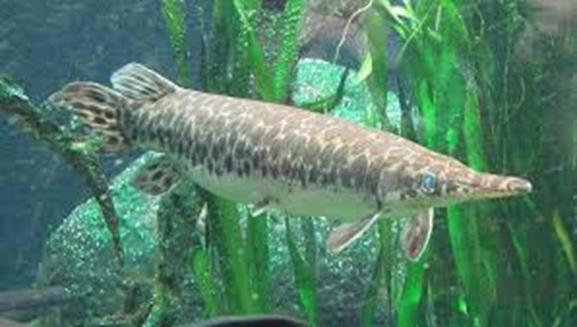
In NEWS: A fish as old as dinosaurs: Cuban scientists race against time to save it
- The Cuban gar (Atractosteus tristoechus) is listed as Critically Endangered on the IUCN Red List. Hence statement 1 is incorrect.
- It is an endemic freshwater fish species found primarily in the Zapata Swamp of Cuba. Hence statement 2 is incorrect.
- Centuries of exploitation for meat and other uses have contributed significantly to its population decline.
- Habitat loss due to wetland degradation and human activities has reduced the natural breeding grounds of the Cuban gar.
- The introduction of the African walking catfish in 1999 has severely impacted the Cuban gar species through competition and predation.
- The African walking catfish is an invasive species capable of breathing atmospheric oxygen and moving short distances on land, making it highly disruptive to native ecosystems. Hence statement 3 is incorrect.
- The once-pristine Zapata Swamp ecosystem has been ecologically stressed due to invasive species, habitat alteration, and overuse.
| PYQ REFERENCE: (2025) Q. Regarding Peacock tarantula (Gooty tarantula), consider the following statements: I. It is an omnivorous crustacean. II. Its natural habitat in India is only limited to some forest areas. III. In its natural habitat, it is an arboreal species. Which of the statements given above is/are correct? (a) I only (b) I and III (c) II only (d) II and III |
10. Consider the following statements about ‘the Charter Act of 1813’: (2019)
1. It ended the trade monopoly of the East India Company in India except for trade in tea and trade with China.
2. It asserted the sovereignty of the British Crown over the Indian territories held by the Company.
3. The revenues of India were now controlled by the British Parliament.
Which of the statements given above are correct?
(a) 1 and 2 only
(b) 2 and 3 only
(c) 1 and 3 only
(d) 1, 2 and 3
Answer:
Explanation:
- The Charter Act of 1813 ended the Company’s monopoly over Indian trade except:
- Tea trade
- Trade with China. Hence statement 1 is correct.
- For the first time, the Act explicitly declared that the Crown was sovereign, and the territories were held by the Company “in trust” for the Crown.
- This reinforced Parliamentary authority over the Company. Hence statement 2 is correct.
- The 1813 Act did not transfer revenue control to the British Parliament.
- The Company continued to control revenues. Hence statement 3 is incorrect.
- Parliamentary control over finances increased later, especially under:
- Charter Act 1833
- Government of India Act 1858