


1. Consider the following statements in respect of Padma Awards:
1. The Government servants including those working with PSUs, except doctors and scientists, are not eligible for these Awards.
2. The awards are presented by the President of India every year on the occasion of Republic Day.
3. The Padma awards can be given to Indian nationals, while the NRI, foreigners, OCIs are not eligible for Padma awards.
4. The award does not amount to a title and can be used as a suffix or prefix to the awardees’ name
Which of the statements given above is/are correct?
(a) 1 and 2 only
(b) 3 and 4 only
(c) 1, 2 and 3 only
(d) 1, 2 and 4 only
Answer: (a) 1 and 2 only
Explanation:
In NEWS: President Droupadi Murmu would confer Padma awards to 131 individuals in 2026
Padma Awards:
- Padma Awards – one of the highest civilian Awards of the country, are conferred in three categories, namely, Padma Vibhushan, Padma Bhushan and Padma Shri.
- The awards are announced on the occasion of Republic Day every year where the awardees are presented a Sanad (certificate) signed by the President and a medallion. Hence statement 2 is correct.
- ‘Padma Vibhushan’ is awarded for exceptional and distinguished service;
- ‘Padma Bhushan’ for distinguished service of high order and
- ‘Padma Shri’ for distinguished service in any field.
- Padma Awards, which were instituted in the year 1954, are announced every year on the occasion of Republic Day except for brief interruption(s) during the years 1978 and 1979 and 1993 to 1997.
- All persons without distinction of race, occupation, position or sex are eligible for these awards. However, Government servants including those working with PSUs, except doctors and scientists, are not eligible for these Awards. Hence statement 1 is correct.
- The award seeks to recognize works of distinction and is given for distinguished and exceptional achievements/service in all fields of activities/disciplines. An illustrative list of the fields is as under:
- Art (includes Music, Painting, Sculpture, Photography, Cinema, Theatre etc.)
- Social work (includes social service, charitable service, contribution in community projects etc.)
- Public Affairs (includes Law, Public Life, Politics etc.)
- Science & Engineering (includes Space Engineering, Nuclear Science, Information Technology, Research & Development in Science & its allied subjects etc.)
- Trade & Industry (includes Banking, Economic Activities, Management, Promotion of Tourism, Business etc.)
- Medicine (includes medical research, distinction/specialization in Ayurveda, Homeopathy, Sidhha, Allopathy, Naturopathy etc.)
- Literature & Education (includes Journalism, Teaching, Book composing, Literature, Poetry, Promotion of education, Promotion of literacy, Education Reforms etc.)
- Civil Service (includes distinction/excellence in administration etc. by Government Servants)
- Sports (includes popular Sports, Athletics, Adventure, Mountaineering, promotion of sports, Yoga etc.)
- Others (fields not covered above and may include propagation of Indian Culture, protection of Human Rights, Wild Life protection/conservation etc.)
- The award is normally not conferred posthumously. However, in highly deserving cases, the Government could consider giving an award posthumously.
- A higher category of Padma award can be conferred on a person only where a period of at least five years has elapsed since conferment of the earlier Padma award. However, in highly deserving cases, a relaxation can be made by the Awards Committee.
- The recipients are also given a small replica of the medallion, which they can wear during any ceremonial/State functions etc., if the awardees so desire. The names of the awardees are published in the Gazette of India on the day of the presentation ceremony.
- The total number of awards to be given in a year (excluding posthumous awards and to NRI/foreigners/OCIs) should not be more than 120. Hence statement 3 is incorrect.
- The award does not amount to a title and cannot be used as a suffix or prefix to the awardees’ name. Hence statement 4 is incorrect.
Who decides
- The Padma Awards are conferred on the recommendations made by the Padma Awards Committee, which is constituted by the Prime Minister every year.
- The nomination process is open to the public. Even self-nomination can be made.
| PYQ REFERENCE: (2021) Q. Consider the following statements in respect of Bharat Ratna and Padma Awards: 1. Bharat Ratna and Padma Awards are titles under the Article 18(1) of the Constitution of India. 2. Padma Awards, which were instituted in the year 1954, were suspended only once. 3. The number of Bharat Ratna Awards is restricted to a maximum of five in a particular year. Which of the above statements are not correct? (a) 1 and 2 only (b) 2 and 3 only (c) 1 and 3 only (d) 1, 2 and 3 |
Source:https://www.thehindu.com/news/national/full-list-of-padma-award-2026-winners/article70549263.ece
https://www.padmaawards.gov.in/PadmaAwards/AboutAwards
2. With reference to Delimitation in India, consider the following statements:
1. Delimitation is the process of fixing or re-fixing the boundaries of territorial constituencies and determining the number of seats in the Lok Sabha and State Legislative Assemblies based on the geographical size of the state.
2. The Delimitation Commission of India is chaired by the President of India.
3. The constitution of India provides for readjustment of Lok Sabha constituencies after each Census through a Delimitation Act enacted by Parliament.
Which of the statements given above is/are correct?
(a) 1 only
(b) 1 and 2
(c) 2 and 3
(d) 3 only
Answer: (d) 3 only
Explanation:
In NEWS: Delimitation after 2027, redrawing power in India
Delimitation refers to the process of fixing or re-fixing the boundaries of territorial constituencies and determining the number of seats in the Lok Sabha and State Legislative Assemblies to ensure equal representation based on population. Hence statement 1 is incorrect.
Historical Evolution of Delimitation in India
- Pre-Independence Period: Delimitation was carried out under the Government of India Acts of 1909, 1919, and 1935, primarily to allocate representation in legislative bodies.
- Post-Independence Phase: After the adoption of the Constitution, delimitation was mandated under Articles 82 and 170.
- First Delimitation (1952): Based on the 1951 Census, following the Delimitation Commission Act, 1952. Established constituencies for the first general elections.
- Subsequent Delimitation Exercises: 1963 (1961 Census) and 1973 (1971 Census) adjusted boundaries and seats in line with population growth.
- Freeze on Delimitation (1976): The 42nd Constitutional Amendment Act, 1976 froze the allocation of Lok Sabha and Assembly seats based on the 1971 Census until 2000, to encourage population control.
- Post-2000 Developments
- The 84th Constitutional Amendment Act, 2001 extended the freeze till 2026, but allowed boundary readjustments.
- The 87th Constitutional Amendment Act, 2003 enabled delimitation using 2001 Census data without increasing seats.
- Latest Delimitation (2002–2008): The Delimitation Commission (2002) completed the latest nationwide exercise, effective from 2008.
Constitutional Provisions
- Article 82 : Provides for readjustment of Lok Sabha constituencies after each Census through a Delimitation Act enacted by Parliament. Hence statement 3 is correct.
- Article 170 : Mandates delimitation of State Legislative Assembly constituencies based on population figures of the latest Census.
- 42nd Constitutional Amendment Act, 1976 : Froze delimitation based on the 1971 Census until the year 2000 to promote population control.
- 84th Constitutional Amendment Act, 2001 : Extended the freeze on the number of seats till 2026, while allowing readjustment of boundaries based on the 2001 Census.
- 87th Constitutional Amendment Act, 2003 : Permitted delimitation using the 2001 Census data without altering total seats.
Institutional Mechanism
- Delimitation is carried out by an independent Delimitation Commission, appointed by the President of India.
- It consists of:
- A retired Supreme Court judge as Chairperson. Hence statement 2 is incorrect.
- The Chief Election Commissioner
- The respective State Election Commissioners
- The Commission’s orders have the force of law and cannot be challenged in courts, ensuring political neutrality.
| PYQ REFERENCE: (2024) Q. How many Delimitation Commissions have been constituted by the Government of India till December 2023? (a) One (b) Two (c) Three (d) Four |
3. Consider the following statements:
1. The World Economic Forum (WEF) is an international non-governmental organization founded in 1971 by Klaus Schwab.
2. WEF publishes reports such as the Global Risks Report and Global Gender Gap Report.
Which of the statements given above is/are correct?
(a) 1 only
(b) 2 only
(c) Both 1 and 2
(d) Neither 1 nor 2
Answer: (c) Both 1 and 2
Explanation:
In NEWS: World Economic Forum has become Western Geopolitical Forum. And China is filling the gap
Recent issues with background:
- World Economic Forum (WEF) is an annual international meeting, often held at Davos, Switzerland, bringing together political, business, and civil society leaders.
- The WEF is increasingly dominated by Western geopolitical priorities, with discussions heavily focused on US-EU tensions, trade disputes, and conflicts like Ukraine.
- Many Global South countries find Davos discussions less relevant to their development and economic challenges.
- China hosts alternative forums such as:
- Boao Forum for Asia – Asia-focused economic dialogue
- Annual Meeting of the New Champions – sometimes called “Asian Davos,” emphasizing business and innovation
- These China-led forums focus on South-South cooperation, trade, infrastructure, and development, providing a counterweight to WEF’s Western tilt.
- The WEF’s global economic relevance is perceived to be declining in some regions because it is viewed as a proxy for Western geopolitical interests.
- This shift indicates the emerging multipolar world order, where non-Western powers are creating forums reflecting their priorities and those of developing countries.
World Economic Forum (WEF):
- Founded in 1971 by Klaus Schwab in Switzerland.
- Headquarters: Cologny, Switzerland.
- Type: International non-governmental organization (NGO). Hence statement 1 is correct.
- Purpose: Improve the state of the world through public-private cooperation.
- Annual Meeting: Held at Davos, Switzerland; discusses global economic, political, social, and technological issues.
- Regional Meetings: Africa, Asia, Latin America, etc.
- Reports Published:
- Global Competitiveness Report
- Global Risks Report
- Global Gender Gap Report. Hence statement 2 is correct.
- Future of Jobs Report
- Global Cybersecurity Outlook
- Top 10 Emerging Technologies
- Chief Economists’ Outlook
- Annual Report
- Global Cooperation Barometer
- Travel & Tourism Development Index
- Fostering Effective Energy Transition Report
- New Nature Economy Reports
- Membership: Corporates and institutions; participation requires paid membership.
| PYQ REFERENCE: Q. The Global Competitiveness Report is published by the (2019) (a) International Monetary Fund (b) United Nations Conference on Trade and Development (c) World Economic Forum (d) World Bank Which of the following gives ‘Global Gender Gap Index’ ranking to the countries of the world? (2017) (a) World Economic Forum (b) UN Human Rights Council (c) UN Women (d) World Health Organisation |
4. Consider the following statements:
Statement-I: Per- and polyfluoroalkyl substances (PFAS) are referred to as “forever chemicals.”
Statement-II: The carbon–fluorine bonds in PFAS molecules are extremely strong, making them highly resistant to environmental degradation.
Which one of the following is correct in respect of the above statements?
(a) Both Statement-I and Statement-II are correct and Statement-II is the correct explanation for Statement-I
(b) Both Statement-I and Statement-II are correct, and Statement-II is not the correct explanation for Statement-I
(c) Statement-I is correct but Statement-II is incorrect
(d) Statement-I is incorrect but Statement-II is correct
Answer: (a) Both Statement-I and Statement-II are correct and Statement-II is the correct explanation for Statement-I
Explanation:
In NEWS: Rice University Breakthrough Promises Faster PFAS Pollution Cleanup
Per- and polyfluoroalkyl substances (PFAS):
- PFAS are “forever chemicals” with strong carbon–fluorine bonds, making them extremely persistent in the environment. Hence, Both Statement-I and Statement-II are correct and Statement-II is the correct explanation for Statement-I.
- They are used in products for water-, stain-, and heat-resistance and accumulate in soil and water over decades.
- Exposure to PFAS is linked to cancer, kidney and liver disease, and immune disorders.
- Existing technologies like activated carbon or reverse osmosis capture but do not destroy PFAS, leaving disposal as a challenge.
- Scientists at Rice University developed a layered double hydroxide (LDH) material made from copper and aluminium to absorb PFAS.
- The LDH material is positively charged, enabling rapid attraction and absorption of negatively charged PFAS molecules.
- This new material can absorb certain PFAS up to 100 times faster than current filtration methods.
- The LDH approach allows non-thermal destruction of PFAS at relatively lower temperatures (400–500 °C), producing stable waste suitable for landfill.
- Scaling for industrial use and regulatory approvals remain key challenges for widespread deployment.
| PYQ REFERENCE: (2024) Q. With reference to perfluoroalkyl and Polyfluoroalkyl substances (PFAS) that are used in making many consumer products, consider the following statements : 1. PFAS are found to be widespread in drinking water, food and food packaging material. 2. PFAS are not easily degraded in the environment. 3. Persistent exposure to PFAS can lead to bioaccumulation in animal bodies. Which of the statements given above are correct? (a) 1 and 2 only (b) 2 and 3 only (c) 1 and 3 only (d) 1, 2 and 3 |
Source: https://www.gktoday.in/rice-university-breakthrough-promises-faster-pfas-pollution-cleanup/
5.With reference to Pygmy Hogs, consider the following statements:
I. They are solitary animals.
II. They are keystone grassland species.
III. They are classified as critically Endangered on the IUCN Red List.
Which of the statements given above is/are correct?
(a) I only
(b) I and III
(c) II only
(d) II and III
Answer: (c) II only
Explanation:
In NEWS: A little pig goes a long way – India’s pygmy hog is vanishing from its grasslands, just as it is needed the most
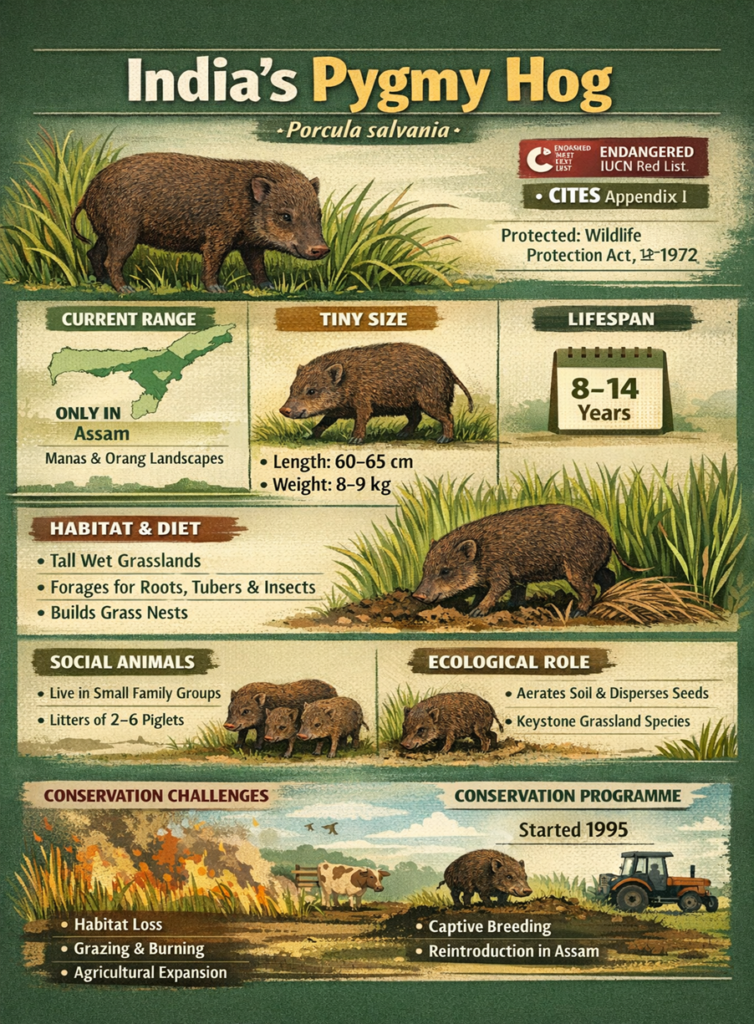
- The pygmy hog inhabits tall wet grasslands of the sub-Himalayan region.
- Once widespread across northern India and parts of Nepal, its current wild population survives only in Assam, mainly in and around Manas and Orang landscapes.
- Adult pygmy hogs are extremely small, measuring about 60–65 cm in length and weighing 8–9 kg.
- They have dark brownish coats, a tapered head, short tail, and small visible canines in males.
- Lifespan in the wild is estimated at 8–14 years.
- Pygmy hogs are social animals that live in small family groups. Hence statement 1 is incorrect.
- They dig grass nests for shelter, foraging primarily for roots, tubers, insects and other small food items.
- Breeding is seasonal, with litters of 2–6 piglets after a gestation of about 100 days.
- Ecologically, the pygmy hog is a keystone grassland species. Hence statement 2 is correct.
- The species faced near extinction due to rapid loss and degradation of grasslands, caused by unregulated burning, overgrazing, agricultural expansion, and habitat succession.
- These pressures drastically reduced both habitat quality and population numbers.
- A major conservation turnaround began in 1995 with the launch of the Pygmy Hog Conservation Programme (PHCP), involving captive breeding, habitat management, and systematic reintroduction into protected grasslands.
- The pygmy hog is classified as Endangered on the IUCN Red List, listed under CITES Appendix I, and is accorded the highest level of legal. Hence statement 3 is incorrect.
| PYQ REFERENCE: (2013) Q. Consider the following: 1. Star tortoise 2. Monitor lizard 3. Pygmy hog 4. Spider monkey Which of the above are naturally found in India? (a) 1, 2 and 3 only (b) 2 and 3 only (c) 1 and 4 only (d) 1, 2, 3 and 4 |
Source: https://www.downtoearth.org.in/wildlife-biodiversity/a-little-pig-goes-a-long-way
6. Consider the following statements with reference to Madras hedgehog:
1. It is a nocturnal mammal endemic to peninsular India.
2. It survives in dense forests.
3. It rolls up to reduce the chance of being captured by predators.
Which of the statements given above are correct?
(a) 1 and 2 only
(b) 2 only
(c) 3 only
(d) 1 and 3 only
Answer: (d) 1 and 3 only
Explanation:
In NEWS: Under moonlit scrub – Survival of this hidden guardian tells us whether our scrublands still breathe
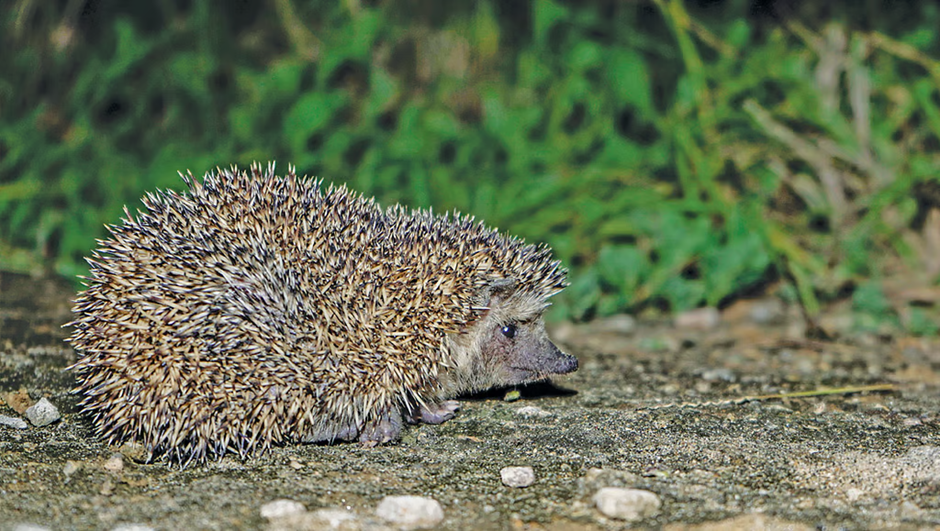
- Madras hedgehog (Paraechinus nudiventris), a little-known, nocturnal mammal is endemic to peninsular India, especially in Tamil Nadu, Kerala, Andhra Pradesh, and parts of Karnataka. Hence statement 1 is correct.
- This small species, also called the bare-bellied hedgehog, survives in dry scrublands, thorn forests, grasslands, and scrub edges of farmlands, avoiding dense forests. Hence statement 2 is incorrect.
- At night it forages for insects, worms, snails, and small reptiles, acting as a natural pest controller and contributing to soil aeration, an important ecological function in dry ecosystems.
- The Madras hedgehog weighs about 130–315 g and lives roughly five to six years.
- It is well adapted to arid landscapes: its quills protect against predators such as foxes, jackals, and mongooses, and it curls into a tight ball when threatened. Hence statement 3 is correct.
- Its poor eyesight is compensated by keen smell and hearing.
- Despite its ecological role and endemic status, the species is overlooked and under-studied, and its population trends are uncertain.
- Major threats include habitat loss due to agriculture, plantations, and infrastructure development (such as wind and solar projects), poaching, and road mortality.
- Cultural myths about medicinal properties of its body parts have also led to illegal hunting in some areas.
| PYQ REFERENCE: (2021) Q. Consider the following animals: 1. Hedgehog 2. Marmot 3. Pangolin To reduce the chance of being captured by predators, which of the above organisms rolls up/roll up and protects/protects its/their vulnerable parts? (a) 1 and 2 only (b) 2 only (c) 3 only (d) 1 and 3 only |
Source:https://www.downtoearth.org.in/wildlife-biodiversity/under-moonlit-scrub
7. Consider the following about pumped-storage hydroelectricity (PSH):
1. Pumped-storage hydroelectricity (PSH) stores electricity in the form of gravitational potential energy by moving water between two reservoirs at different elevations.
2. India plans to develop 100 GW of hydro pumped storage capacity by 2030.
Which of the statements given above is/are correct?
(a) 1 only
(b) 2 only
(c) Both 1 and 2
(d) Neither 1 nor 2
Answer: (a) 1 only
Explanation:
In NEWS:
- India has charted a formal roadmap to develop 100 GW of hydro pumped storage capacity by 2047 to help stabilize its rapidly growing renewable energy sector. Hence statement 2 is incorrect.
- This plan integrates long-duration energy storage as a core component of grid reliability and peak demand management.
- Over 120 potential pumped storage sites have been identified nationwide, with total potential exceeding ~180 GW, out of which 100 GW is targeted for development by 2047.
- About 22 GW is already under development, and 50–60 GW are shortlisted for rollout by 2032–37 in line with renewable expansion plans.
- Key states expected to lead early development include Andhra Pradesh, Maharashtra, Odisha, Gujarat, and Tamil Nadu, with projects that leverage existing reservoirs and off-river (closed-loop) systems to reduce social and environmental impacts.
Pumped hydro storage:
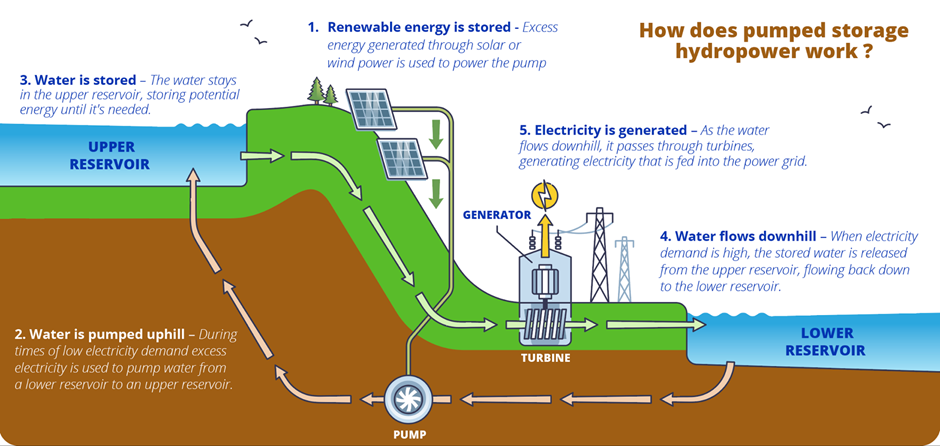
- Pumped-storage hydroelectricity (PSH) is a form of energy storage and grid management technology that works like a giant water-based battery.
- It stores electricity in the form of gravitational potential energy by moving water between two reservoirs at different elevations. Hence statement 1 is correct.
- It is the largest form of grid energy storage worldwide, accounting for the vast majority of installed storage capacity.
Mechanism:
- When electricity demand is low, surplus or cheap power (often from renewables like solar and wind) is used to pump water from a lower reservoir up to a higher one.
- When demand is high, water is released back down to the lower reservoir through turbines, generating electricity.
- The system uses reversible pump-turbines that can both pump water up and generate electricity when water flows down.
Benefits
- PSH balances supply and demand on the grid and stabilises it by storing excess power and releasing it when needed.
- It helps manage intermittent renewable energy, such as solar and wind, by capturing surplus generation.
- Though it consumes more energy to pump water up than it generates when released, it increases system value by providing electricity at peak demand times when prices are higher.
| PYQ REFERENCE: (2024) Q. Recently, the term “pumped-storage hydropower” is actually and appropriately discussed in the context of which one of the following? (a) Irrigation of terraced crop fields (b) Lift irrigation of cereal crops (c) Long-duration energy storage (d) Rainwater harvesting system |
8. Consider the following statements:
Statement-I: The Ratle hydroelectric project is a run‑of‑river hydro project designed for non‑consumptive use.
Statement-II: The Ratle hydroelectric project is being built on one of the “western rivers” allocated primarily to Pakistan under the Indus Waters Treaty of 1960.
Which one of the following is correct in respect of the above statements?
(a) Both Statement-I and Statement-II are correct and Statement-I explains Statement-II
(b) Both Statement-I and Statement-II are correct, but Statement-II does not explain Statement-I
(c) Statement-1 is correct, but Statement-II is incorrect
(d) Statement-I is incorrect, but Statement-II is correct
Answer: (a) Both Statement-I and Statement-II are correct and Statement-I explains Statement-II
Explanation:
In NEWS: Centre’s panel affirms Ratle hydroelectric project green nod validity till December 2030
Ratle Hydroelectric Project:
- Ratle Hydroelectric Project (850 MW), is a Run of River Scheme located on River Chenab at village Drabshalla, district Kishtwar, Union Territory of Jammu and Kashmir.
- It is designed with a 133 m gravity dam and an underground powerhouse housing four main turbines, aiming to generate approximately 3,136 million units of electricity annually once completed.
- It has four 205 MW Francis turbines and one 30 MW unit, giving an installed capacity of 850 MW.
- The project is executed by Ratle Hydroelectric Power Corporation Limited (RHPCL), a joint venture between NHPC Ltd and the Jammu and Kashmir government.
- The Ratle project is built on the Chenab, one of the “western rivers” (along with Jhelum and Indus) allocated primarily to Pakistan under the Indus Waters Treaty of 1960. The treaty allows India non‑consumptive use such as run‑of‑river hydro projects but with design constraints to protect downstream flows.
Hence both Statement-I and Statement-II are correct and Statement-I explains Statement-II
| PYQ REFERENCE: (1979) Q. Which hydro-electric project produces maximum power energy? (a) Bhakra Nangal (b) Koyna (c) Hirakud (d) Salal |
9. Why is the Rafah Border Crossing particularly important during conflict in Gaza?
(a) It allows Israel to control all trade
(b) It serves as the main international airport for Gaza
(c) It provides the only viable external link when land, sea, and air routes are restricted
(d) It is the headquarters of the Palestinian Authority
Answer: (c) It provides the only viable external link when land, sea, and air routes are restricted
Explanation:
In NEWS: Rafah border crossing between Gaza and Egypt could reopen to increase humanitarian efforts
Rafah Border Crossing:
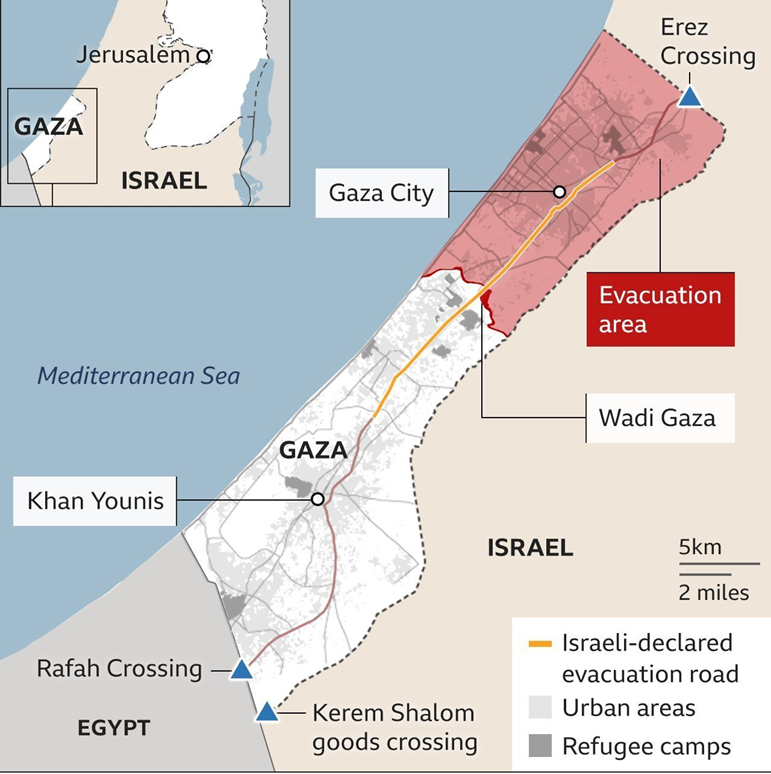
- The Rafah Border Crossing is the only border crossing between the Gaza Strip and Egypt and is located in Rafah at the southern edge of Gaza and the northern border of Egypt.
- It serves as Gaza’s sole gateway to a country other than Israel, making it crucial for people movement and humanitarian access.
- The crossing was opened after the 1979 Egypt–Israel peace treaty and remained under Israeli control until 2005.
- In 2005, control was transferred to the Palestinian Authority on the Gaza side and Egyptian Border Guards on the Egyptian side, with oversight from the European Union Border Assistance Mission (EUBAM Rafah).
- After Hamas took control of Gaza in 2007, the EU mission withdrew, and Egypt closed the crossing. Since then, Rafah has only been opened intermittently for limited movements.
- Rafah is vital for humanitarian aid delivery, access to medical care, and travel out of Gaza, because the other border crossings are controlled by Israel.
- It is especially important during conflict when land, sea, and air access to Gaza is restricted, making Rafah the primary external link for civilians. Hence option (c) is correct.
| PYQ REFERENCE: (2023) Q. Consider the following pairs: Region often mentioned in news Reason for being in news 1. North Kivu and Ituri – War between Armenia and Azerbaijan 2. Nagorno-Karabakh – Insurgency in Mozambique 3. Kherson and Zaporizhzhia – Dispute between Israel and Lebanon How many of the above pairs are correctly matched? (a) Only one (b) Only two (c) All three (d) None |
10. Consider the following pairs:
| National Park | River Flowing through the park | |
| 1 | Corbett National Park | Ganga |
| 2 | Kaziranga National Park | Manas |
| 3 | Silent Valley National Park | Kaveri |
Which of the above pairs is/are correctly matched?
(a) 1 and 2
(b) 3 only
(c) 1 and 3
(d) None
Answer: (d) None
Explanation:
- The Ramganga River flows through Corbett, not the Ganga itself. While Ramganga is a tributary, technically the park does not have the main Ganga river flowing through it.
- The Brahmaputra River flows through Kaziranga, not Manas. Manas River flows through Manas National Park.
- The Kaveri River originates near Talakaveri in Karnataka, while Silent Valley National Park is in Kerala. The river flowing through Silent Valley is Kunthipuzha, a tributary of Bharathapuzha.
Hence all are incorrect.