


1. According to the Economic Survey 2026, Which of the following factors were the drivers of private consumption growth in India?
1. Low inflation
2. Stable employment conditions
3. Improved agricultural performance
4. Tax reforms and rationalisation
Select the correct answer using the code below:
(a) 1 and 2 only
(b) 1, 2 and 3 only
(c) 1, 2, 3 and 4
(d) 2, 3 and 4 only
Answer: (c) 1, 2, 3 and 4
Explanation:
In NEWS: Economic Survey 2026: Consumption growth to slow down ‘slightly’ despite rise in domestic demand
Economic Survey 2026: Consumption Growth in India
- India’s growth is strongly driven by private spending rather than investment or exports.
- Rural and urban households at the lower end of income distribution are seeing improved consumption.
- The slight slowdown is temporary, with consumption expected to remain resilient due to supportive macroeconomic conditions.
Consumption Share & Growth
- In FY 2025-26, private final consumption expenditure (PFCE) accounted for 61.5% of GDP, the highest since FY 2011-12.
- PFCE growth is estimated at 7.0% for FY 2025-26 (first advance estimate), slightly lower than 7.2% in FY 2024-25.
- The Indian economy is currently in its most consumption-driven phase since 2012.
- Domestic demand remains a strong driver of economic growth in FY 2026.
Drivers of Consumption
- Low inflation, stable employment, and higher real incomes are supporting consumption.
- Improved agricultural performance has increased rural spending.
- Tax reforms and rationalisation have improved urban consumption.
Hence all are correct.
Half-Yearly Trends
- PFCE growth was 7.3% in H1 FY 2025-26 and increased to 7.5% in H1 FY 2026-27.
- Second-half projections indicate a slight moderation in consumption growth.
Inequality and Inclusion
- Consumption-based inequality has declined according to the Household Consumption Expenditure Survey 2023-24.
- The bottom 5–10% of the population in rural and urban areas saw the highest increase in per capita monthly consumption between 2022-23 and 2023-24.
| PYQ REFERENCE: (2015) Q. A decrease in tax to GDP ratio of a country indicates which of the following? 1. Slowing economic growth rate 2. Less equitable distribution of national income Select the correct answer using the code given below. (a) 1 only (b) 2 only (c) Both 1 and 2 (d) Neither1 nor 2 |
2. Consider the following statements about the Designs Act, 2000:
I. The Act was introduced to comply with the TRIPS Agreement.
II. It governs both industrial designs and trademarks.
III. Functional features of a product can be registered under the Act.
IV. The initial term of protection for a registered design is 10 years.
Which of the statements given above are correct?
(a) I and IV only
(b) I and III only
(c) II and IV only
(d) I, II and IV
Answer: (a) I and IV only
Explanation:
In NEWS: Department for Promotion of Industry and Internal Trade Proposes Amendments to Designs Act to Align with Global Best Practices
Designs Act:
- The Designs Act, 2000 is the primary legislation in India governing the protection of industrial designs, having repealed the earlier 1911 Act to align with international standards like the TRIPS Agreement. Hence statement I is correct and statement II is incorrect..
- Managed by the Ministry of Commerce and Industry, it protects the aesthetic “look and feel” of a product, such as its shape, configuration, or pattern rather than its functional utility.
- Functional features cannot be registered; only aesthetic features are protected. Hence statement III is incorrect.
Core Provisions and Concepts
- Definition of “Design”: Under Section 2(d), design refers to features of shape, configuration, or ornament applied to an article by any industrial process that appeal solely to the eye.
- Absolute Novelty: A design must be new or original and not previously published anywhere in the world to qualify for registration.
- Exclusions: Registration is prohibited for designs that lack novelty, contain scandalous or obscene matter, or are purely functional.
- Locarno Classification: The Act uses this international classification system to categorize goods based on their subject matter rather than the material used.
Registration and Duration
1. Application: Filed at the Patent Office (headquartered in Kolkata) by the creator or proprietor.
2. Protection Period: Initial protection lasts for 10 years, extendable for an additional 5 years (total 15 years) upon payment of renewal fees. Hence statement IV is correct.
3. Restoration: Lapsed designs can be restored within one year if the failure to pay fees was unintentional.
Infringement and Remedies
Infringement (often called piracy) occurs when a third party applies a registered design or a “fraudulent or obvious imitation” to a product without consent.
- Civil Remedies: Proprietors can seek injunctions to stop the imitation and claim damages.
- Statutory Penalty: A registered owner can recover up to ₹25,000 for each contravention, with a total cap of ₹50,000 per design as a contract debt.
- Judicial Jurisdiction: Cases must be filed in a District Court or higher; if the design’s validity is challenged, the case is transferred to the High Court.
| PYQ REFERENCE: (2017) Q. With reference to the ‘National Intellectual Property Rights Policy’, consider the following statements: 1. It reiterates India’s commitment to the Doha Development Agenda and the TRIPS Agreement. 2. Department of Industrial Policy and Promotion is the nodal agency for regulating intellectual property rights in India. Which of the above statements is/are correct? (a) 1 only (b) 2 only (c) Both 1 and 2 (d) Neither 1 nor 2 |
Source: https://www.pib.gov.in/PressReleasePage.aspx?PRID=2219951®=3&lang=1
3. Consider the following statements:
Statement-I: Coking coal is a Critical and Strategic Mineral in India.
Statement-II: Coking coal is notified under Part D of the Mines and Minerals (Development and Regulation) Act, 1957.
Which one of the following is correct in respect of the above statements?
(a) Both Statement-I and Statement-II are correct and Statement-II explains Statement-I
(b) Both Statement-I and Statement-II are correct, but Statement-II does not explain Statement-I
(c) Statement-I is correct, but Statement-II is incorrect
(d) Statement-I is incorrect, but Statement-II is correct
Answer: (a) Both Statement-I and Statement-II are correct and Statement-II explains Statement-I
Explanation:
In NEWS: Government Notifies Coking Coal as Critical & Strategic Mineral under MMDR Act, 1957
Recent Amendment:
- Under the Mines and Minerals (Development and Regulation) Act, 1957 (MMDR Act), 1957, Section 11C empowers the Central Government to notify critical and strategic minerals; accordingly, the First Schedule has been amended by updating Part A to read “Coal, including Coking Coal” and by including “Coking Coal” in Part D as a Critical and Strategic Mineral. Hence both Statement-I and Statement-II are correct and Statement-II explains Statement-I
Coking coal:
- Coking coal, also known as metallurgical coal, is a specific grade of bituminous coal essential for the production of steel.
- Unlike thermal coal used for power generation, coking coal has unique properties that allow it to soften and liquefy when heated in an oxygen-free environment, eventually resolidifying into a hard, porous substance called coke.
- China is the world’s largest producer (62%), followed by Australia (15%), Russia (9%), and the USA (5%).
Coking coal in India:
- India currently imports nearly 95% of its high-grade coking coal requirements for steelmaking, creating a massive foreign exchange outgo.
- India has 37.37 billion tonnes of coking coal resources.
- Major reserves: Jharkhand, Madhya Pradesh, West Bengal, Chhattisgarh.
Key Applications of Coking Coal:
- Steel Production (Primary Use): Approx. 70% of global steel is produced via the Blast Furnace-Basic Oxygen Furnace (BF-BOF) route, relying on coke for chemical reduction of iron ore.
- Foundry Coke: Used in smaller furnaces to melt iron and steel scrap for casting.
- Pulverized Coal Injection (PCI): High-grade metallurgical coal can be injected directly into blast furnaces to reduce the overall coke requirement.
- By-product Utilization: The coking process produces coal tar and coke oven gas, which are used to manufacture chemicals, plastics (e.g., Bakelite), and, in some cases, as a source for medicinal products.
| PYQ REFERENCE: (2015) Q. In India, the steel production industry requires the import of (a) Saltpetre (b) Rock phosphate (c) Coking coal (d) All of the above |
Source: https://www.pib.gov.in/PressReleasePage.aspx?PRID=2219947®=3&lang=1
4. Consider the following statements:
Statement I: A weakened polar vortex can lead to extreme winter cold in the south Arctic region.
Statement II: When the polar vortex is strong, the jet stream remains relatively circular, keeping Arctic air confined to Polar Regions.
Statement III: Uneven faster warming of the earth in Polar Regions compared to the tropics, can destabilize the polar vortex.
Which one of the following is correct in respect of the above statements?
(a) Both Statement II and Statement III are correct and both explain Statement I
(b) Both Statement II and Statement III are correct but only one explains Statement I
(c) Only Statement II is correct and it explains Statement I
(d) Only Statement III is correct and it explains Statement I
Answer: (a) Both Statement II and Statement III are correct and both explain Statement I
Explanation:
In NEWS: Polar vortex: What’s behind the lethal winter storm in the United States?
Polar Vortex:
- A polar vortex is a large area of low-pressure and cold air swirling around the Arctic (North Pole) and Antarctic (South Pole).
- It exists in the troposphere (0–15 km) and stratosphere (15–50 km).
- Normally, it confines the cold Arctic air to the Polar Regions.
Role of Jet Stream
- The jet stream is a narrow band of strong winds in the upper atmosphere.
- Strong polar vortex → circular jet stream → Arctic air confined → normal winter conditions in mid-latitudes.
- Weak polar vortex → wavier jet stream → Arctic air spills south → extreme cold waves.
Impact of Climate Change:
- The Polar Regions are warming faster than the tropics (Arctic amplification).
- This reduces the temperature gradient between the poles and mid-latitudes.
- As a result, the polar vortex weakens, becomes unstable, and can displace cold air southwards, causing winter storms in mid-latitudes.
- A weakened polar vortex allows Arctic air to migrate south, resulting in extreme winter cold far from the poles, including the US, Europe, and Asia.
Hence, Both Statement II and Statement III are correct and both explain Statement I
| PYQ REFERENCE: (2025) Q. Consider the following statements: Statement I: The amount of dust particles in the atmosphere is more in subtropical and temperate areas than in equatorial and polar regions. Statement II: Subtropical and temperate areas have less dry winds. Which one of the following is correct in respect of the above statements? (a) Both Statement I and Statement II are correct and Statement II explains Statement I (b) Both Statement I and Statement II are correct but Statement II does not explain Statement I (c) Statement I is correct but Statement II is not correct (d) Statement I is not correct but Statement II is correct |
5. Consider the following statements:
1. Brazil and the USA together account for 70% of the global soybean exports.
2. China is the largest soybean importer in the world.
3. In India, Madhya Pradesh has the largest soybean production, accounting for almost 50% of the nation’s output.
How many of the statements given above are correct?
(a) Only one
(b) Only two
(c) All three
(d) None
Answer: (c) All three
Explanation:
In NEWS: China to Boost Brazilian Soybean Imports in Early 2026 Amid Price Advantage
Soybean:
- Soybean (Glycine max) is a legume crop rich in protein and oil.
- It is used for edible oil, soymeal (animal feed), and industrial products.
- Major soybean-producing countries: USA, Brazil, Argentina, China, and India.
- Soybean is a short-day, warm-season crop, sensitive to frost.
Global Production & Trade
- Brazil and the USA are the top two global soybean exporters, accounting for over 70% of world trade. Hence statement 1 is correct.
- China is the largest soybean importer, primarily to meet domestic feed demand for its livestock sector. Hence statement 2 is correct.
- Global soybean trade is influenced by:
- Weather and crop yields (e.g., Brazil’s record harvest)
- International tariffs and trade agreements
- Global livestock feed demand, particularly from China
- The US-China trade tensions and tariffs significantly affect global soybean flows.
- Brazil often gains export share when US soybeans are relatively expensive or tariffed.
- Soybean prices are highly sensitive to global currency fluctuations, especially USD/BRL and USD/CNY.
India & Soybean
- India is a soybean-producing and consuming country, mainly for edible oil and soymeal.
- Major soybean-growing states in India: Madhya Pradesh, Maharashtra, Rajasthan, and Karnataka.
- Madhya Pradesh has the largest soybean production in India, accounting for almost 50% of the nation’s output. Hence statement 3 is correct.
- India exports soymeal but imports soy oil and occasionally soybeans to meet domestic consumption.
- India’s soybean production has grown due to expansion of oilseed cultivation and improved seed varieties.
- India is affected by global soybean prices, since soymeal is a key input for poultry, dairy, and livestock industries.
Recent Market Trends
- China’s soybean imports dominate global trade, often impacting prices worldwide.
- Seasonal dynamics: Brazilian soybean harvest (Jan–Mar) affects early-year supply, US harvest (Sep–Nov) affects late-year supply.
- Trade flows are influenced by: price competitiveness, supply availability, and logistics costs.
- Geopolitical or trade policy decisions (e.g., US-China trade deals) can shift sourcing between Brazil and USA.
- Global soybean demand is projected to increase with rising meat consumption in Asia.
| PYQ REFERENCE: (2014) Q. Consider the following pairs Region Well-known for the production of 1. Kinnaur : Areca nut 2. Mewat : Mango 3. Coromandel : Soya bean Which of the above pairs is/are correctly matched? (a) 1 and 2 only (b) 3 only (c) 1, 2 and 3 (d) None |
6. Which one of the following best describes the aim of Sampoornata Abhiyan 2.0?
(a) To reduce maternal and neonatal mortality among poor pregnant women.
(b) To achieve 100% literacy by promoting collaboration between voluntary organizations and the government’s education system and local communities.
(c) To achieve 100% saturation of selected development indicators in Aspirational Districts and Blocks through convergence and monitoring
(d) To provide additional financial assistance to States for social sector development
Answer: (c) To achieve 100% saturation of selected development indicators in Aspirational Districts and Blocks through convergence and monitoring
Explanation:
In NEWS: Launch of Sampoornata Abhiyan 2.0 by NITI Aayog
Sampoornata Abhiyan 2.0:
- Sampoornata Abhiyan 2.0 is a time-bound national campaign launched by NITI Aayog.
- The campaign aims at achieving 100% saturation of key development indicators in lagging regions. Hence option (c) is correct.
- It covers Aspirational Districts as well as Aspirational Blocks across India.
- Sampoornata Abhiyan 2.0 is implemented for a three-month duration.
- The campaign is aligned with the goals of the Aspirational Districts Programme (ADP) and Aspirational Blocks Programme (ABP).
- Key focus sectors under the campaign include health, nutrition, education, sanitation, and animal welfare.
- At the district level, indicators such as birth weight recording, TB case notification, and school toilet facilities are monitored.
- At the block level, emphasis is placed on Anganwadi services, supplementary nutrition, drinking water, sanitation, and vaccination of cattle.
- The campaign follows a saturation-based approach, rather than incremental improvement.
- Implementation involves district and block-level action plans, supported by monthly monitoring and data-driven review mechanisms.
- Sampoornata Abhiyan 2.0 promotes convergence of Central schemes, State initiatives, and local administration efforts.
- It strengthens last-mile service delivery through intensive field-level monitoring.
- The campaign reflects the principles of cooperative federalism and competitive federalism.
- NITI Aayog acts as a facilitator and performance monitor, not an implementing agency.
| PYQ REFERENCE: (2017) Q. What is the aim of the programme ‘Unnat Bharat Abhiyan’? (a) Achieving 100% literacy by promoting collaboration between voluntary organizations and government’s education system and local communities. (b) Connecting institutions of higher education with local communities to address development challenges through appropriate technologies. (c) Strengthening India’s scientific research institutions in order to make India a scientific and technological power. (d) Developing human capital by allocating special funds for health care and education of rural and urban poor, and organizing skill development programmes and vocational training for them. |
Source: https://www.pib.gov.in/PressReleasePage.aspx?PRID=2219753®=3&lang=1
7. Coringa Wildlife Sanctuary is primarily associated with which type of ecosystem?
(a) Alpine forest
(b) Mangrove
(c) Grassland
(d) Desert
Answer: (b) Mangrove
Explanation:
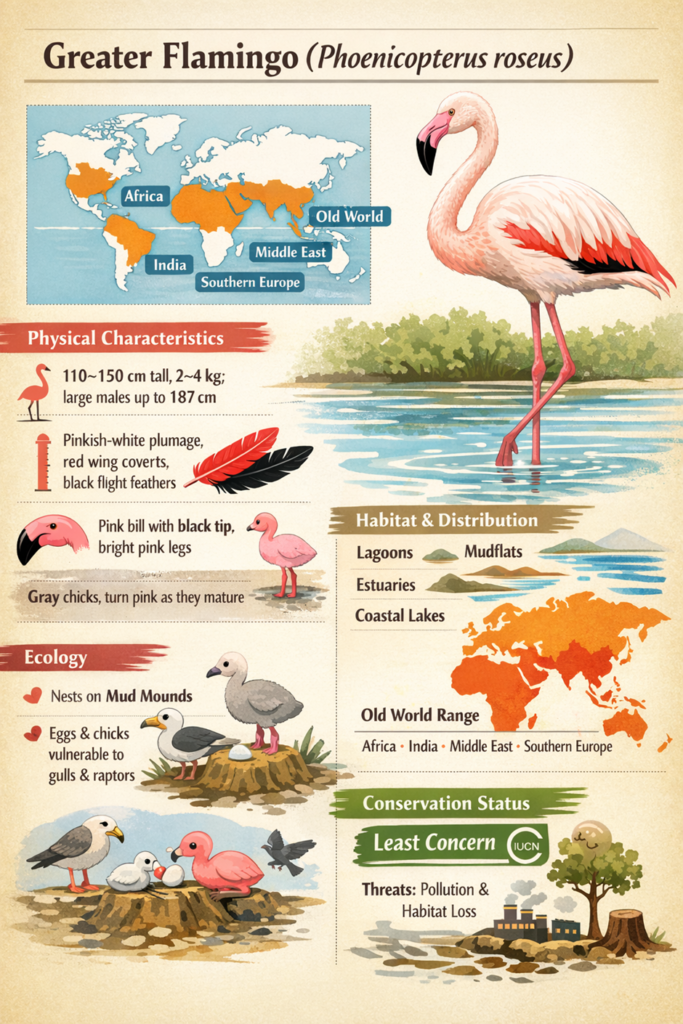
In NEWS: Greater flamingos (Phoenicopterus roseus) are sighted on Hope Island in Coringa Wildlife Sanctuary in the Kakinada Bay of Andhra Pradesh for the first time this season on Tuesday.
Coringa Wildlife Sanctuary:
- Coringa Wildlife Sanctuary is an estuarine wildlife sanctuary located near Kakinada in Andhra Pradesh, India, covering about 235.7 km² and governed by the Andhra Pradesh Forest Department.
- It was established on 5 July 1978 to protect the unique mangrove‑estuary ecosystem. Hence option (b) is correct.
- The sanctuary is part of the Godavari estuary and represents the third largest stretch of mangrove forests in India, with 24 mangrove tree species and more than 120 bird species recorded.
- Its intricate mangrove root systems help stabilise the coastline, reduce erosion, and provide habitat and nursery grounds for fish and other aquatic life.
Flora:
- Dominated by rich mangrove vegetation, including species such as Avicennia officinalis, Avicennia marina, Rhizophora mucronata, and Sonneratia apetala.
Fauna:
- Birds: Includes critically endangered species like the white‑backed vulture and long‑billed vulture, and diverse waterbirds such as herons, egrets, flamingos, and more.
- Other wildlife includes golden jackal, sea turtles, fishing cats, and a healthy population of smooth‑coated otters. Notably, the sanctuary has an 18‑km sand pit where Olive Ridley sea turtles nest from January to March each year.
Geography & Habitat:
- The sanctuary lies on the deltaic branches of the Godavari and Gouthami Rivers at Kakinada Bay, with extensive backwaters and marsh vegetation.
Threats:
- Mangrove exploitation for fuelwood, poaching, habitat destruction, and pressures from industrialisation and aquaculture are among the key conservation challenges. Efforts are ongoing to protect and restore the mangrove ecosystem.
| PYQ REFERENCE: (2004) Q. Match List I (National Park/Sanctuary) with List II (State) and select the correct answer using the codes given below: List-I List-II A. Kanger Ghati National Park 1. Chhattisgarh B. Nagerhole National Park 2. Haryana C. Kugti Wildlife Sanctuary 3. Himachal Pradesh D. Sultanpur Bird Sanctuary 4. Karnataka Codes : (a) A-3; B-2; C-1; D-4 (b) A-1; B-4; C-3; D-2 (c) A-3; B-4; C-1; D-2 (d) A-1; B-2; C-3; D-4 |
8. Consider the following statements about Tulu Language:
1. It belongs to the Dravidian language family.
2. It is one of the 22 scheduled languages of India.
3. It is one among the classical languages in India.
How many of the above statements is/are correct?
(a) Only one
(b) Only two
(c) All the three
(d) None
Answer: (a) Only one
Explanation:
In NEWS: Karnataka govt. in favour of declaring Tulu 2nd official language: Minister
- Tulu is a Dravidian language spoken primarily in Tulu Nadu, a region comprising the coastal districts of Dakshina Kannada and Udupi in Karnataka, and the Kasaragod district in Kerala. Hence statement 1 is correct.
- It is one of the oldest South Indian languages, with a history spanning approximately 2,000 to 3,000 years.
- While it is a highly developed language with a rich oral heritage, it is not currently one of the 22 scheduled languages of India. Hence statement 2 is incorrect.
- As of January 2026, the Karnataka government is actively considering declaring it the state’s second official language.
- Historically, Tulu was written using the Tigalari script (also known as the Tulu-Tigalari script), which evolved from the Grantha script. Today, it is most commonly written using the Kannada script.
- There are several dialects categorized geographically (Northwest, Southwest, etc.) and socially (such as Brahmin and Common Tulu).
- Tulu is famous for its folk literature, including Paddanas (sung narratives) and traditional arts like Yakshagana and Bhuta Kola.
- Tulu language is not one among the classical languages in India. Hence statement 3 is incorrect.
| PYQ REFERENCE: (2024) Q. The Constitution (71st Amendment) Act, 1992 amends the Eighth Schedule to the Constitution to include which of the following languages? 1. Konkani 2. Manipuri 3. Nepali 4. Maithilis Select the correct answer using the code given below: (a) 1, 2 and 3 (b) 1, 2 and 4 (c) 1,3 and 4 (d) 2.3 and 4 |
9. Consider the following pairs:
| Buddhist Sites | State |
| 1. Ratnagiri | Rajastan |
| 2. Udayagiri | Gujarat |
| 3. Lalitgiri | Odisha |
Which of the pairs given above is/are correctly matched?
(a) 1 and 2
(b) 2 only
(c) 1 and 3
(d) 3 only
Answer: (d) 3 only
Explanation:
In NEWS: State’s 3 Buddhist sites in tentative list for Unesco ‘World Heritage’ tag
Buddhist Sites in UNESCO Tentative List:
- UNESCO has added the ‘Diamond Triangle’ of Ratnagiri, Udayagiri, and Lalitgiri in Odisha to India’s tentative list for World Heritage status. Hence pair 3 is correctly matched.
- These sites are located in Jajpur and Cuttack districts of Odisha.
- The Archaeological Survey of India (ASI) compiled and submitted the nomination to UNESCO through India’s permanent representative.
Historical and Cultural Significance
- The three sites witnessed propagation of all three major schools of Buddhism: Hinayana, Mahayana, and Vajrayana.
- Ratnagiri: Largest site, spread over 18 acres, located on Assia hill range, banks of Kelua river.
- Udayagiri: Traditionally called ‘hill of rising sun’.
- Lalitgiri: Traditionally called ‘red hill’.
- All three sites have stupas, monasteries, relics, and statues of Lord Buddha and other Buddhist deities.
UNESCO Tentative List Details
- Entry into the tentative list is mandatory before a site can be nominated for World Heritage inscription.
- India currently has 70 sites on the tentative list, classified as cultural, natural, and mixed.
- Other Odisha sites on the tentative list include: Ekamra Kshetra (Bhubaneswar), Chilika Lake (Ganjam district), and Chausathi Yogini temples in Bhubaneswar and Balangir.
| PYQ REFERENCE: (2022) Q. Consider the following pairs: Site of Ashoka’s major rock edicts Location in the State of 1. Dhauli — Odisha 2. Erragudi — Andhra Pradesh 3. Jaugada — Madhya Pradesh 4. Kalsi — Karnataka How many pairs given above are correctly matched? (a) Only one pair (b) Only two pairs (c) Only three pairs (d) All four pairs |
10. The Brahmaputra, Irrawaddy and Mekong rivers originate in Tibet narrow and parallel mountain ranges in their upper reaches. Of these rivers, Brahmaputra makes a “U” turn in its course to flow into India. This “U” turn is due to?
(a) Uplift of folded Himalayan series.
(b) Syntaxial bending of geologically young Himalayas.
(c) Geotectonic disturbance in the tertiary folded mountain chains.
(d) Both (a) and (b) above
Answer: (b) Syntaxial bending of geologically young Himalayas.
Explanation:
- The Brahmaputra originates in Tibet, flowing eastwards initially.
- Near the Namcha Barwa syntaxis, the river makes a sharp “U”-turn to enter India (Arunachal Pradesh).
- This “U-turn” occurs due to the syntaxial bending of the Himalayan ranges, where the Himalayan arc bends sharply in the eastern sector.
- Hence option (b) is correct.