

1. Perception of integrity can be as significant as actual integrity in public life. Discuss
| Syllabus: Ethics General Studies – : IV Public/Civil service values and Ethics in Public administration: Status and problems; ethical concerns and dilemmas in government and private institutions; laws, rules, regulations and conscience as sources of ethical guidance; accountability and ethical governance; strengthening of ethical and moral values in governance; ethical issues in international relations and funding; corporate governance. |
IN NEWS: Governance is the ultimate currency in Kerala
In the realm of public administration and political ethics, integrity is often viewed as the cornerstone of institutional legitimacy. However, the statement suggests that the subjective perception of honesty and ethical conduct by the public is just as critical as the objective reality of a public official’s behavior.
1. The Dual Nature of Integrity
Integrity in public life operates on two distinct levels:
- Actual Integrity: This refers to the adherence to moral and ethical principles, honesty, and the absence of corruption. It is an internal quality demonstrated through consistent, rule-bound behavior.
- Perceived Integrity: This is the public’s “image” or “impression” of an official or institution. It is built through transparency, communication, and the visible avoidance of conflicts of interest.
2. Why Perception is Significant
Public life is governed by the social contract. If citizens believe their leaders are corrupt—even if those leaders are technically honest—the functional outcomes for society can be just as damaging as actual corruption.
- Public Trust and Cooperation: Governance requires the consent and cooperation of the governed. If a regulatory body is perceived to be biased, citizens are less likely to comply with its directives, leading to a breakdown in law and order.
- Institutional Legitimacy: Perception acts as the currency of legitimacy. A “crisis of confidence” can paralyze a government, making it impossible to implement long-term reforms, regardless of the merit of those policies.
- Social Cohesion: When public officials are perceived to lack integrity, it fosters cynicism and polarization. This can lead to the erosion of democratic values, as citizens may feel that “the system is rigged.”
3. The “Caesar’s Wife” Principle
The famous adage that “Caesar’s wife must be above suspicion” encapsulates this idea. It is not enough for a public servant to be clean; they must appear clean.
- Avoidance of Conflict of Interest: A judge may have the “actual integrity” to remain impartial while hearing a case involving a distant relative. However, the “perception” of bias would remain. To maintain public faith, the judge must recuse themselves.
- Transparency as a Bridge: Transparency serves as the mechanism that aligns perception with reality. Without it, even the most honest administration can be undone by rumors or opacity.
4. The Risks of Prioritizing Perception
While perception is vital, it carries inherent dangers if prioritized over substance:
- Symbolism over Substance: An official might focus on “virtue signaling” or PR exercises to manage their image while engaging in actual misconduct behind the scenes.
- Vulnerability to Misinformation: In the digital age, perception can be easily manipulated by fake news or political propaganda, making it difficult for even the most ethical officials to maintain a positive public image.
In public life, integrity is not a private virtue but a public utility. Actual integrity provides the foundation for governance, but perceived integrity provides the climate in which governance becomes possible. For a stable and effective democracy, the two must be treated as inseparable; one provides the moral authority, while the other provides the social license to lead.
| PYQ REFERENCE UPSC 2021 Q. ‘In the context of the work environment, differentiate between ‘ethical competence’ and ‘moral competence’. |
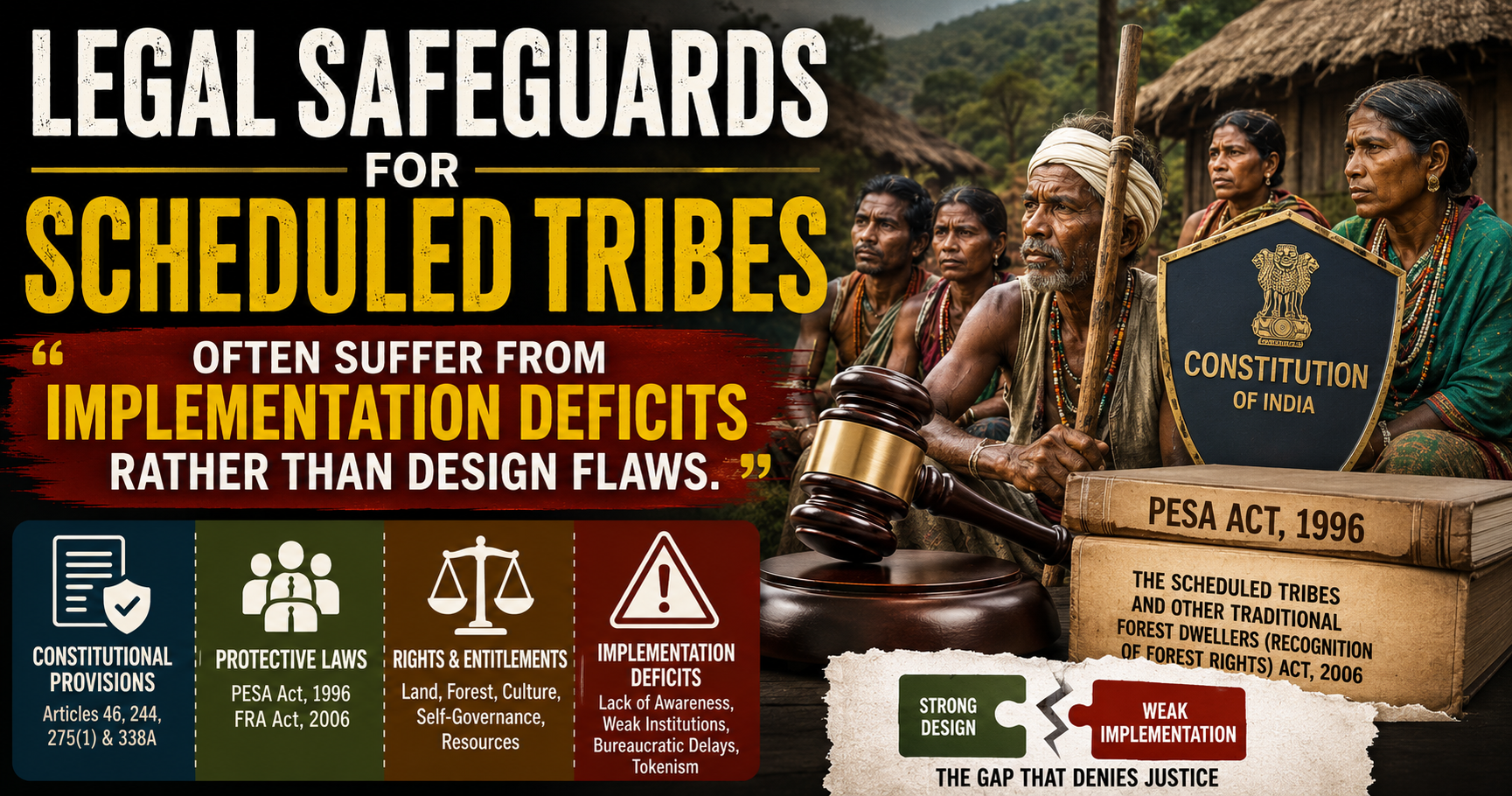
2. “Legal safeguards for Scheduled Tribes often suffer from implementation deficits rather than design flaws.” Critically examine
| Syllabus: Indian Society General Studies – : I Salient features of Indian Society, Diversity of India. |
IN NEWS: What does the latest ruling mean for the Forest Rights Act?
The protection of Scheduled Tribes (STs) in India is anchored in a sophisticated “protective discrimination” framework. However, a critical examination reveals a persistent gap between the de jure (legal) provisions and the de facto (actual) outcomes.
1. The Design: A Robust Constitutional and Statutory Framework
The legislative design is often praised for its multi-layered approach to tribal welfare:
- The Fifth and Sixth Schedules: These provide for the administration of tribal areas and “Scheduled Areas,” granting tribes a degree of autonomy and self-governance.
- Article 46: A Directive Principle that mandates the State to promote the educational and economic interests of STs and protect them from social injustice.
- The PESA Act (1996): Extends self-rule to tribal areas through Gram Sabhas, empowering them to manage natural resources and resolve local disputes.
- The Forest Rights Act (FRA), 2006: A landmark design intended to correct “historical injustices” by recognizing individual and community forest rights.
- SC/ST Prevention of Atrocities Act (1989): A stringent legal deterrent designed to prevent violence and humiliation.
2. The Implementation Deficit: Where Design Meets Reality
Despite the depth of these laws, the “implementation deficit” arises from systemic, administrative, and social hurdles.
A. Dilution of PESA and Gram Sabhas
While PESA designs the Gram Sabha as a powerful decision-making body, in practice, its role is often reduced to a consultative one. State governments frequently bypass Gram Sabhas for land acquisition or mining projects, prioritizing ease of doing business over tribal consent.
B. The FRA “Rejection Rate”
The Forest Rights Act is perfectly designed to grant land titles. However, implementation is marred by:
- High Rejection Rates: A significant percentage of claims are rejected on flimsy grounds, such as lack of satellite evidence or technical errors in filing.
- Bureaucratic Apathy: Local forest officials often view tribal residents as “encroachers” rather than rights-holders, leading to a clash between the law’s intent and its execution.
C. Institutional Weakness of TRIFED and NSTFDC
Agencies designed to ensure fair prices for Minor Forest Produce (MFP) often suffer from inadequate infrastructure, lack of procurement centers, and the persistent presence of middlemen who siphon off profits.
D. Judicial and Police Lacunae
Under the SC/ST Atrocities Act, the conviction rate remains strikingly low. Delays in filing First Information Reports (FIRs), inadequate investigations, and a massive backlog of cases in special courts undermine the act’s deterrent power.
3. Are there truly no “Design Flaws”?
While the implementation is the primary culprit, certain design flaws do exist:
- Definition Ambiguity: The criteria for “Scheduled” status remain somewhat archaic, sometimes leading to the exclusion of deserving communities or the inclusion of politically influential ones.
- Conflicting Laws: There is a fundamental design conflict between the Forest Conservation Act (1980)—which centralizes control—and the FRA (2006)—which decentralizes it. This creates a legal “tug-of-war” that officials often settle in favor of the older, more restrictive law.
- Lack of Penalties for Officials: Many tribal laws lack “teeth” regarding administrative accountability. There are few penalties for officials who fail to process FRA claims or ignore PESA mandates.
The statement holds significant weight: the Indian state has been more successful at legislating for STs than governing for them. The deficit is largely one of political will and administrative empathy.
To bridge this gap, the focus must shift from creating new laws to strengthening existing institutions. This includes the digitalization of land records, sensitizing the local bureaucracy, and ensuring that the “Governor’s Report” on Scheduled Areas—a constitutional requirement—becomes a meaningful tool for oversight rather than a mere formality.
| PYQ REFERENCE UPSC 2016 Q. “Why are the tribals in India referred to as ‘the Scheduled Tribes’? Indicate the major provisions enshrined in the Constitution of India for their upliftment.” |