


1. With reference to the Information Technology (Intermediary Guidelines and Digital Media Ethics Code) Amendment Rules, 2026, consider the following statements:
1. Photorealistic AI-generated content must be prominently labelled by social media platforms.
2. Illegal content ordered by a court or government must be taken down within 24 hours.
3. Non-compliance with the rules can lead to loss of safe harbour protection for intermediaries.
4. States are allowed to designate more than one officer to issue takedown orders.
Which of the statements given above is/are correct?
(a) 1 and 2 only
(b) 1, 3 and 4 only
(c) 2 and 4 only
(d) 1, 2, 3 and 4
Answer: (b) 1, 3 and 4 only
Explanation:
In NEWS: Centre prescribes labels for all photorealistic AI content online
IT (Intermediary Guidelines and Digital Media Ethics Code) Amendment Rules, 2026:
- The amendments are issued under the Information Technology Act, 2000.
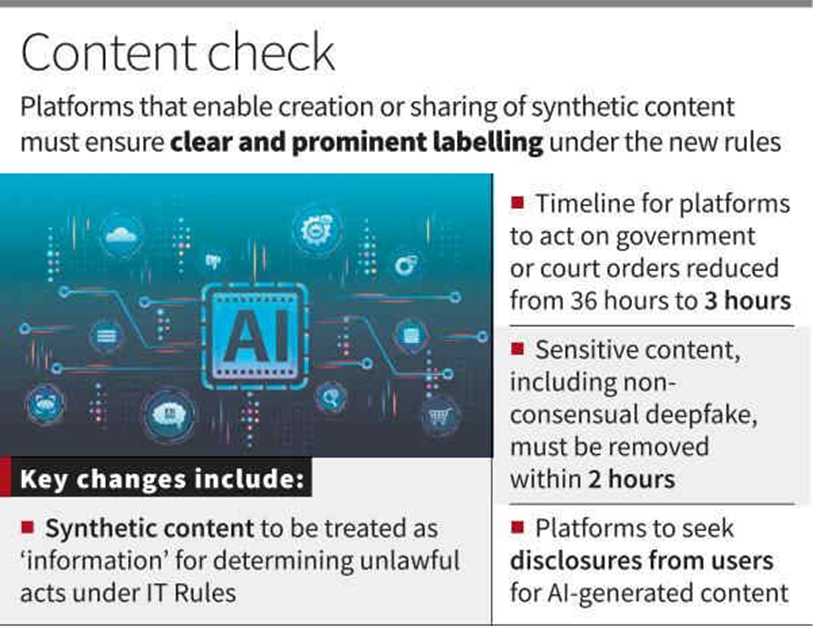
- Photorealistic AI-generated (synthetic) content must be prominently labelled online. Hence statement 1 is correct.
- Synthetic content includes audio, visual or audiovisual information artificially created or modified to appear real.
- Social media intermediaries must seek disclosure from users regarding AI-generated content.
- Platforms may proactively label or remove synthetic content if user disclosure is absent.
- Illegal content ordered by court or government must be removed within three hours. Hence statement 2 is incorrect.
- Sensitive content such as non-consensual deepfakes must be removed within two hours.
- Failure to comply may lead to loss of safe harbour protection. Hence statement 3 is correct.
- Safe harbour provides legal immunity to intermediaries for third-party content subject to due diligence.
- States are allowed to designate more than one authorised officer for issuing takedown orders. Hence statement 4 is correct.
- The amended rules come into force from 20 February 2026.
| PYQ REFERENCE: (2021) Q. With regards to Information Technology (Guidelines for Intermediaries and Digital Media Ethics Code) Rules, 2021, consider the following statements. 1. The guidelines are for Over the Top (OTT) platforms only. 2. It has the Code of Ethics and Procedure and Safeguards for the intermediaries (as defined in the guidelines). 3. The Ministry of Information and Broadcasting, Govt. of India shall formulate an oversight mechanism. 4. The rules require intermediaries to set up a grievance redressal mechanism. Which of the statements given above is/are correct? (a) 1 and 2 only (b) 2 only (c) 2, 3 and 4 only (d) 4 only |
2. With reference to the “Prithvi Vigyan Scheme”, consider the following statements:
1. It aims to strengthen Earth System Science services covering atmosphere, hydrosphere, geosphere, cryosphere and biosphere.
2. It is implemented under the Ministry of Earth Sciences (MoES)
3. The Expansion of Doppler Weather Radar (DWR) network and Automatic Weather Stations (AWS) is part of the scheme.
How many of the statements given above are correct?
(a) Only one
(b) Only two
(c) All three
(d) None
Answer: (c) All three
Explanation:
In NEWS:
PRITHVI VIGYAN SCHEME:
- PRITHVI Scheme is implemented under the Ministry of Earth Sciences (MoES). Hence statement 2 is correct.
- The scheme aims to strengthen Earth System Science services covering atmosphere, hydrosphere, geosphere, cryosphere and biosphere. Hence statement 1 is correct.
- It enhances long-term Earth observation networks including atmospheric, oceanic, cryospheric and geophysical systems.
- Expansion of Doppler Weather Radar (DWR) network and Automatic Weather Stations (AWS) is part of the scheme. Hence statement 3 is correct.
- The scheme includes strengthening of ocean observation systems such as Argo floats, ADCP moorings, GNSS tide gauges and wave rider buoys.
- High-performance computing systems like HPC-Tarang are used for operational ocean forecasting.
- Integrated glacio-hydrological monitoring systems have been established in Himalayan regions.
- The seismic monitoring network has expanded, enabling detection of earthquakes of magnitude 3.0 and above.
- The scheme supports improved forecasting of cyclones, heatwaves, cold waves, thunderstorms and other severe weather events.
- Alerts are disseminated through IMD using the Common Alerting Protocol (CAP) via the SACHET platform.
- Gram Panchayat Level Weather Forecasting (GPLWF) initiative provides localized forecasts through digital platforms like e-GramSwaraj and Mausamgram.
- PRITHVI outputs support disaster management, agriculture, water resource management and early warning systems.
| PYQ REFERENCE: (2014) Q. Consider the following statements regarding ‘Earth Hour’: 1. It is an initiative of UNEP and UNESCO. 2. It is a movement in which the participants switch off the lights for one hour on a certain day every year. 3. It is a movement to raise awareness about climate change and the need to save the planet. Which of the statements given above is/are correct? (a) 1 and 3 only (b) 2 only (c) 2 and 3 only (d) 1, 2 and 3 |
Source: https://www.pib.gov.in/PressReleasePage.aspx?PRID=2226188®=3&lang=1
3. Which one of the following is the purpose of ‘Swavalambini’, a scheme of the Government of India?
(a) Promoting entrepreneurship among female students in Higher Educational Institutions
(b) Providing housing assistance to urban women beneficiaries
(c) Providing pension benefits to women workers in informal sector
(d) Supporting rural self-help groups through microfinance
Answer: (a) Promoting entrepreneurship among female students in Higher Educational Institutions
Explanation:
In NEWS: The Ministry of Skill Development and Entrepreneurship (MSDE) in collaboration with the Women Entrepreneurship Platform of NITI Aayog as knowledge partner, launched the Swavalambini – a Women Entrepreneurship Programme in February, 2025 in six Higher Education Institutions (HEIs)/Universities of Assam, Meghalaya, Mizoram, Uttar Pradesh and Telangana as a pilot project.
Swavalambini – Women Entrepreneurship Programme
- Launched by: Ministry of Skill Development and Entrepreneurship (MSDE).
- Knowledge Partner: Women Entrepreneurship Platform (WEP) of NITI Aayog.
- Launch Year: February 2025.
- Nature: Pilot project.
- Implementing Institutes:
- National Institute for Entrepreneurship and Small Business Development (NIESBUD), Noida
- Indian Institute of Entrepreneurship (IIE), Guwahati
- Objective:
- Promote entrepreneurship among female students.
- Support transition from idea stage to enterprise creation.
- Develop entrepreneurial mindset and awareness.
- Target Group: Female students in Higher Educational Institutions (HEIs)/Universities. Hence option (a) is correct.
- States covered in pilot phase:
- Assam
- Meghalaya
- Mizoram
- Uttar Pradesh
- Telangana
- Training Structure (Multi-stage):
- Entrepreneurship Awareness Programme (EAP)
- Entrepreneurship Development Programme (EDP)
- 21 weeks mentorship and handholding support.
- Additional Component:
- Faculty Development Programme (FDP) for educators.
- Support Activities:
- Mentorship by industry leaders.
- Workshops and seed funding support by NITI Aayog.
- Award To Reward (ATR) initiative for recognition.
- Monitoring: MSDE with NITI Aayog collaboration.
| PYQ REFERENCE: (2016) Q. Which one of the following is a purpose of ‘UDAY’, a scheme of the Government? (a) Providing technical and financial assistance to startup entrepreneurs in the field of renewable sources of energy (b) Providing electricity to every household in the countries by 2018 (c) Replacing the coal-based power plants with natural gas, nuclear, solar, wind and tidal power plants over a period of time (d) Providing for financial turnaround and revival of power distribution |
Source: https://www.pib.gov.in/PressReleasePage.aspx?PRID=2225466®=3&lang=1
4. With reference to the PM SVANidhi Scheme, consider the following statements:
1. The scheme provides working capital loans to urban street vendors in multiple tranches based on repayment performance.
2. The scheme is implemented by the Ministry of Rural Development.
Which of the statements given above is/are correct?
(a) 1 only
(b) 2 only
(c) Both 1 and 2
(d) Neither 1 nor 2
Answer: (a) 1 only
Explanation:
In NEWS: IMPROVEMENT UNDER PM SVANIDHI SCHEME
PM SVANidhi Scheme:
- PM SVANidhi (Pradhan Mantri Street Vendor’s AtmaNirbhar Nidhi) was launched in June 2020.
- Objective: Provide working capital loans to urban street vendors affected by COVID-19. Hence statement 1 is correct.
- Implemented by the Ministry of Housing and Urban Affairs (MoHUA). Hence statement 2 is incorrect.
- Loans provided in three tranches:
- Next tranche eligibility after successful repayment of previous loan.
- Scheme features:
- Prevents over-indebtedness through staggered lending.
- Encourages sustainable repayment behaviour.
- Provides UPI-linked RuPay Credit Cards (after successful second tranche repayment).
- Impact:
- Around 20% growth in average annual business income (2023–2025 study).
- Helps build formal credit history for informal vendors.
- Coverage expanded under restructured scheme:
- Extended till March 2030.
- Includes census towns, urban agglomerations and peri-urban areas.
- Implementation:
- State Governments/ULBs identify beneficiaries.
- Digital literacy camps and cashback incentives for digital payments.
| PYQ REFERENCE: (2016) Q. With reference to ‘Stand Up India Scheme’, which of the following statements is/are correct? 1. Its purpose is to promote entrepreneurship among SC/ST and women entrepreneurs. 2. It provides for refinance through SIDBI. Select the correct answer using the code given below. (a) 1 only (b) 2 only (c) Both 1 and 2 (d) Neither 1 nor 2 |
Source: https://www.pib.gov.in/PressReleasePage.aspx?PRID=2225510®=3&lang=1
5. The Network Readiness Index (NRI) is prepared by which organisation?
(a) World Economic Forum
(b) Portulans Institute
(c) International Telecommunication Union
(d) World Bank
Answer: (b) Portulans Institute
Explanation:
In NEWS: India shines in Network Readiness Index Report 2025, prepared by Portulans Institute based in Washington DC
Network Readiness Index (NRI) 2025:
- The Network Readiness Index (NRI) is prepared by the Portulans Institute, an independent non-profit research institute based in Washington DC. Hence option (b) is correct.
- The NRI assesses the network-based readiness of economies using four pillars:
- Technology
- People
- Governance
- Impact
- The index evaluates countries based on 53 indicators across digital infrastructure, skills, policies, and socio-economic outcomes.
- The NRI 2025 covers 127 economies worldwide.
- India improved its ranking to 45th position in NRI 2025.
- India’s score increased from 53.63 (2024) to 54.43 (2025).
- India secured 1st rank globally in:
- Annual investment in telecommunication services
- AI scientific publications
- ICT services exports
- E-commerce legislation
- India ranked 2nd globally in:
- FTTH/Building internet subscriptions
- Mobile broadband internet traffic within the country
- International internet bandwidth
- India ranked 3rd globally in:
- Domestic market scale
- Income inequality (indicator context)
- According to the report, India demonstrates higher network readiness than expected for its income level.
- India stands 2nd among lower-middle-income countries in the NRI 2025.
| PYQ REFERENCE: (2017) Q. In India, it is legally mandatory for which of the following to report on cyber security incidents? 1. Service providers 2. Data centers 3. Body corporate Select the correct answer using the codes given below: (a) 1 only (b) 1 and 2 only (c) 3 only (d) 1, 2 and 3 |
Source: https://www.pib.gov.in/PressReleasePage.aspx?PRID=2225406®=3&lang=1
6. Which one of the following best describes the ‘Kimberley Process’?
(a) An international initiative to regulate trade in rare earth minerals
(b) A United Nations programme for regulating gemstone exports
(c) A global agreement to promote sustainable gold mining
(d) A certification mechanism to prevent trade in conflict diamonds
Answer: (d) A certification mechanism to prevent trade in conflict diamonds
Explanation:
In NEWS: A chance for India to polish the Kimberley Process
Kimberley Process (KP):
- The Kimberley Process (KP) is an international initiative to regulate the trade in conflict diamonds. Hence option (d) is correct.
- Conflict diamonds are rough diamonds used by rebel or insurgent groups to finance conflicts against legitimate governments.
- The Kimberley Process was initiated in May 2000 by countries of southern Africa.
- The Kimberley Process Certification Scheme (KPCS) was established in 2003.
- Under KPCS:
- Rough diamonds can be traded only between KP participant countries.
- Each shipment must carry a Kimberley Process certificate.
- Member countries enforce certification through domestic legislation.
- KP currently has 60 participants, representing about 86 countries.
- The Kimberley Process accounts for approximately 99.8% of global rough diamond production.
- Participant countries must share statistical data related to diamond production and trade.
- India has assumed the Chairmanship of the Kimberley Process for 2026.
| PYQ REFERENCE: (2018) Q. Which one of the following foreign travellers elaborately discussed diamonds and diamond mines of India? (a) Francois Bernier (b) Jean-Baptiste Tavernier (c) Jean de Thevenot (d) Abbe Barthelemy Carre |
7. With reference to the BharatSHRI project, consider the following statements:
1. BharatSHRI is a project of the Archaeological Survey of India aimed at digitising and creating a repository of inscriptions across India.
2. The repository includes details of each inscription, such as location, king/dynasty, language, script, period, transcript, and description.
Which of the statements given above is/are correct?
(a) 1 only
(b) 2 only
(c) Both 1 and 2
(d) Neither 1 nor 2
Answer: (c) Both 1 and 2
Explanation:
In NEWS: As part of the ongoing digitisation of inscription estampages under the Bharat Shared Repository of Inscriptions (BharatSHRI) project, the Epigraphy Division of the Archaeological Survey of India (ASI) has begun recopying inscriptions whose estampages are damaged.
BharatSHRI (Bharat Shared Repository of Inscriptions):
- BharatSHRI is a project of the Archaeological Survey of India (ASI), under its Epigraphy Division.
- The project aims to digitise and create a central repository of inscriptions (estampages) from across India. Hence statement 1 is correct.
- The repository includes details of each inscription, such as location, king/dynasty, language, script, period, transcript, and description. Hence statement 2 is correct.
- Over 76,000 inscriptions in several languages are being digitised, including more than 25,000 Tamil inscriptions.
- The ASI is recopying damaged or partially missing inscriptions to improve clarity in the digital records.
- 18 technical teams are involved nationwide, with 4 teams currently deployed in Tamil Nadu (Tiruchi, Ulundurpet, Tiruppur, Thanjavur).
- Some inscriptions belong to Raja Raja Chola, Rajendra Chola, and Vijayanagar rulers, originally copied between 1887 and 1915.
- The ASI has allocated ₹15 lakh for the recopying drive.
- The project allows online users to access clear and accurate digitised estampages for research and reference.
- BharatSHRI contributes to preservation, documentation, and wider accessibility of India’s epigraphical heritage.
| PYQ REFERENCE: (2023) Q. With reference to ancient India, consider the following statements : 1. The concept of Stupa is Buddhist in origin. 2. Stupa was generally a repository of relics. 3. Stupa was a votive and commemorative structure in Buddhist tradition. How many of the statements given above are correct? (a) Only one (b) Only two (c) All three (d) None |
8. The Government of India banned the veterinary use of a particular non-steroidal anti-inflammatory drug (NSAID) after it was found responsible for the drastic decline of vulture populations in India during the late 20th and early 21st centuries. Which one of the following drugs is being referred to?
(a) Diclofenac
(b) Ibuprofen
(c) Paracetamol
(d) Meloxicam
Answer: (a) Diclofenac
Explanation:
In NEWS: Vulture Conservation Sees Revival Milestone in Maharashtra
- Migratory species like Himalayan Griffon Vulture and Eurasian Griffon Vulture have been recently sighted in Maharashtra, indicating ecological recovery.
Diclofenac and thread to Vulture population:
- Vulture populations in India declined drastically during the late 20th and early 21st centuries mainly due to veterinary use of diclofenac and other harmful non-steroidal anti-inflammatory drugs (NSAIDs).
- Diclofenac is a non-steroidal anti-inflammatory drug (NSAID) used as a painkiller and anti-inflammatory medicine.
- It was widely used in veterinary medicine to treat livestock.
- Vultures feeding on carcasses of animals treated with diclofenac suffered kidney failure, leading to mass mortality.
- Diclofenac caused a drastic decline (over 95%) in populations of several vulture species in India during the 1990s–2000s.
- India banned veterinary use of diclofenac in 2006 to protect vultures.
- Safer alternative drugs such as meloxicam are recommended for veterinary use.
- Diclofenac is still allowed for human medical use, but multi-dose vials are regulated to prevent misuse in animals.
- Vultures are important scavengers and help in disease control by removing carcasses.
| PYQ REFERENCE: (2012) Q. Vultures which used to be very common in the Indian countryside some years ago are rarely seen nowadays. This is attributed to (a) the destruction of their nesting sites by new invasive species (b) a drug used by cattle owners for treating their diseased cattle (c) scarcity of food available to them (d) a widespread, persistent and fatal disease among them. |
Source: https://www.gktoday.in/vulture-conservation-sees-revival-milestone-in-maharashtra/
9. With reference to the Lymphatic Filariasis elimination programme in India, consider the following statements:
1. Lymphatic Filariasis (LF) is a vector-borne parasitic disease, commonly known as elephantiasis which is transmitted mainly by the female Culex mosquito
2. India aims to eliminate Lymphatic Filariasis by 2027, ahead of the global SDG target of 2030.
3. Hydrocele surgery for patients affected by Lymphatic Filariasis is covered under the Ayushman Bharat – Pradhan Mantri Jan Arogya Yojana (AB-PMJAY).
Which of the statements given above are correct?
(a) 1 and 2 only
(b) 2 and 3 only
(c) 1, 2 and 3
(d) 1 only
Answer: (b) 2 and 3 only
Explanation:
In NEWS: Union Health Minister Shri J.P. Nadda Launches Annual Nationwide Mass Drug Administration Campaign for Lymphatic Filariasis Elimination across 12 Endemic States
Lymphatic Filariasis (LF):
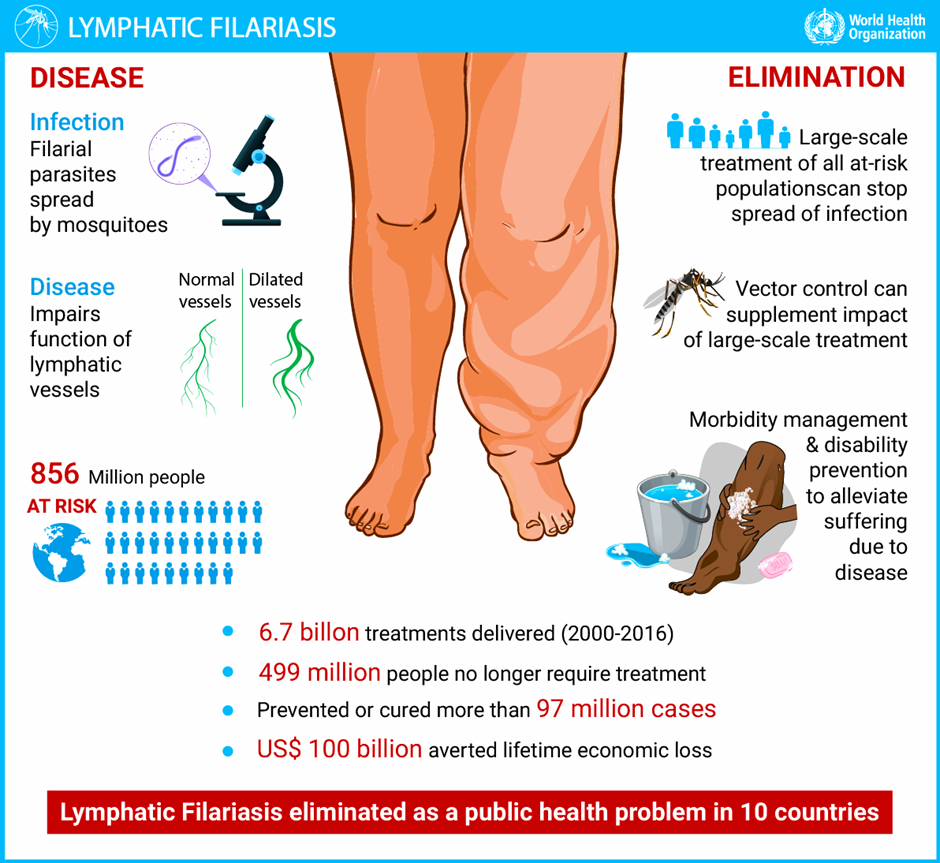
- Lymphatic Filariasis (LF) is a vector-borne parasitic disease, commonly known as elephantiasis.
- It is transmitted mainly by the female Anopheles mosquito, which breeds in polluted and stagnant water. Hence statement 1 is incorrect.
- The disease damages the lymphatic system and can cause chronic conditions such as lymphoedema and hydrocele.
- The Government of India aims to eliminate LF as a public health problem by 2027, ahead of the global SDG target of 2030. Hence statement 2 is correct.
- LF is endemic in 348 districts across 20 States and Union Territories in India.
- About 41% of endemic districts have stopped Mass Drug Administration (MDA) after clearing the Transmission Assessment Survey (TAS-1).
- Around 50% of districts continue annual MDA due to microfilaria rates above 1%.
- The primary strategy for elimination is the Mass Drug Administration (MDA) campaign, ensuring preventive treatment to eligible populations.
- India has transitioned to a unified annual MDA campaign replacing earlier biannual rounds.
- The elimination strategy follows an Enhanced Five-Pronged approach including vector control, surveillance, community participation, and morbidity management.
- Morbidity Management and Disability Prevention (MMDP) includes hydrocele surgeries and supportive care for affected individuals.
- Ayushman Arogya Mandirs play a role in early screening, detection, and treatment of LF cases.
- Hydrocele surgery is covered under Ayushman Bharat – Pradhan Mantri Jan Arogya Yojana (AB-PMJAY). Hence statement 3 is correct.
- Directly observed drug consumption is emphasized to improve compliance and coverage.
- Multi-sectoral collaboration involving Panchayati Raj institutions and allied ministries is part of the elimination strategy.
- Data monitoring and reporting are supported through the Integrated Health Information Portal (IHIP).
- Community engagement and awareness are key to overcoming last-mile challenges and drug hesitancy.
| PYQ REFERENCE: (2017) Q. Consider the following statements: 1. In tropical regions, Zika virus disease is transmitted by ‘the same mosquito that transmits dengue. 2. Sexual transmission of Zika virus disease is possible Which of the statements given above is/are correct? (a) 1 only (b) 2 only (c) Both 1 and 2 (d) Neither 1 nor 2 |
Source: https://www.pib.gov.in/PressReleasePage.aspx?PRID=2225910®=3&lang=1
10. Sanghabhuti, an Indian Buddhist monk, who travelled to China at the end of the fourth century AD, was the author of a commentary on:
(a) Prajnaparamita Sutra
(b) Visuddhimagga
(c) Sarvastivada Vinaya Sain
(d) Lalitavistara
Answer: (c) Sarvastivada Vinaya Sain
Explanation:
- Sanghabhuti (also known as Saṃghabhūti) was a prominent Indian Buddhist monk from Kashmir who traveled to Chang’an, China, around 381–384 AD. He is historically recognized for his critical role in the transmission of the Sarvastivada tradition to China.
Key details of his contributions include:
- Commentary & Translation: He is specifically credited with the translation and authorship of a commentary (often identified as the Vibhasa) on the Sarvastivada Vinaya, which provided essential rules for monastic discipline.
- Monastic Influence: His work helped establish the monastic code for the burgeoning Chinese Buddhist community during the Former Qin dynasty.
- Other Works: He is also noted for his involvement in translating the Abhidharmavibhasa Sastra.
Other options are incorrect:
- (a) Prajnaparamita Sutra: These Mahayana “Perfection of Wisdom” texts were primarily associated with other translators like Kumarajiva.
- (b) Visuddhimagga: This is a landmark Theravada text written by Buddhaghosa in Sri Lanka during the 5th century, after Sanghabhuti’s time.
- (d) Lalitavistara: While it is a biographical text on the life of Buddha used in both Sarvastivada and Mahayana traditions, Sanghabhuti is not historically linked to its commentary.