

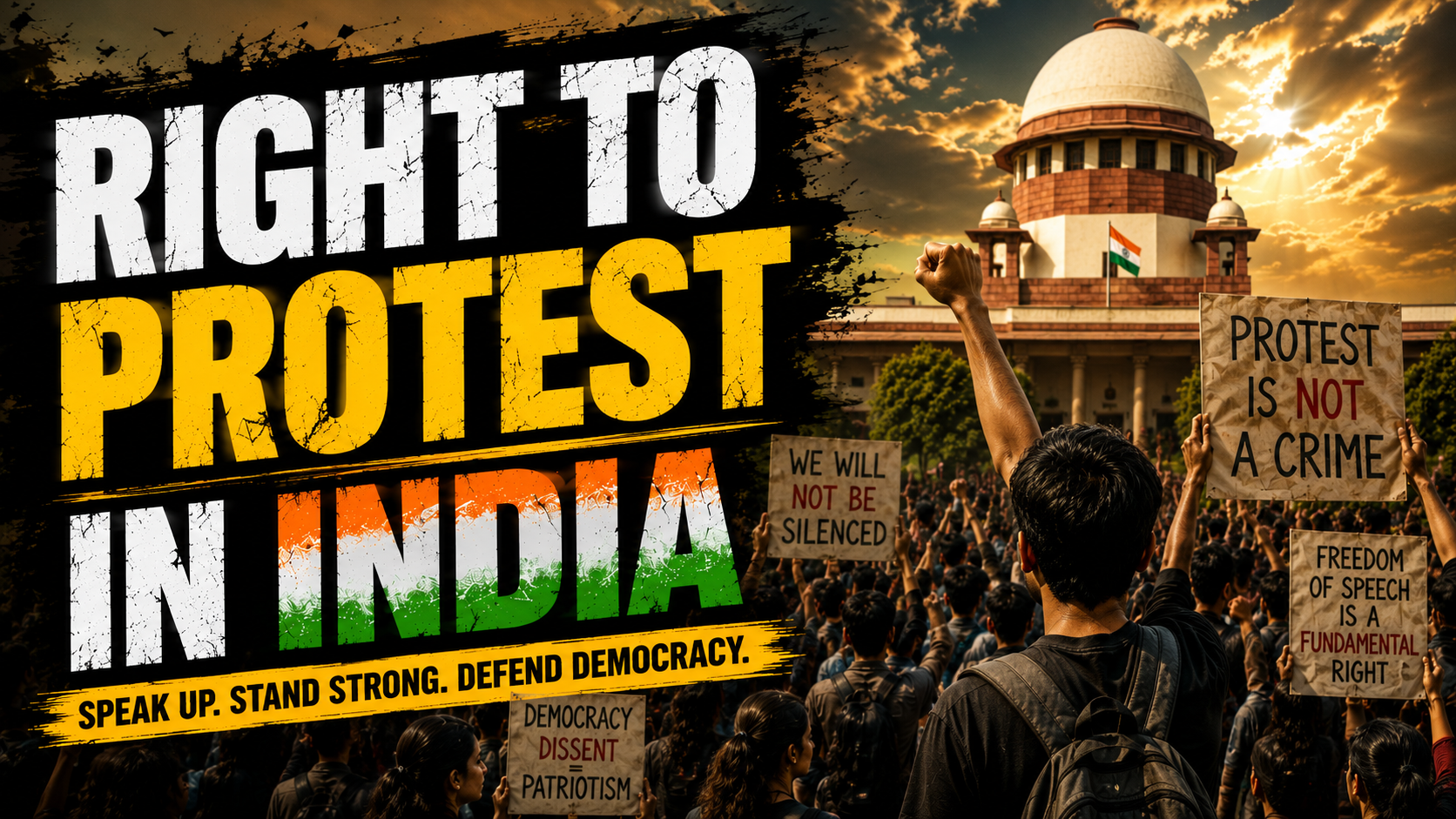
1. Discuss the relationship between freedom of speech, freedom of assembly and democratic accountability in India.
| Syllabus: Indian Polity General Studies –: II Structure, organization and functioning of the Executive and the Judiciary—Ministries and Departments of the Government; pressure groups and formal/informal associations and their role in the Polity. |
IN NEWS: Protecting protest
Democracy is sustained not merely through periodic elections but through continuous citizen participation and accountability. In India, freedom of speech and expression [Article 19(1)(a)] and freedom to assemble peacefully and without arms [Article 19(1)(b)] together constitute the foundation of democratic accountability by enabling citizens to question, criticize and influence those in power.
Relationship Between Freedom of Speech, Freedom of Assembly and Democratic Accountability
1. Enables Public Scrutiny of Government
- Freedom of speech allows citizens, media and civil society to expose corruption, maladministration and abuse of power.
- Peaceful assemblies transform individual concerns into collective democratic action, compelling governments to respond.
2. Strengthens Participatory Democracy
- Public meetings, rallies, protests and social movements facilitate citizen participation beyond elections.
- They bridge the gap between representative and participatory democracy.
3. Acts as a Check on Executive Power
- Public criticism and peaceful demonstrations discourage arbitrary governance.
- They reinforce constitutional principles of transparency, accountability and rule of law.
4. Influences Public Policy
- Organized public opinion has shaped several policy decisions, including:
- Right to Information movement.
- Anti-corruption reforms leading to the Lokpal framework.
- Farmers’ protests influencing agricultural legislation.
5. Protects Rights of Marginalised Groups
- Assemblies provide a democratic platform for workers, women, tribal communities, minorities and students to articulate grievances that may otherwise remain unheard.
6. Promotes Deliberative Democracy
- Open debate encourages informed public discourse and improves the quality of governance through diverse viewpoints.
Constitutional and Judicial Safeguards
- Article 19(2) permits reasonable restrictions on speech in the interests of sovereignty, security, public order, decency, morality, etc.
- Article 19(3) allows reasonable restrictions on peaceful assembly in the interest of sovereignty and public order.
- The Supreme Court has repeatedly held that restrictions must satisfy the tests of legality, necessity and proportionality.
- In Mazdoor Kisan Shakti Sangathan v. Union of India, the Court recognised peaceful protest as a constitutional right while balancing it with public convenience.
- In Anuradha Bhasin v. Union of India, the Court affirmed that restrictions affecting freedom of expression must be proportionate and subject to judicial review.
- In Shaheen Bagh judgment, the Court held that public protests are legitimate but cannot indefinitely occupy public spaces.
Emerging Challenges
- Frequent restrictions citing public order and security concerns.
- Misuse of criminal laws and preventive detention against dissent.
- Internet shutdowns affecting speech and peaceful mobilisation.
- Spread of misinformation and hate speech on digital platforms.
- Balancing citizens’ right to protest with the rights of commuters and essential services.
Way Forward
- Ensure restrictions strictly satisfy the constitutional test of reasonableness and proportionality.
- Establish transparent and predictable procedures for granting permission for peaceful assemblies.
- Strengthen institutional accountability through independent media, civil society and parliamentary oversight.
- Promote responsible digital governance to counter misinformation while safeguarding free expression.
- Enhance civic education to encourage peaceful, informed and constitutional forms of democratic participation.
| PYQ REFERENCE UPSC 2014 Q. What do you understand about the concept of “freedom of speech and expression”? Does it cover hate speech also? Why do the films in India stand on a slightly different plane from other forms of expression? Discuss. |
2. What is the principle of ‘minimum use of force’ in policing? Explain its significance in a constitutional democracy.
| Syllabus: Indian Polity General Studies–: II Structure, organization and functioning of the Executive and the Judiciary—Ministries and Departments of the Government; pressure groups and formal/informal associations and their role in the Polity. |
IN NEWS: Over 70% of police back immunity for using force
The principle of minimum use of force is a fundamental rule of law enforcement and constitutional jurisprudence. It dictates that state security forces must deploy only the lowest degree of physical coercion necessary to achieve a legitimate law enforcement objective, such as effecting an arrest, quelling a riot, or maintaining public order.
Under this doctrine, physical force is an exceptional measure of last resort rather than an acceptable shortcut to compliance.
1. Core Pillars of the Principle
A. Necessity and Exhaustion of Alternatives
- Definition: Force can only be deployed when all non-violent means—such as verbal warnings, de-escalation, negotiation, or tactical withdrawal—are either ineffective or impossible given the immediate danger.
- Judicial Backing: In Karam Singh v. Hardayal Singh (1979), the High Court established that police force is strictly contingent upon meeting prerequisite thresholds, asserting that force is unlawful unless non-violent measures to disperse a crowd have first failed.
B. Proportionality and Graduated Response
- Definition: The force used must directly correspond to the level of threat posed by the individual or situation. It must scale incrementally—from verbal orders to riot equipment, with lethal force reserved purely for threats to life—and instantly cease once control is established.
- Judicial Backing: In Anita Thakur v. State of J&K (2016), the Supreme Court held that while police can use reasonable force to manage disruptive crowds, continuing to use force after a situation is brought under control constitutes excessive, illegal violence that violates basic human rights and dignity.
C. Legality and Strict Scrutiny
- Definition: Every application of force must have explicit authorization in statutory law and comply with constitutional checks. Statutory provisions like Section 130(3) of the CrPC (now mirrored in the Bharatiya Nagarik Suraksha Sanhita, 2023) mandate that state forces use only as “little force” as necessary.
2. Significance in a Constitutional Democracy
A. Protection of Fundamental Right to Life and Liberty (Article 21)
- Constitutional Nexus: Article 21 guarantees that no person shall be deprived of life or personal liberty except according to a procedure established by law—a procedure that must be “fair, just, and reasonable” (Maneka Gandhi v. Union of India, 1978).
- Judicial Precedent: In Extra Judicial Execution Victim Families Association v. Union of India (2016), the Supreme Court ruled that state agents do not possess an unchecked license to kill even in disturbed areas under AFSPA. The Court emphasized that every encounter or excessive use of force resulting in death must be independently investigated, reaffirming that state action must never bypass the constitutional right to life.
B. Protection Against Extrajudicial Punishment and Safeguarding Due Process
- Constitutional Nexus: A constitutional framework enforces a strict separation of powers. The police are agents of apprehension, while adjudication and punishment are strictly reserved for the judiciary.
- Judicial Precedent: In D.K. Basu v. State of West Bengal (1997), the Supreme Court condemned custodial violence and arbitrary police force as a blow to the rule of law. The Court laid down mandatory guidelines for arrests to prevent torture and extrajudicial violence, establishing that “custodial violence is an assault upon human dignity.”
C. Preservation of Democratic Dissent and Assembly [Article 19(1)(a) & 19(1)(b)]
- Constitutional Nexus: Peaceful assembly and free speech are vital to democratic accountability. Misusing force to disperse crowds suppresses citizens’ abilities to question power.
- Judicial Precedent: In Re: Ramlila Maidan Incident (2012), the Supreme Court ruled that peaceful assembly is a fundamental right, and the police cannot use force or lathi charges arbitrarily against sleeping or peaceful crowds. The Court reiterated that force must be an absolute last resort, applied with maximum restraint.
D. Sustaining “Policing by Consent” and Institutional Legitimacy
- Constitutional Nexus: Democratic states rely on legitimacy rather than authoritarian coercion.
- Judicial Precedent: In Prakash Singh v. Union of India (2006), the Supreme Court issued sweeping directives for police reform to free law enforcement from political pressure and make it an accountable institution that serves citizens rather than terrorizes them. Restraint builds public trust, which is necessary for law enforcement to function in a free society.
The principle of minimum use of force marks the boundary between democratic policing and authoritarian state control. By binding state power to Articles 14, 19, and 21 of the Constitution and enforcing accountability through judicial precedents like D.K. Basu and Ramlila Maidan, constitutional democracies ensure that police officers remain defenders of the law rather than threats to citizen liberties.
| PYQ REFERENCE UPSC 2023 Q. The increasing instances of the use of force by the police and the lack of accountability have raised questions about the rule of law in India. Examine the issues and suggest reforms in the police system in India. (15 Marks, 250 Words) |