

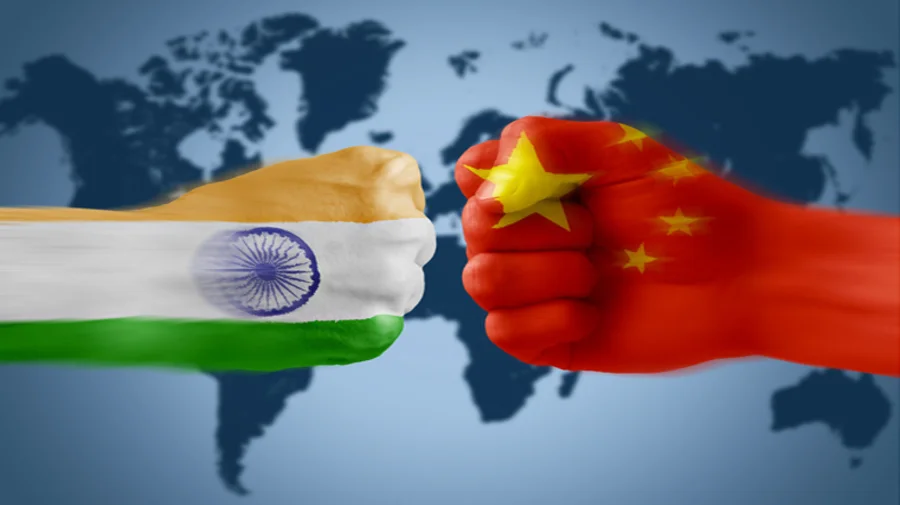
1. What is meant by the ‘package settlement’ approach in the India-China boundary negotiations? Why has India consistently supported this framework?
| Syllabus: International Relations General Studies – : II India and its neighborhood- relations. |
IN NEWS: The ‘harvest’ China wants is one India cannot afford
The “Package Settlement” approach is a foundational concept in the history of India-China boundary negotiations. It posits that the unresolved dispute along the 3,488 km Line of Actual Control (LAC)—divided into the Western (Ladakh), Middle (Himachal Pradesh/Uttarakhand), and Eastern (Arunachal Pradesh) sectors—must be settled as a single, comprehensive political package rather than piecemeal or sector-by-sector agreements.
This framework was formally codified in Article IV of the 2005 Agreement on Political Parameters and Guiding Principles for the Settlement of the India-China Boundary Question, which states:
“The boundary settlement must be final, covering all sectors of the India-China boundary.”
Understanding the ‘Package Settlement’ Approach
Historically rooted in proposals made by Chinese Premier Zhou Enlai (1960) and later formalised by Deng Xiaoping (1980), the package deal fundamentally suggests a mutual swap based on the status quo:
- The Chinese Premise: China sought India’s recognition of Chinese sovereignty over Aksai Chin (Western Sector) in exchange for China recognizing the McMahon Line or Indian sovereignty over Arunachal Pradesh (Eastern Sector).
- The Dynamic Evolution: While initially proposed by China to legitimize its territorial gains from 1962, the interpretation of the “package” has evolved. Today, India views it as a holistic diplomatic exercise where concessions and alignments across all three sectors must be negotiated simultaneously to ensure strategic balance, precluding China from altering terms unilaterally in any single sector.
Why India Consistently Supports the Package Framework
India’s insistence on a comprehensive package settlement over a segmented, sector-by-sector approach is driven by deeply considered strategic, historical, and geopolitical calculations:
1. Rejection of the “Early Harvest” Trap
China has frequently attempted to shift the goalposts by proposing an “Early Harvest” approach—such as attempting to settle the less contentious Sikkim or Middle sectors separately (a strategy reiterated by Chinese diplomats as recently as 2017 and in subsequent border dialogues). India rejects this because:
- Settling easier sectors first dilutes India’s negotiating leverage.
- Once China secures its objectives in a specific sector, it loses the incentive to negotiate fairly on the highly contested Western (Aksai Chin) and Eastern sectors.
2. Safeguarding Territorial Integrity in the Eastern Sector
Under Deng Xiaoping’s original package offer, the swap seemed straightforward. However, in the 21st century, China altered its stance, claiming major chunks of the Eastern sector (demanding Tawang in Arunachal Pradesh, which it refers to as Zangnan or South Tibet).
- By sticking to a comprehensive package framework, India prevents China from cherry-picking sectors or pocketing gains in Ladakh while continuing to aggressively claim territories in Arunachal Pradesh.
3. Prevention of Salami-Slicing Tacts
A segmented negotiation framework allows room for China’s well-documented “salami-slicing” strategy (gradual, small-scale military encroachments to alter the status quo, as seen during the 2020 Galwan and eastern Ladakh standoffs). A comprehensive package links peace, boundary delimitation, and overall bilateral relations together. It forces China to look at the border holistically rather than exploiting localized tactical advantages.
4. Legal and Political Consistency
India’s position aligns strictly with the bilateral institutional frameworks established over decades:
- The 2005 Guiding Principles: Article VII explicitly protects settled populations (“In reaching a boundary settlement, the two sides shall safeguard due interests of their settled populations in the border areas”). This protects regions like Tawang.
- By demanding a comprehensive package, India ensures that the legal protections negotiated in 2005 apply uniformly across the entire frontier, preventing China from separating legal principles from geographic sectors.
5. Geopolitical Leverage and Overall Ties
India has firmly stated that the state of the border determines the state of the overall bilateral relationship. Supporting a package settlement means India will not normalize economic or trade ties while the border remains destabilized in fragments. It forces a macro-political resolution rather than leaving it to localized military-to-military adjustments.
The structural robustness of India’s stance is backed by the formal Three-Stage Process agreed upon by the Special Representatives (SRs) of both nations:
| Stage | Objective | Status / Indian Stance |
| Stage 1 | Agreement on Political Parameters and Guiding Principles | Achieved in 2005. Forms the legal bedrock of the package framework. |
| Stage 2 | Evolving a Framework for a Comprehensive Settlement | Ongoing/Stalled. India insists this framework must cover all sectors equally. |
| Stage 3 | Delineation and Demarcation of the Border on the Maps & Ground | Final phase, dependent entirely on the successful completion of Stage 2. |
For India, the ‘package settlement’ approach is not merely a diplomatic preference but a strategic shield. A sector-by-sector negotiation would allow Beijing to apply asymmetric military pressure on localized sectors (like Eastern Ladakh) while isolating other areas. By maintaining that “nothing is agreed until everything is agreed,” India ensures that any final resolution with China will be fair, mutual, and structurally sustainable, safeguarding its sovereignty from Ladakh to Arunachal Pradesh.
| PYQ REFERENCE UPSC 2024 Q. “India has a long and troubled border with China and Pakistan fraught with contentious issues. Examine the conflicting issues and security challenges along the border. Also give out the development being undertaken in these areas under the Border Area Development Programme (BADP) and Border Infrastructure and Management (BIM) Scheme.” |
2. India’s semiconductor strategy reflects the broader challenge of balancing technological sovereignty with global integration. Discuss.
| Syllabus: Science and Technology General Studies – : III Achievements of Indians in science & technology; indigenization of technology and developing new technology. |
IN NEWS: The future of India’s chip industry
Semiconductors are the bedrock of modern geopolitics, driving everything from artificial intelligence to strategic defense systems. However, the semiconductor value chain is arguably the most globalized and fragmented industry in the world:
For India, technological sovereignty does not mean autarky (self-sufficiency). Rather, it means achieving strategic autonomy—ensuring that a geopolitical crisis (like a conflict in the Taiwan Strait) cannot unilaterally cripple India’s digital economy or defense capabilities.
1. Pillars of Technological Sovereignty (The “Local” Push)
Through the India Semiconductor Mission (ISM), backed by a initial financial outlay of $10 billion (₹76,000 crore), India has initiated a structural shift to anchor critical nodes of the supply chain domestically.
- Fabrication Capabilities (The Holy Grail): India has greenlit mega-projects to transition from a design-only hub to a manufacturing powerhouse. Key projects—such as the Tata Electronics fab in Dholera, Gujarat (partnering with Taiwan’s PSMC) and CG Power’s facility—represent the first concrete steps toward manufacturing physical silicon chips on Indian soil.
- ATMP and Testing Operations: Realizing that full-scale leading-edge fabrication takes a decade to mature, India has focused heavily on ATMP (Assembly, Testing, Marking, and Packaging) and Outsourced Semiconductor Assembly and Test (OSAT) facilities. The Micron plant in Sanand, Gujarat, serves as an anchor, creating an immediate domestic node for finishing chips.
- Design Sovereignty (The DLI Scheme): India already designs roughly 20% of the world’s integrated circuits, but historically for foreign multinationals. The Design Linked Incentive (DLI) scheme nurtures indigenous startups, allowing India to retain intellectual property (IP) sovereignty rather than just acting as a back-office backend.
2. The Imperative of Global Integration (The “Global” Reality)
No single nation, including the United States, can build an entirely domestic semiconductor supply chain. India’s strategy is explicitly designed to integrate deeply into the global ecosystem, rather than walling itself off.
- Deep Geopolitical Partnerships (The Quad & iCET): India has leveraged plurilateral frameworks to secure its supply chain. Under the US-India Initiative on Critical and Emerging Technology (iCET) and the Quad Semiconductor Supply Chain Initiative, India positions itself as a trusted “friend-shoring” destination, alternative to China.
- Reliance on Global Monopolies: Building a chip requires lithography machines from ASML (Netherlands), specialized chemicals from Japan, and design software (EDA tools) from the US. India’s strategy recognizes this by actively inviting global giants to set up ecosystems locally, easing import restrictions on these hyper-specialized components.
- Attracting Global Foundries via Subsidies: The capital expenditure is heavily subsidized by the Indian government (up to 50% of project costs). This massive fiscal incentive acknowledges that global capital and foreign technology transfers are prerequisites for domestic sovereignty.
3. The Structural Challenges in Balancing the Two
The tension between being sovereign and being integrated manifests in several distinct friction points:
- The Technology Node Gap vs. Commercial Viability: India is starting primarily with mature nodes ($28\text{nm}$ to $90\text{nm}$ or legacy nodes), which are critical for automotive, defense, and IoT power management. While this builds immediate sovereignty for local manufacturing sectors, the world is integrating around sub-$3\text{nm}$ logic chips for AI and smartphones. India remains dependent on global integration for advanced computing.
- Resource Asymmetry (Water and Power): Semiconductor fabs require millions of gallons of ultra-pure water daily and uninterrupted, fluctuation-free power. Forcing local “sovereignty” in regions prone to infrastructure deficits runs the risk of lowering yield rates, making Indian-made chips commercially uncompetitive in the integrated global market.
- The Talent Paradox: India possesses an elite talent pool for chip design, but lacks a seasoned workforce for chip fabrication (chemical engineering, cleanroom protocols, operational metallurgy). Bridging this requires importing global talent and setting up joint training institutes with countries like Taiwan.
India’s semiconductor strategy demonstrates that modern technological sovereignty is not built on isolation, but on strategic interdependence.
By developing domestic fabrication and ATMP capabilities, India ensures it is no longer just a passive consumer at the mercy of global supply disruptions. By simultaneously embedding itself into Western and East Asian technology corridors through iCET and joint ventures, India ensures it stays at the cutting edge of technological evolution. The ultimate goal of the India Semiconductor Mission is to make India so vital to the global semiconductor value chain that its technological sovereignty is guaranteed by its sheer integration.
| PYQ REFERENCE UPSC 2025 Q. “India aims to become a semiconductor manufacturing hub. What are the challenges faced by the semiconductor industry in India? Mention the salient features of the India Semiconductor Mission.” (250 words, 15 marks) |