

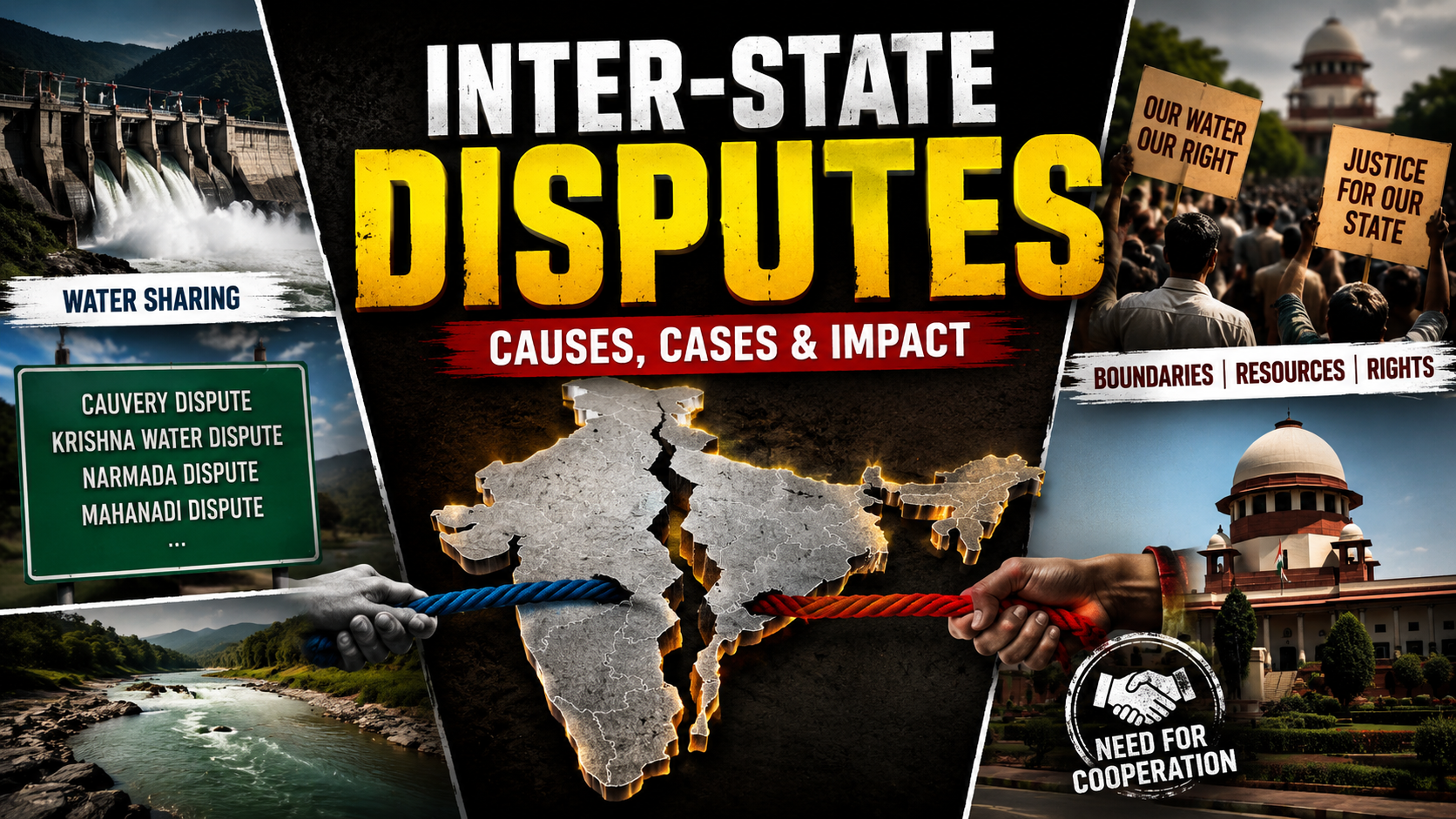
1. The Inter-State Council and Zonal Councils were envisaged as instruments of cooperative federalism, but their effectiveness depends upon timely implementation of their recommendations. Discuss. (15 marks, 250 words)
| Syllabus: Indian Polity General Studies – : II Functions and responsibilities of the Union and the States, issues and challenges pertaining to the federal structure, devolution of powers and finances up to local levels and challenges therein. |
IN NEWS: Mediating Telangana’s inter-State issues
India’s federal system requires continuous consultation and coordination between the Union and States, particularly because several policy issues transcend State boundaries. The Inter-State Council (ISC), constituted under Article 263, and the Zonal Councils, created under the States Reorganisation Act, 1956, provide institutional mechanisms for such cooperation. However, their effectiveness depends not merely on deliberation but on follow-up and timely implementation of agreed recommendations.
Role in promoting cooperative federalism
1. Institutionalised dialogue
- The ISC provides a constitutional platform for discussing inter-State and Centre–State disputes and matters of common interest.
- Zonal Councils facilitate regular interaction among neighbouring States and the Union, reducing dependence on ad-hoc political negotiations.
2. Consensus-building
- They enable States to articulate concerns collectively on issues such as water sharing, internal security, infrastructure, migration and economic coordination.
- This promotes negotiation rather than litigation or unilateral decision-making.
3. Strengthening national integration
- Zonal Councils encourage a regional approach to problems cutting across administrative boundaries.
- For instance, issues concerning Left-Wing Extremism, trafficking, border management and inter-State transport require coordinated action among multiple States.
4. Preventive dispute resolution
- Regular consultation can address disputes before they escalate into constitutional or judicial conflicts.
- Thus, these bodies complement institutions such as the Supreme Court, GST Council and Finance Commission.
Why implementation remains the critical weakness
1. Recommendations are generally advisory
- Their deliberations do not ordinarily possess the binding force of judicial decisions.
- Consequently, implementation ultimately depends upon the political and administrative commitment of participating governments.
2. Irregularity in institutional functioning
- The ISC has historically suffered from long intervals between meetings.
- Delayed meetings reduce its ability to respond to rapidly evolving federal challenges.
3. Political differences
- Divergent political interests between the Union and States can transform cooperative forums into platforms for confrontation.
- Recommendations may therefore remain pending despite consensus at the deliberative stage.
4. Weak follow-up mechanisms
- There is inadequate institutionalised monitoring of:
- decisions taken;
- departments responsible for implementation;
- timelines;
- reasons for non-compliance.
5. Administrative fragmentation
- Many recommendations require action by several ministries and State departments. Lack of coordination can result in implementation gaps even where political agreement exists.
Way forward
- Regular constitutional scheduling: Ensure periodic meetings of the ISC and Zonal Councils rather than convening them predominantly in response to crises.
- Time-bound Action Taken Reports: Every major recommendation should have a designated nodal authority, deadline and publicly accessible status.
- Strengthen the Secretariat: Provide greater professional and research capacity to track inter-State issues and implementation.
- Chief Ministers’ participation: Increase substantive agenda-setting by States rather than treating these bodies merely as Union-led consultative forums.
- Issue-specific working groups: Create permanent or time-bound groups for subjects such as water, migration, internal security and inter-State infrastructure.
- Link deliberation with outcomes: Recommendations should be converted into measurable administrative action wherever consensus exists.
| PYQ REFERENCE UPSC 2020 Q. “How have the recommendations of the 14th Finance Commission enabled the States to improve their fiscal position?” |
2. “The rapid expansion of unconditional cash transfers by States raises concerns about the quality and sustainability of public expenditure.” Examine. (15 marks, 250 words)
| Syllabus: Governance General Studies – : II Welfare schemes for vulnerable sections of the population by the Centre and States and the performance of these schemes; mechanisms, laws, institutions and Bodies constituted for the protection and betterment of these vulnerable sections. |
IN NEWS: The cost of unconditional cash transfers
In recent years, several Indian State governments have rapidly expanded Unconditional Cash Transfers (UCTs)—direct monetary assistance provided to beneficiaries without specific obligations (such as school enrollment or medical visits). Prominent examples include schemes targeting women, youth, and farmers (e.g., Ladli Behna, Kalaignar Magalir Urimai Thogai, Gruha Lakshmi).
While UCTs provide immediate social safety nets and foster financial inclusion, their proliferation has sparked an intense debate regarding fiscal prudence, the quality of public spending, and long-term economic growth.
Concerns Regarding Quality & Sustainability of Expenditure
1. Shift from Capital to Revenue Expenditure
- Lower Multiplier Effect: UCTs are categorized under revenue expenditure (committed, non-asset-creating outlay). Capital expenditure (Capex)—such as building roads, irrigation, healthcare, and schools—has an economic multiplier of approximately $2.45$, whereas revenue transfers yield a far lower multiplier (around $0.9$ to $1.0$).
- Crowding Out Asset Creation: High committed revenue spending forces States to reduce capital outlays, weakening long-term productivity and infrastructure growth.
2. Deterioration of State Fiscal Health
- Breaching Fiscal Deficit Targets: Many States are exceeding the standard 3% Fiscal Deficit-to-GSDP threshold mandated under State FRBM (Fiscal Responsibility and Budget Management) acts.
- Debt Burden: The ballooning debt-to-GSDP ratios limit the financial flexibility of States to handle sudden macroeconomic shocks, natural disasters, or revenue shortfalls.
3. Opportunity Cost for Essential Public Goods
- Direct cash transfers can act as a substitute for systemic investments in basic public services. Allocating significant budgetary shares to cash payouts frequently starves primary health centers, state-run schools, and public transport systems of necessary operational funds.
4. Risk of Structural Dependency & Distortions
- Without conditions nudging beneficiaries toward skill development, employment, or healthcare uptake, unconditional transfers run the risk of creating long-term welfare dependency.
- In certain low-wage informal sectors, unconditional handouts can temporarily distort local labor supply dynamics.
Arguments in Favor of Unconditional Cash Transfers
Despite fiscal pressures, UCTs deliver distinct social and economic advantages that explain their popularity and policy appeal:
- Immediate Poverty Alleviation: Delivers instant liquidity to vulnerable households, mitigating food insecurity and distress borrowing.
- Gender Empowerment: Transfers targeted at women enhance intra-household bargaining power, financial autonomy, and spending on children’s nutrition.
- Administrative Efficiency: Leveraging the JAM (Jan Dhan-Aadhaar-Mobile) Trinity drastically minimizes leakages, corruption, and middleman costs compared to physical distribution schemes.
- Economic Stimulus: Injected cash directly boosts local consumption and aggregate demand, particularly in low-income rural economies.
Way Forward
- Rationalization and Smart Targeting:
- Transition from broad or quasi-universal coverage to strict means-tested targeting using dynamic database integration (e.g., linking income, tax, and property data) to eliminate free-rider leakage.
- Cap on Revenue Transfers:
- Establish a statutory limit on welfare cash transfers as a percentage of a State’s Own Tax Revenue (OTR) to preserve funds for capital investments.
- Transition to Conditional & Skill-Linked Transfers:
- Gradually link cash assistance to tangible socio-economic outcomes—such as vocational training, preventive healthcare checks, or child immunization—converting passive payouts into active human capital development.
- Institutional Oversight:
- Set up independent State Fiscal Councils to evaluate the long-term fiscal impact and cost-benefit ratio of proposed cash transfer schemes prior to implementation.
| PYQ REFERENCE UPSC 2015 Q. “In what way could replacement of price subsidy with Direct Benefit Transfer (DBT) change the scenario of subsidies in India? Discuss.” |